Optimizing Refractory Linings for Tilting Rotary Furnaces in Secondary Aluminum Recycling
A lining brief for secondary aluminum plants running tilting rotary furnaces: the four duties that make a rotary lining different (rotation, tilting, door duty, scrap chemistry), the stack-up where a
Secondary aluminum is where the margin lives thin. Scrap in, alloy out, and the spread between them is decided by energy per ton, metal loss to dross, and how many shifts the furnace actually runs. The tilting rotary furnace — the workhorse of scrap recycling — concentrates all three pressures in one machine, and its lining sits at the centre of all three.
A rotary furnace lining is not a stationary furnace lining with a rotation duty added. It is a different engineering problem: the refractory mass turns, the melt line moves, the shell presents a new face to the air every second, and the hydraulics pay for every kilogram. This article walks through the lining decisions that matter in that machine — insulation choice, mass budget, chemistry, and the verification habits that keep a thin margin from evaporating.
What makes the rotary furnace different
Four duties shape the lining of a secondary aluminum rotary furnace, and each one rules out a solution that would work elsewhere.
Rotation. The drum turns through every melt cycle. The lining flexes on each revolution, the charge tumbles against the working face, and any rigid, heavy lining build-up fights the machine instead of serving it. Castable linings crack under this duty; over-thick board linings delaminate at the anchors.
Tilting. Pouring tilts the whole furnace, moving the melt line and loading the hydraulics. Lining weight at the pouring end is paid twice — once in cylinder sizing, once in cycle time.
Door duty. Charging is frequent and dirty: scrap goes in cold, the door stays open while it does, and the lining at the mouth cycles hard.
Chemistry. Painted scrap, machining chips, magnesium and zinc in the alloy mix — the dross chemistry in secondary melting is harsher than in a primary cast house, and any layer the melt can reach has to be chemically quiet.
The lining stack-up that works
The pattern that holds across most secondary rotary installations, from the melt outward:
A working face suited to the furnace operator's scrap mix — castable or refractory brick in the zones the charge punishes.
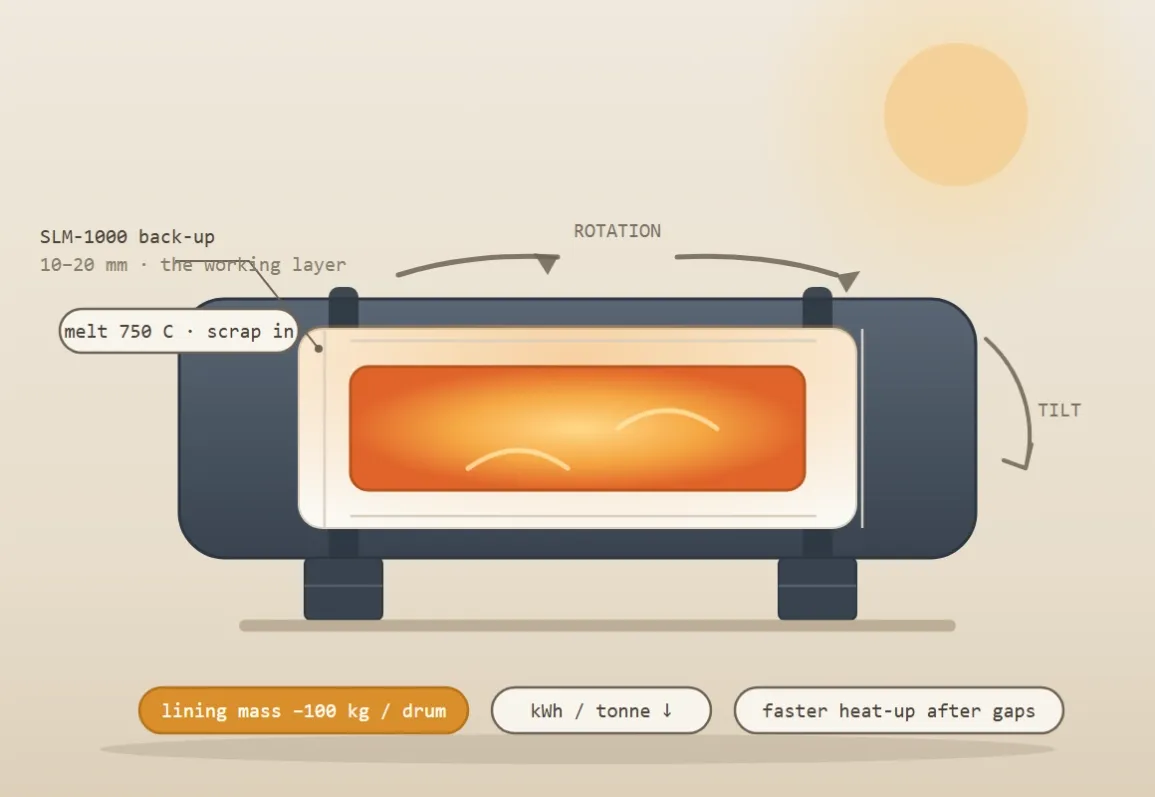
A thin microporous back-up layer doing the thermal work. At aluminum temperatures the grade is SLM-1000, and the thickness argument is the same one that cuts standing losses in a stationary furnace — the reducing kWh per tonne arithmetic applies directly here — but with a twist the rotary machine adds: every square metre of lining that shrinks from 100 mm of brick to 15 mm of board removes roughly 100 kilograms from the rotating mass of a typical drum, and that mass is carried, accelerated and tilted thousands of times per shift.
The steel shell, kept cool enough to protect — and surveyed to prove it.
The segment format matters more here than in any stationary furnace. Boards cut as curved segments against the drum's radius, numbered per position, with staggered joints between courses, hold together through rotation where a field-cut patchwork works itself loose. That is a fabrication answer, and it is why SLM nano insulation boards are made in machined kits against shell drawings rather than as flat plates.
The energy arithmetic, honestly
Three lines move when the lining is optimized, and it is worth keeping them separate:
Standing loss through the shell. A rotating shell sheds heat faster than a static one — the turning surface constantly meets fresh air. Cutting the lining's conductivity cuts this loss every second of the cycle.
Heat-up after gaps. Low lining mass means the drum reaches melt temperature quickly after a weekend, a shift gap or a liner change. In a recycling plant running variable scrap arrivals, those gaps are frequent, and the saved ramp is real production.
Pour temperature stability. A cooler, better-insulated shell means the melt arrives at the tap with less temperature fade — which shows up as fewer off-spec heats and less rework at the caster.
The honest total lands where it always does with back-up insulation: a meaningful cut in the shell-loss share, which is a single-digit to low-teens percentage of total input, not a transformation of the whole furnace. What tips the economics in secondary recycling is that the margin per tonne is thin, so the same absolute saving is a larger slice of profit — and the weight saving rides along free.
Chemistry: what happens when the working face cracks
Sooner or later the working lining opens — a crack along a seam, a spall where charge impact concentrates. In a secondary furnace the melt that reaches through carries dross chemistry the primary cast house never sees. The back-up layer's job at that moment is to be boring: a fully oxidised, fuel-free inorganic sheet that neither reacts with the melt nor adds hydrogen to the alloy, containing the situation until the next repair instead of becoming one.
That same chemistry argument is why the new lining's first heat matters. A drum lining takes its first rotation hot, and driving the moisture out too fast turns a good lining into a spalled one — the controlled ramp in the preheat and dry-out curve exists for exactly this moment.
Verify on a machine that moves
Surveying a rotating furnace is its own small discipline. The shell presents every orientation to the camera, so pick reference angles — at rest, mark positions on the shell — and survey at the same drum position each time, same emissivity, same distances. The method is the performance verification guide applied to a moving target; a hot patch that follows a marked position across surveys is a lining issue, and one that moves with the drum is a melt-side issue. Both belong in the per-campaign file, next to the arrival checks from the incoming inspection protocol.
For the completed lining build-up these kits produce, the anchored ladle back-up assembly page shows the assembly in place.
If you run tilting or rotary furnaces and want a lining proposal against your drum geometry, scrap mix and cycle — with the weight and kWh numbers filled in — send us the machine data.
Questions on grades, drum kits or a specific energy-per-tonne target: sales@slmthermal.com