Reducing kWh per Ton in Aluminum Melting Furnaces with Ultra-Thin Backup Insulation
A cast-house energy brief: where the heat actually goes in an aluminum melting or holding furnace, why aluminum linings are a chemistry and insurance problem as much as a thermal one, what a 10-20 mm
Every cast house keeps the same scoreboard: kilowatt-hours per ton of melted metal. Gas or electricity, reverberatory or crucible, primary or scrap — the number absorbs everything, and the monthly meeting is about moving it down.
Insulation is one of the few levers that moves it down without asking anything of the operators. The catch is that aluminum furnaces are not steel furnaces with lower numbers on the thermometer: the lining lives against a melt that penetrates, a chemistry that punishes the wrong back-up materials, and — on tilting and rotary furnaces — a mechanical duty that punishes heavy ones. This article is about what an ultra-thin microporous back-up layer changes in the energy arithmetic of a cast house, and where its limits honestly sit.
Where the heat actually goes
A melting furnace at 750 to 900 C loses energy four ways, and only one of them is the insulation's to fix.
The melt itself absorbs the useful heat — that is the product. Doors, seals and exhaust carry their shares, and those belong to operations. The fourth path is steady conduction and radiation through the walls, roof and hearth: heat that leaves continuously, during the melt, during the hold, and overnight, whether or not anyone is charging scrap. On a typical reverberatory furnace this standing loss is a single-digit to low-teens percentage of total input — exactly the honest framing the ROI model applies to steel ladles, and it is the share an insulation upgrade can actually reach. Anyone promising a thirty percent cut in total furnace energy by changing the back-up layer is moving the goalposts.
The reason that modest-looking share is still worth pursuing is compounding: standing losses run every hour of the year, they set how long the furnace takes to reach casting temperature after a hold, and in buffer furnaces between melter and caster they are the dominant cost of simply existing.
Why aluminum linings are a different problem
Run the wall arithmetic with steel-furnace intuition and you will overdesign the hot face and underdesign the chemistry.
Aluminum at 750 C is not hot by refractory standards — the working lining in most aluminum furnaces is nowhere near its temperature limit. What the melt does instead is hunt: it infiltrates every crack, reacts with anything reducible, and finds the back-up layer through joints the day the hot face develops its first opening. The back-up insulation in an aluminum furnace is therefore an insurance layer as much as a thermal one, and the insurance question has two clauses: how well it insulates, and what it does when the melt finally meets it.
A microporous board answers both. Thermally, at the mean temperatures aluminum furnaces actually run, its conductivity sits far below the insulating firebrick or castable it replaces — the numbers to compare are on the conductivity curve at real mean temperatures, not the headline figure. The grade to specify for cast-house walls and hearths is SLM-1000, rated comfortably above the aluminum temperature range with margin for hold and upset conditions. Chemically, it is a fully oxidised, fuel-free inorganic sheet: it does not melt into the melt, feed a reaction, or add anything to a dross skim — and when a hot-face crack does reach it, the failure is a localised repair, not a burn-through of the shell.
What the ultra-thin layer changes in the arithmetic
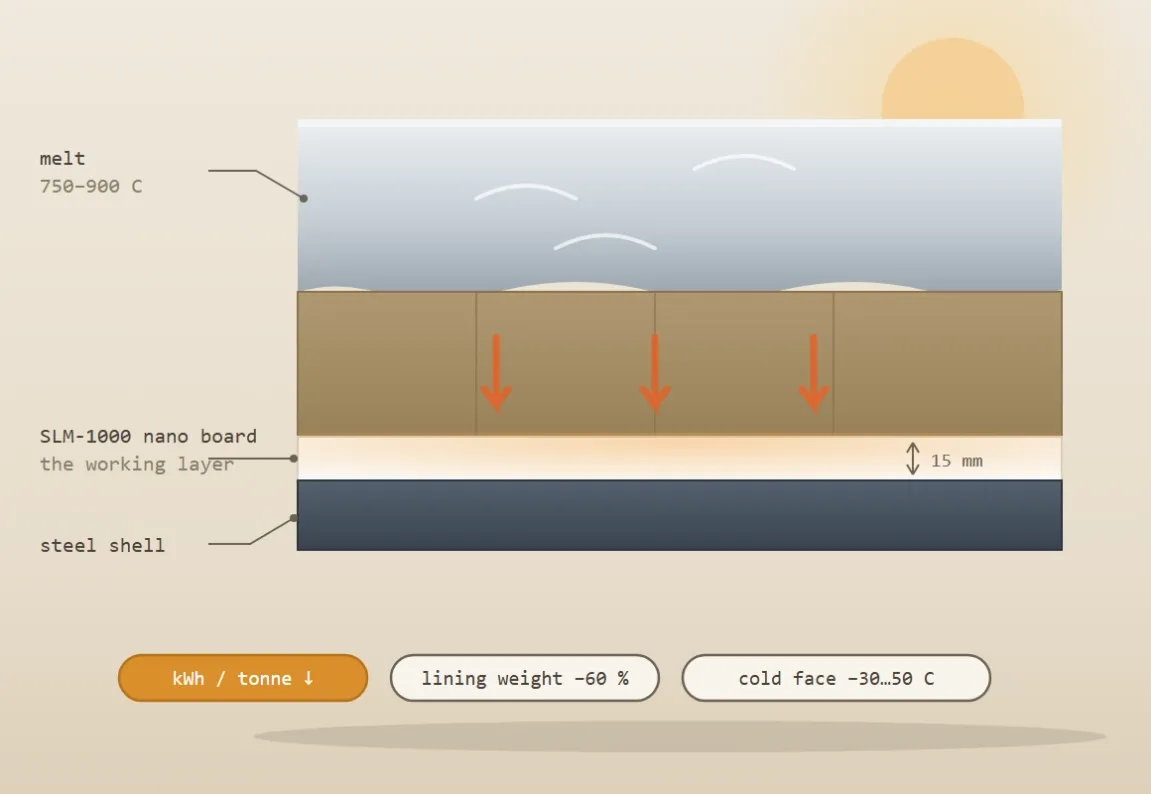
The thickness comparison does the persuading. Where a wall might carry 100 to 150 mm of insulating brick to hold shell losses at target, 10 to 20 mm of microporous board holds the same thermal resistance — which means the designer can either shrink the wall to add melt volume, keep the wall and drop the cold face by the 30 to 50 C the better back-up delivers, or split the difference. Where that calculation ends depends on the furnace; the method for running it is the same one the thickness sizing guide walks through for ladles.
Two secondary effects matter as much as the steady-state number in cast houses:
Faster cycles. Low thermal mass means less heat stored in the lining, and a furnace that reaches casting temperature sooner after every drain and cool-down. On batch melting, the saved ramp time is production.
Cleaner night losses. Holding furnaces that sit between shifts lose through the walls all night. Cutting that rate is the difference between Monday morning's first tap costing a full heat-up and costing a trim.
The verification habit that keeps the savings honest is the same one steel uses: fix an energy baseline, install, then survey. Shell temperatures read through the performance verification guide — a hot streak on a cast-house wall is the melt having found a path, which in aluminum is a maintenance item with a clock on it — and the kWh-per-tonne series after the change, compared across a like season and production mix, is the number that goes to the budget meeting.
Weight: the tilting and rotary argument
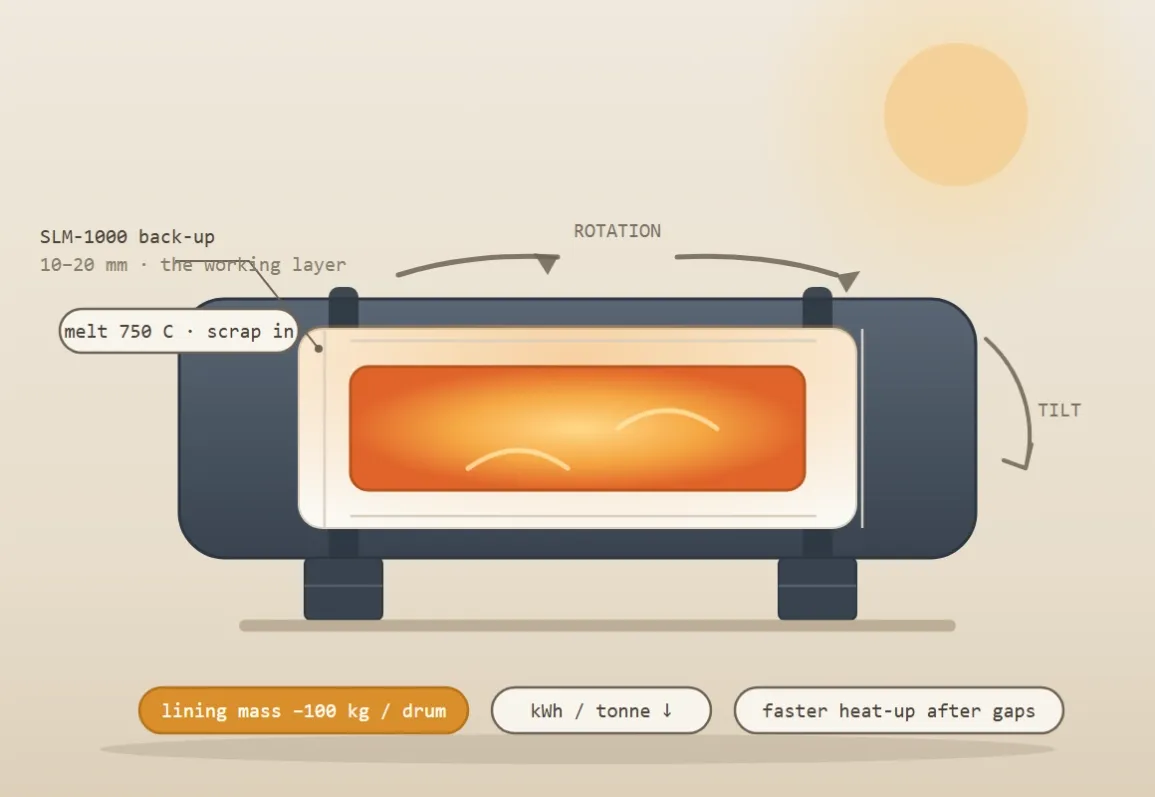
On stationary furnaces, weight is a footnote. On tilting furnaces and rotary drums — the heart of secondary aluminum recycling — it is a design constraint: every kilogram of lining is carried by the hydraulics on every tilt, and heavy linings are also the ones that crack under their own mechanical duty as the drum rotates.
Here the microporous layer's density — roughly a quarter to a third of insulating brick for the same resistance — removes lining mass directly from the hydraulic budget, and its flexibility as a board tolerates rotation better than a thick rigid casting. For a rotary furnace, where the lining must survive both the melt and its own tumbling duty cycle, that combination is usually the argument that closes the design review, and it is why SLM nano insulation boards are made in machined segment kits sized to a drum's geometry rather than sold as flat plates to be fought on site.
Sourcing the cast-house kit
The procurement discipline is the same as any refractory buy, with aluminum-specific emphasis. Incoming batches get the incoming inspection treatment — thickness tolerance matters more in aluminum walls because the melt temperature sits close to the insulation's working range and the design has less slack. The supplier questions worth asking before the first order are the ones in the supplier audit checklist, with batch certificates at the top. And the handling rules for getting boards from pallet to furnace without chipped edges are in the storage and cutting field guide — an edge chip behind a cracked hot face is exactly the gap the melt is looking for.
For a completed back-up assembly in place, the anchored ladle back-up assembly page shows the build-up; the wall layers in an aluminum furnace differ in chemistry, not in concept.
If you send us your furnace type, melt temperature and the wall section you are running now, we will return a back-up specification with the kWh arithmetic filled in — including what it will and will not save.
Questions on grades, hearth and wall kits or a specific kWh-per-tonne target: sales@slmthermal.com