Sep 19, 2026
Storing, Handling, and Cutting Nano Insulation Boards: A Field Guide
A field guide to the weeks between delivery and installation — why a board rated for 1100 C still needs care at ambient temperature, the five warehouse storage rules that protect the moisture barrier
Most of the damage a nano insulation board ever suffers happens between delivery and installation — not in the furnace. A material engineered to hold its shape at 1100 C can be written off in a wet warehouse corner, a careless forklift fork, or a saw cut made over an unsupported edge. None of that shows up on a temperature curve, and all of it shows up in the lining.
The container loading guide ends where this one begins: the pallets are off the truck and sitting on your floor. What happens in the next few weeks — before the boards ever see heat — decides whether the thermal performance you paid for is the performance you install.
Why a board that survives 1100 C needs care at 25 C
Three properties shape everything in this guide.
Low density. At 220 to 300 kg per cubic metre, the board is mostly structured air. That is the entire point thermally, and it is also why the edges chip when the board is dropped on a corner and why a board bridged across two supports will snap under its own weight plus a worker's knee.
Open, hygroscopic pore structure. The same nanopores that suppress conduction will pull moisture out of damp air over weeks. Moisture inside the board is not a storage problem — it becomes a first-heat problem, which is why the preheat and dry-out curve devotes its slowest ramp to getting water out safely. Everything you do in the warehouse is about not adding to that burden.
Compressive strength that is real but finite. The board handles clamping, anchors, and stacking. It does not handle point loads, fork tips, or being used as a workbench, and the damage from all three tends to be internal — the face looks fine while the core has crushed.
On arrival: unload, inspect, photograph
The claim you might need to make later is won or lost in the first hour.
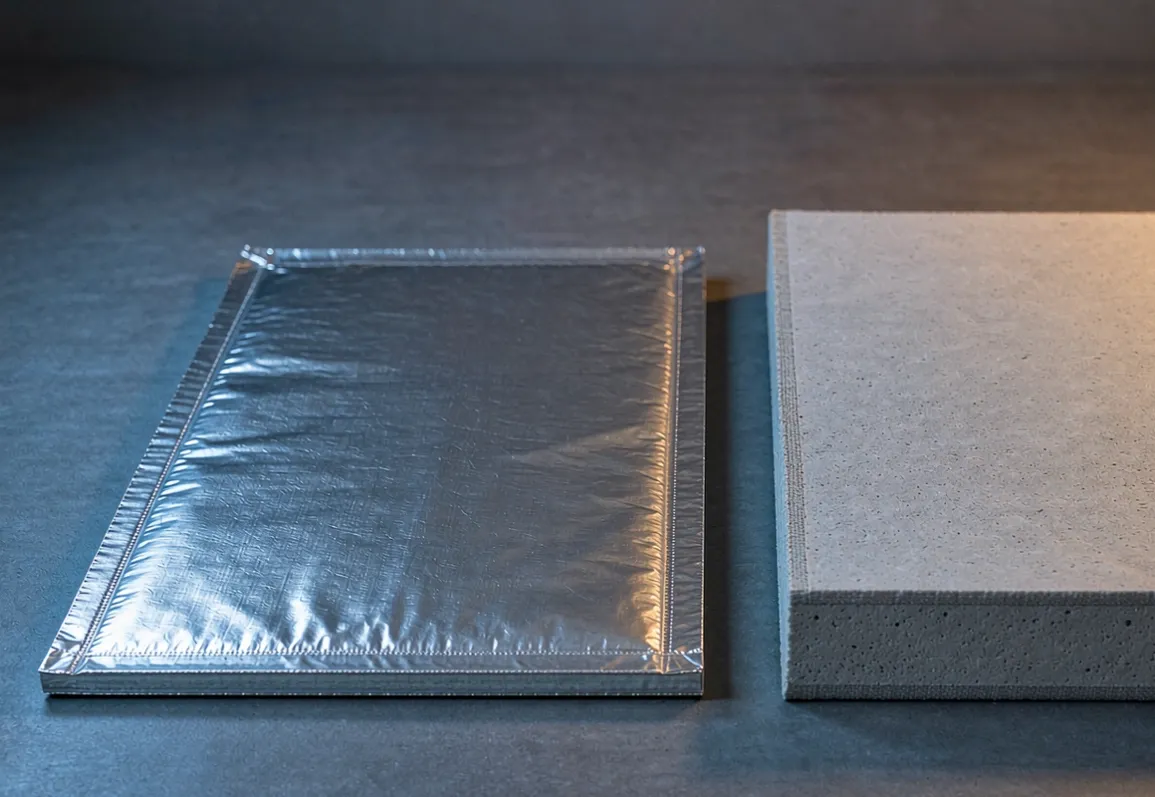
Before signing anything, walk the pallets. Look for broken shrink-wrap, torn vapour barrier, crushed corners, and any carton that reads wet. Photograph every finding next to the pallet label so the batch number is in frame. Then follow the incoming inspection protocol — thickness check on a sample of boards, moisture reading if a meter is available, and the same record kept with the batch paperwork.
Boards with transport damage should never simply be "the ones we will use first." They are the ones the claim is about, and they must stay identifiable until the claim is closed.
Warehouse storage: five rules
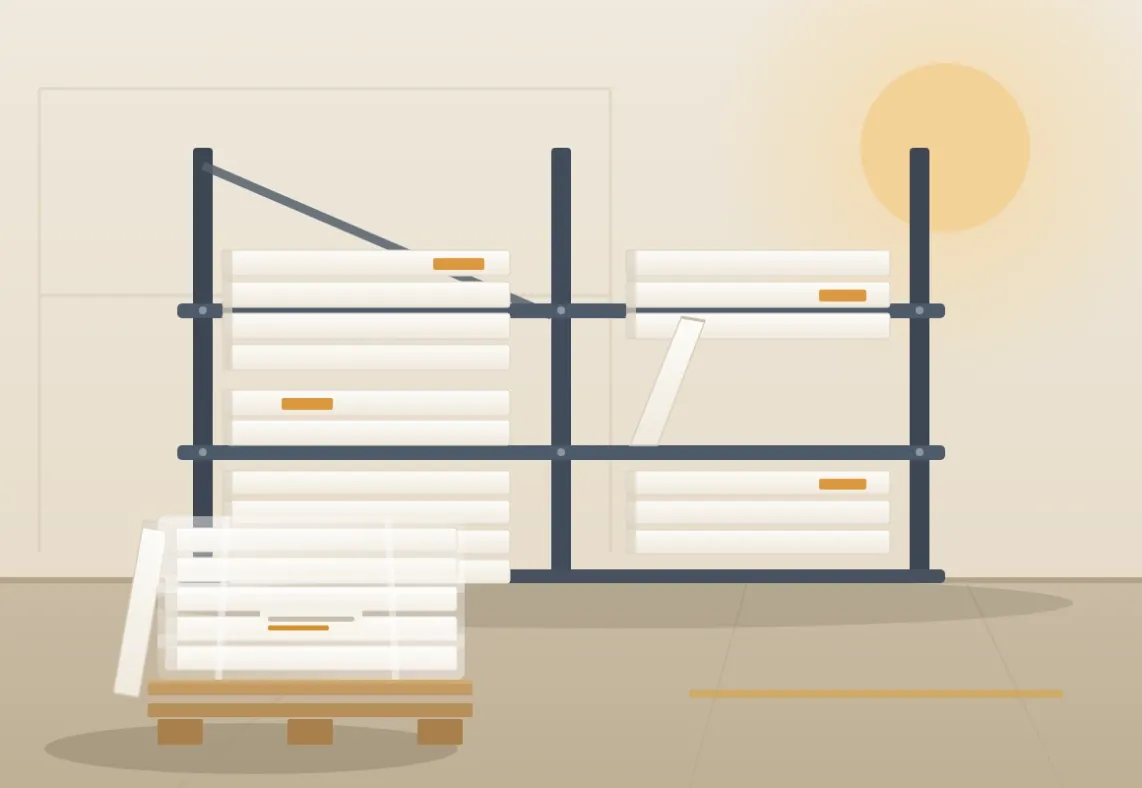
Flat and fully supported. Boards lie flat on the original pallet or on runners that support the full length. A board bridging two supports is a beam, and low-density beams fail. This is the single most common self-inflicted damage in mill stores.
Off the floor and covered. Concrete floors breathe moisture, and yard traffic finds every pallet left at ground level. Rack storage or even a few timber runners under the pallet, plus a cover open on one side for airflow, removes both risks at once.
Keep the vapour barrier intact — and repair it after every visit. The factory wrap is the moisture protection you already paid for. Every time someone pulls boards from a stack, re-tape the barrier the same day. If a stack has been open for more than a few days in humid weather, treat it as suspect and check it before installation. What the moisture figure on the delivery paperwork means, and how to read it in context, is covered in the moisture line on a proper data sheet.
Indoors, or under real cover. Outdoor storage under a tarp fails in two ways: condensation cycles on the wrap, and the tarp is never there in month three. If there is no indoor space, a ventilated container or an open-sided shed beats a tarp on a pallet in the yard.
Stack to the limit and rotate. Two pallets high is the sensible maximum with a spreader between, and no carton stacking directly on exposed boards. Rotate stock so the oldest batch goes to the furnace first — batch traceability only works if rotation does.
Handling: carry it like a panel, not like a brick
The rules are short because they are all the same rule: distribute the load, protect the edges.
Two people or a board clamp for anything above 50 mm. Support from underneath across the full width. Carry on edge where the board is rigid enough — most 25 to 50 mm grades tolerate edge-carrying well and it halves the span. Never drag a board across concrete; the grit sands a groove into the face you will later be asked to install. No fork tips into cartons, no corners as pivot points, and no kneeling on a board laid across a ladle shell — that is how cores get crushed under unbroken faces.
Edge chipping deserves its own word. A chipped edge on a board that will be cut anyway costs nothing. A chipped edge on a board that goes in whole becomes a gap at a joint, and gaps are where heat walks past the insulation. Sort damaged boards out during handling, not during installation.
Cutting on site: tools, dust, and tolerance
Cutting this board is easy — that is one of its advantages over fired products — and the difference between a clean cut and a sloppy one is almost entirely support and measurement.
Support the cut line. A straightedge clamped across the board, cut made with a fine-tooth handsaw or a sharp knife in several passes for thinner grades, and the offcut side supported so the board does not snap early and tear the last few millimetres. A board cut over a void will have a ragged, compressed edge no matter how good the saw is.
Dust is nuisance dust — no crystalline silica, no fibres with the aspect ratio that has made ceramic wool a regulated subject — but it is still dust. Cut dry, outdoors or with ventilation, glasses and a basic dust mask, and clean up with a vacuum rather than a broom. This is a five-minute discipline that keeps the crew willing to keep cutting.
Measure the board, not the drawing. Dimensional tolerance on delivery is plus or minus a millimetre if it was specified correctly, and the space the board is going into has its own tolerances on top of that. Cut from measured positions, mark with a pencil not a scribe, and check the first piece of every new size before cutting the rest. Where the required thickness itself is the question rather than the cut, that calculation belongs to the thickness sizing guide, not to the saw.
Keep offcuts sorted by grade and thickness. A labelled offcut rack gets used; a scrap bin gets thrown out. On a typical ladle job, sorted offcuts cover the small infill pieces around nozzles and trunnions that would otherwise be cut from fresh full-size boards.
When a chipped corner matters
Orientation decides. At a joint that will be butted and anchored, a face chip turns into a permanent void once the lining is hot and the board has shrunk a little — every millimetre of missing material at a joint is a millimetre of direct heat path. If a damaged face can be turned away from the joint, or the board re-cut to remove the damage, do that. If neither is possible, the board belongs in a role where its edges are captured rather than butted.
How the boards are actually fixed, spaced, and jointed in a real shell is laid out in the step-by-step ladle installation guide; the short version is that joint quality is a design decision made before the first board is lifted, and storage damage is one of the things that decision has to survive.
The last check before the boards go in
If wrap was broken, storage was imperfect, or the season was humid, add one step to the pre-installation routine: look at the boards the day before they are installed. Any that read visibly damp get pulled aside for drying time under the plan set out in the preheat and dry-out curve rather than going in wet and hoping. The curve can dry a board that arrived damp; what it cannot do is give back performance you lost to a crushed core or a gap you installed.
The arithmetic of a ruined pallet
On a typical order, a pallet written off through storage damage adds several percentage points to the landed cost per installed square metre — more than the price difference between a good quote and a bad one. The economics are worth an hour of racking and a roll of tape.
Two things keep that arithmetic honest. First, order and store against a plan: the grades and quantities on the SLM-1000 product page are only the starting point, and storage space is part of sizing the order. Second, if damage did happen in transit rather than in your store, the packaging commitments that make the claim straightforward are exactly the items covered in the supplier audit checklist — vapour barrier specification, carton construction, and pallet protection are audit questions for a reason.
If you are planning storage for a large order, or want the packaging specification to hand before one is placed, write to us — we ship this material worldwide and the storage guidance above is what we give our own customers with every pallet. To see where the boards end up once they are installed, the anchored ladle back-up assembly page shows the complete build-up in place.
Questions on grades, packaging or a specific storage layout: sales@slmthermal.com