Oct 8, 2026
UL 9540A Is Not a Certificate: How to Read the Four Test Levels in a Supplier's Report
UL states that UL 9540A "does not provide a certification, UL Mark, or pass/fail results" — so a genuine report can still say almost nothing about whether one burning container will ignite its neighbo
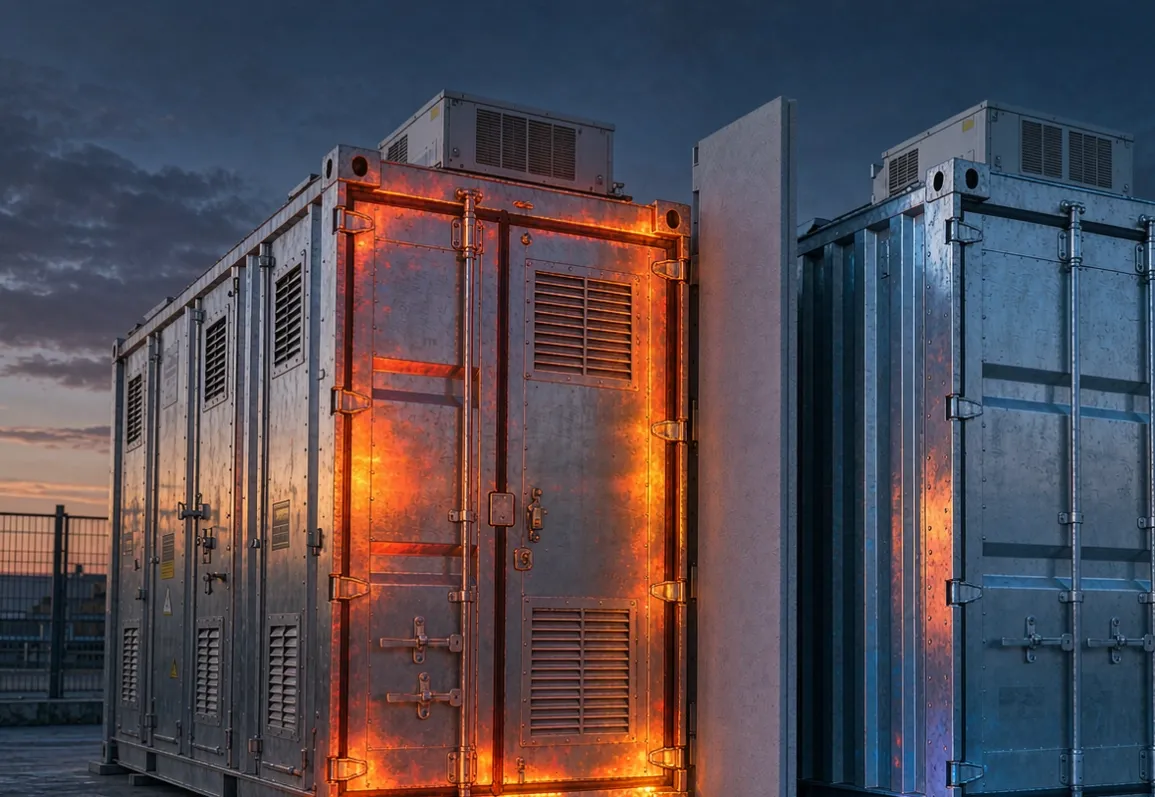
"UL 9540A tested" is the most common line on a BESS datasheet and the least informative one. UL says so itself: as a test method, UL 9540A "does not provide a certification, UL Mark, or pass/fail results." A report can be genuine, recent, issued by a competent laboratory, and still tell you almost nothing about whether one burning container will set fire to its neighbour. What the report is worth depends entirely on which of the four test levels it covers and on whether the configuration tested is the configuration you are buying.
This article is written for anyone on the receiving end of a UL 9540A report — EPC procurement, owner's engineer, AHJ reviewer, or the person who has to sign off a layout. It sets out what each level actually measures, which level carries the only quantitative acceptance criteria, the six things UL's own AHJ checklist tells reviewers to check before trusting a report, and what the accident record says happens when the barrier work is assumed rather than evidenced.
Two sourcing notes up front. Figures quoted from the standard text are flagged as such; figures that come from SGS, Intertek, DNV or a published incident report are labelled as third-party readings and should be verified against the published standard before they enter a contract. Nothing here substitutes for buying ANSI/CAN/UL 9540A and reading the edition you are being asked to comply with.
What UL 9540A actually is
UL 1973 covers batteries, modules and racks. UL 9540 is the system-level listing. UL 9540A is neither: it is a test method that generates data for the other two and for NFPA 855. Intertek's summary is the clearest short version — it is "not a certification standard, but a data-driven methodology."
That distinction has a practical consequence. When a supplier says a cabinet is "UL 9540A certified," the correct response is to ask for the report and turn to the level page, because there is no certificate to look at. The report is a set of measurements with a scope statement, and the scope statement is where the value is.
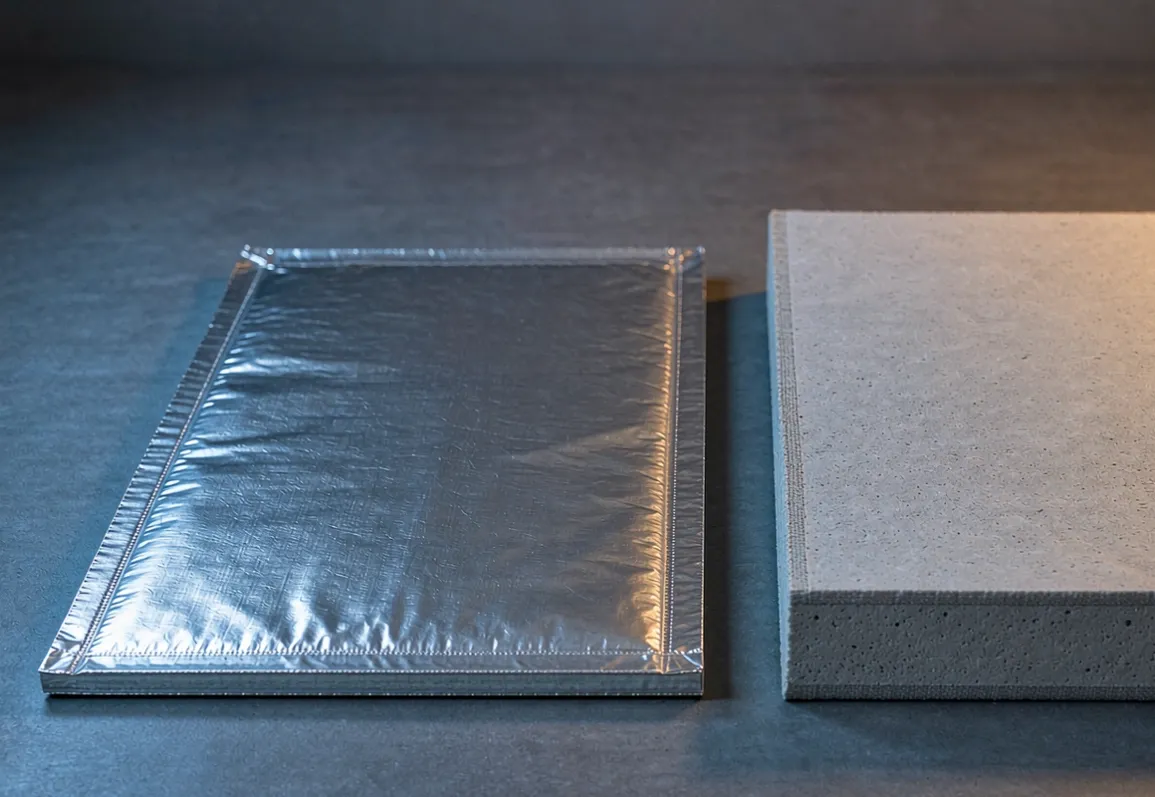
The application map sorts insulation duties by temperature band. BESS fire barriers are an unusual entry in it: the requirement is not steady-state efficiency, it is surviving a defined fire for a defined number of hours, and the evidence for that comes from a test report rather than a conductivity table.
The four levels, and what each one answers
| Level | The question it answers | Main outputs | Acceptance criteria | |---|---|---|---| | Cell | How hot does this cell's venting get, and what gas comes out? | Tvent, gas volume and composition, LFL, Pmax, burning velocity | None. Data only — used for deflagration venting (NFPA 68), explosion prevention (NFPA 69) and spacing inputs | | Module | Does one cell in thermal runaway take the rest of the module with it? | Heat release rate, smoke release rate, module surface temperature, gas composition, flying debris, whether cell-to-cell propagation occurred | Not a pass/fail gate. Editions 5 and 6 expect propagation to occur and measure its rate | | Unit | Does fire move between modules inside a unit, and how much does it heat the surroundings? | Target surface temperature vs Tvent, adjacent wall temperature rise, gas concentration vs LFL | Historically yes (Table 9.1 of Edition 4 and earlier). Under Edition 6, unit level is optional for non-residential systems | | Installation | If one unit burns, does the fire stop there? | Reference wall temperature rise, heat flux, structural steel temperature, debris spread, re-ignition over 24 h | Yes. This is the level with quantitative limits |
The single most useful thing to understand is that the first three levels are data collection. They characterise a battery. They do not clear an installation.
The second most useful thing is that module level has changed meaning. Under Editions 5 and 6, UL's guidance sets a minimum expectation that propagation occurs — at least one non-triggered cell reaching thermal runaway, and for cells above 10 Ah, three cells or an equivalent 30 Ah. The test is no longer "did it stop," it is "how fast did it go, how much energy was released, and what came out." A supplier presenting a module-level report as evidence of containment is reading an older edition.
The numbers that do decide compliance
The acceptance figures below circulate widely in technical summaries of Edition 6, including SGS SafeGuardS 068/26 and UL's own guidance. Only the installation-level set carries compliance weight for most non-residential projects.
Unit level (Edition 4 and earlier criteria, still quoted in older reports): target unit surface temperature not to exceed cell Tvent; adjacent wall temperature rise not to exceed 97 K; flammable gas concentration no more than 25% of the lower flammability limit in rooms without adequate ventilation.
Installation level, outdoor: no venting or thermal runaway in the target enclosure; no flame passage along interconnecting paths; target cells at or below 90% of Tvent; module enclosures and inner shell at or below Tvent averaged over 60 seconds; reference wall temperature rise of 97 K or less; heat flux of 12.5 kW/m² or less averaged over 60 seconds; stack retains structural integrity.
Installation level, indoor: propagation confined to the initiated row; the same cell, module and inner-shell temperature limits; wall temperature rise of 97 K or less; structural steel corner beams at 538 °C or less averaged over 60 seconds; heat flux of 12.5 kW/m² or less; no burning debris beyond 1.5 m; no re-ignition within 24 hours after suppression stops.
One conflict worth knowing about: some third-party readings quote the indoor target enclosure inner wall at 1.10 × Tvent rather than Tvent. The SGS reading says Tvent. That discrepancy is a reason to check the standard text, not a reason to average the two.
The enclosure geometry, burn duration and material implications of those numbers are covered in the enclosure wall article, including the measured fire conditions behind them — a full-enclosure burn at 1296 °C sustained for more than thirteen hours, with cell-to-cell propagation at 15 to 20 minutes per cell.
Six checks before you trust a report
UL publishes an AHJ checklist for reviewing UL 9540A reports. It is the closest thing to an official answer to "how do I know this report is worth anything," and six of its items do most of the work.
1. Was the laboratory ISO 17025 accredited? The checklist opens with accreditation. A report from a non-accredited facility may be technically sound, but it is not the report the code path assumes.
2. Do the failed cells match between levels? Checklist item 3 requires the number and location of cells driven into thermal runaway at unit level to be consistent with module level. If module level involved three cells and unit level involved one, the two results are not comparable and the unit result is optimistic.
3. Was the initiation method consistent across levels? Item 4. Heater, nail, overcharge and internal short produce different propagation behaviour. Mixing them across levels breaks the comparison.
4. Were any mitigation devices added that are not part of the product? Item 5, and the one that matters most for anyone specifying barriers. The checklist prohibits introducing thermal barriers, partitions or other mitigations that are not part of the product construction, because they change the outcome. If the tested unit had extra board on it, the report describes the tested unit, not the delivered one.
5. Did the test arrangement match the planned installation? Item 11 — including separation to walls and to adjacent units. A unit tested with generous clearance on all sides does not support a tightly packed layout, even at the same level.
6. Was the system at maximum state of charge? Item 12, with verification before the test. SOC drives vent energy; a report run at reduced SOC understates the source term.
NFPA 855 carries the same requirement in its own words: the cells, modules or units tested must be representative of the intended installation configuration, with the only permitted addition being the initiation mechanism.
There is a seventh question that is not on the checklist but should be on your form: what edition? Edition 4, 5 and 6 differ on whether unit level is required, on module-level expectations, and on whether large-scale fire testing is mandatory. "UL 9540A report" without an edition year is not a specification.
Why the level matters: the accident record
EPRI's 2024 failure analysis attributes grid-scale BESS failures roughly as follows: 46% to control systems, 43% to balance-of-system components, 11% to cells. A cell-level report addresses the smallest of those three buckets and none of the other two.
The incidents where the barrier question was examined directly are more specific.
At McMicken, Arizona in April 2019, a 2.16 MWh container went from first arrival at 17:48 to deflagration at 20:04 — about two hours and sixteen minutes — injuring four HAZMAT firefighters among eight to nine hospitalised. DNV GL's investigation is blunt about the mechanism: propagation "was facilitated by the absence of adequate thermal barrier protections between battery cells, which may have stopped or slowed the propagation." Lack of thermal barriers between cells appears as one of five contributing factors, and the clean-agent suppression system is described as incapable of stopping thermal runaway.
DNV GL also criticises the standards of the period for stopping short of prohibiting cell-to-cell propagation and for failing to address non-flaming heat transfer to neighbouring cells, modules and racks. That is the gap passive barriers fill, and it is the gap a cell-level report does not close.
Victorian Big Battery, July 2021: two Megapacks roughly 15 cm apart, one initiating, about six hours to burn out, followed by three days of monitoring before the site was declared controlled. The independent technical report notes site wind speeds of 36 mph against the 12 mph environment of the UL 9540A test — a reminder that the test is a defined condition, not a worst case.
Moss Landing, January 2025: a 300 MW / 1200 MWh facility burned for two days, destroying an estimated 55,000 batteries in what EPA describes as the largest lithium battery cleanup in its history.
The operational consequence is now written into fire service guidance rather than left to judgement. The UK National Fire Chiefs Council position is that a BESS cabinet or enclosure "should be allowed to consume itself," and that applying firefighting jets can prolong the thermal event; its guidance notes events can continue to burn from several hours to several days. Tesla's own emergency response guide permits a Megapack to burn out. Re-ignition is why UL 9540A's installation-level criteria include observation for re-ignition and a termination condition tied to sustained cooling.
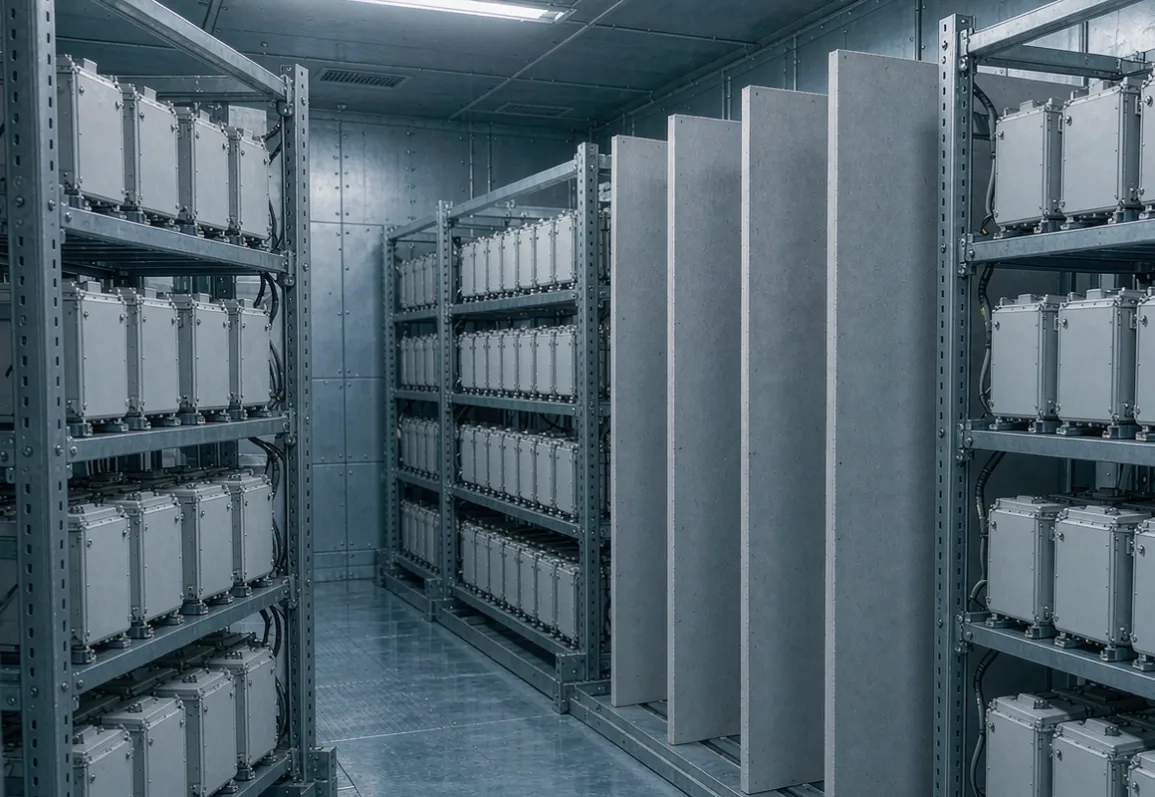
If the plan is to let it burn, the thing that limits the loss is what sits between the burning unit and its neighbours. That is a barrier question, and it is answered at installation level.
What the barrier has to do, in measured terms
Thermal barrier performance at cell and module scale has been measured enough to give useful reference points.
Wacker reports a 2 mm silicone-resin and glass-fibre composite panel tested with nine NMC 35 Ah cells at 100% SOC: vent jet at roughly 1150 °C and indirect path above 1000 °C, with the back face staying below 140 °C and no flame or particle penetration. Third-party testing by PROTEBA is cited alongside it.
Aerogel pad testing at 2 mm gives a cleaner before-and-after: adjacent cell peak temperature of 441.3 °C with no barrier, 175.4 °C and 109.4 °C with the barrier in place, safety valves unopened. The same material is reported to withstand 1200 °C for ten minutes across six cycles without burn-through, and to hold back at least 390 °C at 2 mm and 450 °C at 3 mm under 675 °C for 20 minutes.
A modelling and test study on 314 Ah LFP modules reports that propagation is blocked below roughly 0.035 W/mK, that 1.2 to 1.6 mm of aerogel kept adjacent cells under 100 °C, and that reducing conductivity from 0.11 to 0.024 W/mK moved the propagation delay from 102 seconds to beyond 1800 seconds against a no-insulation baseline interval of 303.4 seconds. The study proposes a ratio criterion: d/λ of 35 mm·m·K/W or higher for complete suppression, 12 or higher for significant delay. That figure comes to us as a secondary summary rather than the journal text — treat the ratio as a design heuristic, not a code requirement.
The cell-level source temperatures those barriers face are higher than most enclosure calculations assume. Published measurements include vent gas above 1370 °C for NMC811 21700 cells, Tvent above 1150 °C for large-format cylindrical aluminium cells, and cell surface peaks of 710 °C for NCA 18650 at 100% SOC and 354 °C for LFP 26650. Across a set of formats, mean vent temperature was 193 °C, mean exothermic onset 238 °C and mean surface peak 567 °C.
Two sizing cautions follow. The first is that the mean temperature is high, so the conductivity you use is the 600–800 °C value, not the headline number — the reason the datasheet guide asks for a four-point curve rather than one figure. The second is that the cell-level results above are achieved at millimetre thicknesses over minutes. The enclosure duty is hours at enclosure-scale temperatures, and thickness has to come from a steady-state calculation against an acceptance temperature, which is what the thickness sizing method sets out. Cell-level barrier data does not scale to an enclosure wall.
The battery-pack barrier article covers the pack-interior case, where millimetre thicknesses and short durations are the actual duty.
Common errors when reviewing a report
Accepting "UL 9540A tested" as a claim of compliance. There is no pass or fail in the method itself. Compliance lives in UL 9540 and NFPA 855, which consume the data.
Stopping at cell level. Eleven percent of EPRI's attributed failure causes are cells. A cell-level report is the correct input to vent sizing and spacing calculations and the wrong input to a propagation argument.
Not matching the tested configuration to the delivered one. Extra board, extra clearance, lower SOC or a different initiation method each move the result, and UL's checklist prohibits the first two explicitly.
Using a barrier thickness carried over from cell level. Covered above; this is the most expensive version of the error because it fails in the test rather than on paper.
Selecting the material on room-temperature conductivity. Aerogel at 0.018 W/mK at 25 °C is roughly 0.068 W/mK at 600 °C; a microporous board at 0.023 W/mK reaches about 0.039 W/mK at 800 °C. In a fire, the headline number is close to meaningless.
Ignoring re-ignition and penetrations. Twenty-four-hour observation exists because batteries re-ignite. Cable ways, rack steel and door frames carry heat past a barrier at any thickness.
Questions that come up
Does a UL 9540A report clear the installation?
It feeds the clearance. NFPA 855 provisions reported for the 2026 revision require large-scale fire testing to be conducted or witnessed by an approved testing laboratory, with a report demonstrating that a fire in one unit does not propagate to adjacent units, and require separation distances to be validated by that testing and reviewed by a registered design professional. The report is evidence; the AHJ and the design professional decide.
Is the unit level still worth commissioning?
UL states Edition 6 does not require it for non-residential systems. It remains useful where you want module-to-module behaviour characterised inside a cabinet, and it is required for residential systems and for non-residential systems using active thermal runaway propagation protection.
What should I ask a supplier to send?
The full report, the edition and date, the laboratory's accreditation scope, the level(s) tested, the initiation method and SOC, the tested arrangement including clearances, and a statement of any mitigations present in the test that are not part of the delivered product. The supplier audit checklist has the wider field list, and the incoming inspection routine is how you confirm the delivered boards match what was qualified.
Which material, aerogel or microporous board?
For a sustained high-temperature enclosure duty, microporous board holds conductivity better above 600 °C and is rated to 1000 or 1200 °C; blanket aerogel is commonly limited to 650 °C. High-temperature aerogel barriers rated to 1400 °C exist at a cost premium and are competitive where thickness is severely constrained. The SLM-1000 vs SLM-1200 comparison guide explains how the two microporous grades differ.
---
SLM supplies high-strength nano insulation boards for BESS enclosure walls, internal segmentation and inter-unit barriers, in 1000 °C and 1200 °C grades. To specify a barrier against a test plan, send the acceptance temperature, the burn duration in the plan, the available wall build-up and the penetration layout — the RFQ template lists the rest. Typical stack arrangements are shown under anchored ladle back-up assembly, or write to sales@slmthermal.com.