Oct 6, 2026
Sintering Furnaces and Continuous Kilns: Why Insulation Thickness Is a Throughput Decision
Continuous furnaces are the easiest place to justify insulation and almost everyone justifies them for the wrong reason. Energy is the smallest of three benefits — temperature uniformity and recovered
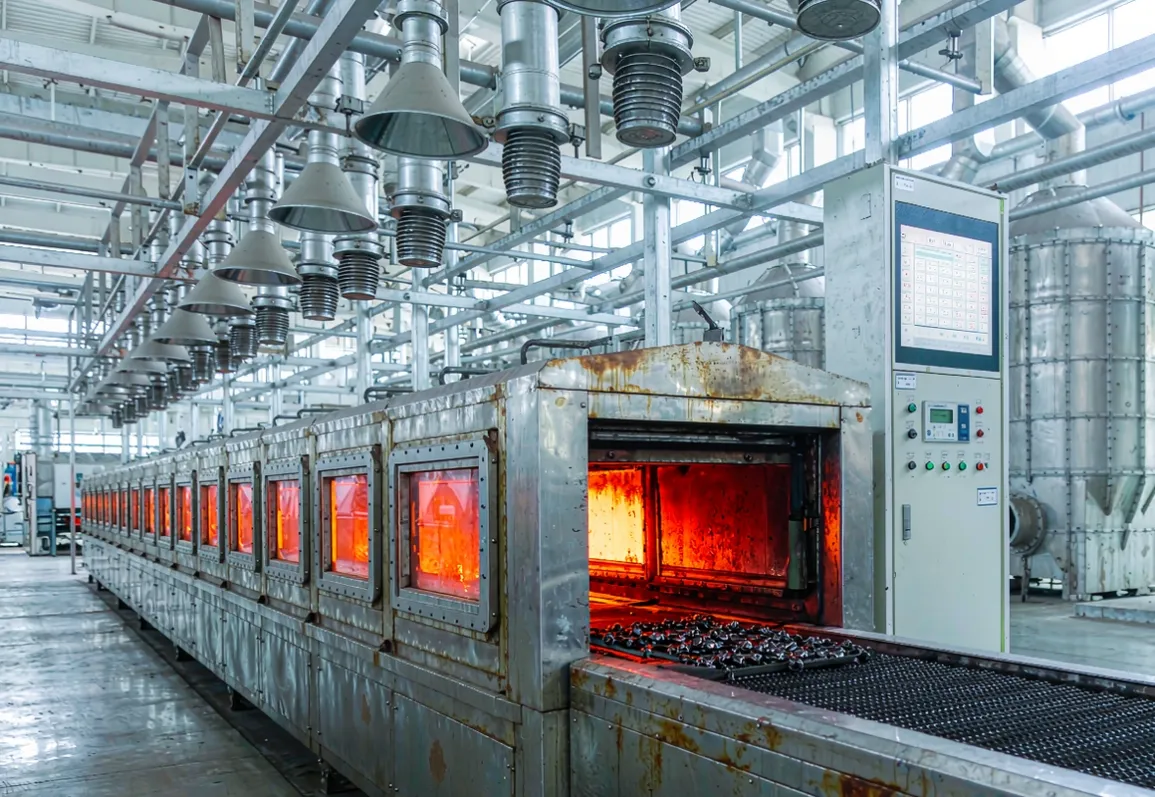
Continuous furnaces are the easiest place to justify insulation, and almost everyone justifies them for the wrong reason.
The standard case is energy: a furnace held at 1150 °C for eight thousand hours a year loses a calculable number of kilowatt-hours through its walls, and better insulation reduces that. The arithmetic is sound and it is also the smallest of the three benefits.
The larger one is geometry, and it gets missed because it does not appear on an energy bill. In a continuous furnace, wall thickness is subtracted from chamber volume. Insulation that delivers the same thermal performance in a third of the thickness gives you back chamber space — and chamber space is throughput.
The application map puts continuous furnaces in the 600–1000 °C band where insulation investment pays most clearly. This is what that looks like in practice on a sintering line.
Why continuous duty is the easy case
Everything that makes insulation hard to evaluate elsewhere is absent here.
A steel ladle cycles: fill, hold, empty, reheat. Heat stored in the refractory mass is a large part of the energy flow, campaigns differ, and the measurement is noisy. A sintering furnace runs at setpoint. Once it is hot, it stays hot, and the heat going in equals the heat going out — through the walls, the openings, the conveyor, and the atmosphere.
That means three things for anyone specifying insulation:
The calculation is trustworthy. Steady-state conduction with stable inputs. No campaign variation to argue about.
The saving accrues continuously. Not per campaign, not per cycle — every hour at temperature, which on a three-shift line is most of the year.
Results are verifiable. Measure shell temperature before and after. If the wall insulation improved, the shell got cooler, and that is directly measurable. The verification article covers how to do it in a way that survives scrutiny.
The three benefits, in ascending order of size
Energy
Real, but usually the smallest in money terms. On a mid-size continuous furnace the wall loss is a meaningful line in the plant's electricity or gas account, and cutting it by half is worth having.
Temperature uniformity
Rarely counted, and in sintering it is often worth more than the energy.
Sintering is a temperature-sensitive process. Dimensional change, densification, and final mechanical properties all depend on the thermal history the part actually saw — not on what the control thermocouple said. A furnace with uneven wall losses develops cold zones, and cold zones produce parts that are under-sintered at one position on the belt and correct at another.
Good, uniform insulation reduces the magnitude of those cold zones. Note the emphasis: uniform. A wall with excellent average insulation and one badly fitted joint still has a cold spot, and in a sintering furnace that cold spot becomes a rejected part rather than a number on a utility bill.
This is why joint quality matters more here than in almost any other application. The joint problem article is written from a ladle perspective, but the mechanism is identical and the consequence is sharper: in continuous duty, every gap is a permanent local defect that runs for years.
Chamber volume — throughput
This is the one that should drive the specification, and it works in both directions.
On a retrofit, insulation thickness is subtracted from the outside. Better insulation in less thickness means the chamber gets wider, and a wider belt or a taller setting height is more parts per hour. A furnace that gains 80 mm of usable internal width on a 600 mm belt gains roughly 13 percent of throughput with no change to the line, the drive, or the building.
On new equipment, the constraint is often the transport envelope or the floor space. The same chamber can be built inside a smaller outer shell, or a larger chamber inside the same shell — and the second option is a sales argument, not just an engineering one.
Either way the conversion is direct: millimetres of wall become millimetres of product. That is a much easier conversation than kilograms of CO₂.
Zone by zone, not one thickness for the whole furnace
The most common specification error on a continuous furnace is treating it as one thermal problem.
A sintering line has at least three zones with genuinely different requirements:
| Zone | Typical temperature | What the insulation is doing | |---|---|---| | Preheat / burn-off | 400–800 °C | Removing binder and lubricant; atmosphere flow is high and the heat demand is chemical as well as thermal | | Sintering / high heat | 1100–1350 °C | The actual process zone; wall loss is highest, uniformity matters most | | Cooling | Controlled down to ambient | Insulation here is often unwanted — you are trying to remove heat, not retain it |
Specifying one thickness and one grade end to end produces a furnace that is over-insulated where it should shed heat and under-insulated where uniformity matters.
The grade question follows from interface temperature, not process temperature. In the high-heat zone the hot face may be at 1200 °C, but what the board sees is the temperature at the back of the working lining, which is far lower once the lining is doing its job. Getting that interface number right is the whole of the thickness sizing method, and it is the number that decides whether the 1000 °C grade is sufficient or the step up to the 1200 °C grade is warranted. The SLM-1000 vs SLM-1200 comparison guide sets out where that boundary falls and what the premium buys.
Most sintering furnaces land below the boundary and specify high-strength nano insulation boards. Some high-temperature ceramic and hard-metal lines run above it, and in those the interface temperature has to be calculated rather than assumed — the board is closer to its own ceiling and there is less margin for a hot-running zone.
What insulation cannot fix
Being blunt about this saves a lot of disappointment, because on a continuous furnace the wall is frequently not the largest loss.
The conveyor. A mesh belt carries parts in cold and carries them out hot, and the belt itself makes the same round trip thousands of times. It is a heat shuttle, it moves an enormous amount of energy, and no wall insulation affects it. Pusher trays and rollers behave the same way.
The openings. Both ends of a continuous furnace are open, and hot atmosphere escapes continuously through them. Curtains, vestibules and door design do more here than any board.
Atmosphere consumption. Protective gas is heated and then lost. That is a process requirement, not an insulation defect.
Thermal bridges. Structural supports, hearth piers, element lead-outs, thermocouple penetrations and drive shafts all conduct heat straight to the shell. A perfectly insulated wall with a dozen steel paths through it will underperform, and the locations show up immediately on an infrared survey as discrete hot spots rather than a general warm surface.
The practical implication: specify the wall insulation to do the wall's job, and do not let it be blamed for the conveyor's losses. If the shell survey shows uniform warmth, the wall is the issue. If it shows hot spots, the bridges are.
Furnace types and where the board fits
Mesh belt furnaces — the standard powder-metal sintering workhorse, typically 1120–1150 °C for ferrous parts. Long, relatively thin walls, and the volume argument applies strongly because chamber width is directly belt width.
Pusher furnaces — higher temperature capability, heavier loading, and more thermal mass in the trays. Same wall logic; more attention to mechanical support of the insulation because vibration and pushing loads are higher.
Roller hearth kilns — used across technical ceramics and lithium-battery cathode materials. Very long, zone-heavy, and the uniformity argument dominates: a roller hearth with cold zones produces inconsistent product across the width for the life of the kiln.
Vacuum sintering furnaces — worth separating, because the answer is different. A vacuum furnace typically has a water-cooled shell with the insulation package inside the hot zone, usually graphite felt or metallic radiation shields. A microporous board is not the right product there: it is designed for an atmospheric-pressure back-up position, and a vacuum hot zone is a different design problem with different materials.
Steel plant sinter strands — very large, very hot, and mostly a refractory engineering problem rather than an insulation one. The board applies in specific positions such as ignition hood back-up and ducting, not as a general wall solution.
Dry-out on a long furnace
Continuous furnace linings are thicker and longer than ladle linings, and they are heated by zones rather than by one burner. That changes the dry-out in two ways worth planning for.
First, the mass of material that has to give up moisture is larger, so the low-temperature holds need to be long enough for steam to actually get out — not merely for the thermocouple to reach temperature.
Second, zone-by-zone heating means the furnace can dry unevenly if the zones are brought up out of sequence. A zone that runs ahead traps moisture migrating from an adjacent cooler zone.
The preheat and dry-out curve is written for ladles, but the principle transfers directly: the rate limit is set by the moisture leaving the material, not by how fast the elements can heat. On a long furnace, add margin rather than subtracting it.
Where nano board is the wrong answer here
As a hot face in the sintering zone. It sits behind the working lining. Always.
In the cooling zone, where you are trying to remove heat.
In a vacuum hot zone, as above — different product family.
Anywhere the atmosphere or process fume can reach it. In sintering, binder burn-off generates substantial volatile load; the insulation layer needs to be behind a barrier that keeps that out of it.
And on procurement: the property lines that matter most in a continuous furnace application are the ones that predict long-term stability under sustained temperature, not the headline conductivity. The datasheet guide explains which numbers carry that information and which are marketing.
---
SLM supplies high-strength nano insulation boards for continuous sintering furnaces, roller hearth kilns and heat-treatment lines. For a retrofit, send the existing wall build-up and the chamber dimensions you need to recover; for new equipment, send the target shell size and the zone temperatures. See the anchored ladle back-up assembly for typical stack arrangements, or reach us at sales@slmthermal.com.