Sep 27, 2026
Where Insulation Board Fits: Refractory vs Insulation, and the Temperature Map That Decides the Board
Refractory and insulation do different jobs and the confusion between them is the most common specification error in a thermal stack. A four-band temperature map: above 1000 C as a ladle back-up layer
The most common specification error we see is not a wrong thickness or a wrong grade. It is a category error — a thermal stack designed as though refractory and insulation were the same product in different shapes. They are not. They do different jobs, they sit in different places, and confusing them produces a lining that fails in a way that looks like a material defect but is actually a design defect.
This is a map of where high-strength nano insulation boards belong in a thermal stack, and just as importantly, where they do not.
The distinction that gets confused on almost every enquiry
A refractory material faces the process. It is selected to survive chemical attack, erosion, thermal shock and mechanical load at temperature. Its job is to keep the process contained.
An insulation material sits behind the refractory, on the cold face. It is selected for one property — how little heat it lets through — and it is deliberately not asked to resist anything. Put it in contact with molten metal or flame and it loses, every time.
The two are complements, never substitutes. In a well-designed stack:
The refractory layer decides how long the lining lasts.
The insulation layer decides the shell temperature, the energy bill, and how much of the heat stays where you want it.
They are frequently purchased together, specified on the same drawing, and installed by the same crew, which is why the distinction keeps getting lost. It is also why a shell running hot is almost never a refractory problem and almost never solved by changing the refractory.
The temperature map — four bands, four different answers
Band 1 — above 1000 C: the board is a back-up layer, never the hot face
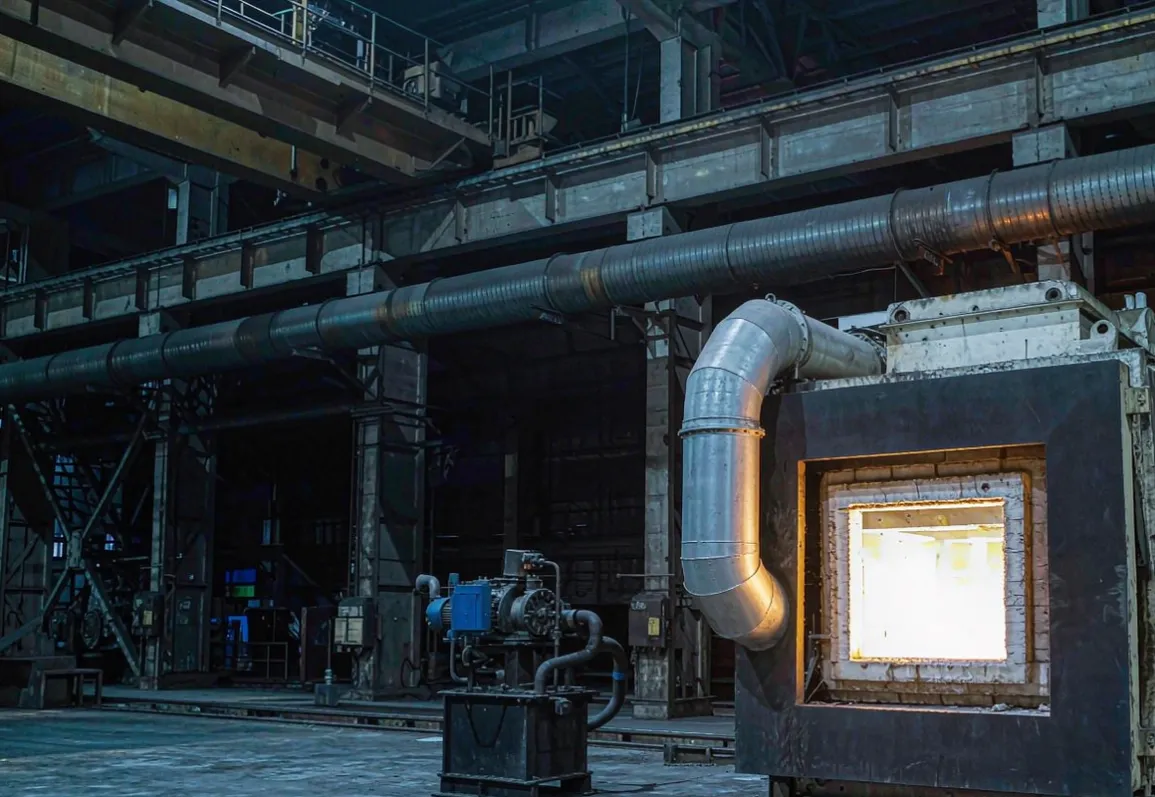
This is the classic steel plant territory: ladles, tundishes, torpedo cars, and the aluminium equivalents. Here the nano board is always behind a working lining, and the question is how much thickness buys you how much shell-temperature reduction.
The grade boundary matters more than anywhere else in this band, because the board is close to its own limit. Where the interface temperature runs above 1000 C, SLM-1200 is the grade to specify; below that, the SLM-1000 vs SLM-1200 comparison guide sets out where the boundary falls and what you gain either side of it.
We have written the steel side of this band in detail already — the seven places beyond the ladle article covers tundish, torpedo car, reheat and heat-treatment furnaces, hot blast stove, glass tank and coke oven battery with the caveat specific to each. The point for this map is narrower: in every one of those positions, the board is a back-up layer, and its specification is driven by interface temperature, not by process temperature.
Band 2 — 600 to 1000 C: continuous furnaces, where insulation pays best
Sintering furnaces, heat-treatment furnaces, reheat furnaces and holding furnaces live here, and this is the band where insulation investment has the clearest return — because these units run continuously at a steady temperature.
Steady state is the easy case for insulation. There is no thermal mass cycling to confuse the measurement, no campaign-to-campaign variation, and the saving accrues every hour the furnace is at temperature, which is most hours of the year. A sintering furnace that loses 3 kW per square metre through its wall loses that continuously, and the annual figure is simply the area times the hours times the energy cost.
It is also the band where insulation changes the equipment, not just the bill. Thinner walls for the same thermal performance mean either more usable chamber volume inside the same footprint, or a smaller outer shell for the same chamber — both of which are worth more than the energy saving in a retrofit where floor space or transport envelope is the binding constraint. Getting from a thermal target to a thickness is what the thickness sizing method does, and for continuous plant the calculation is unusually trustworthy because the inputs are stable.
Band 3 — ambient to 600 C: the point where vacuum panels take over
Below roughly 600 C, the answer changes, and this is where buyers most often specify the wrong product.
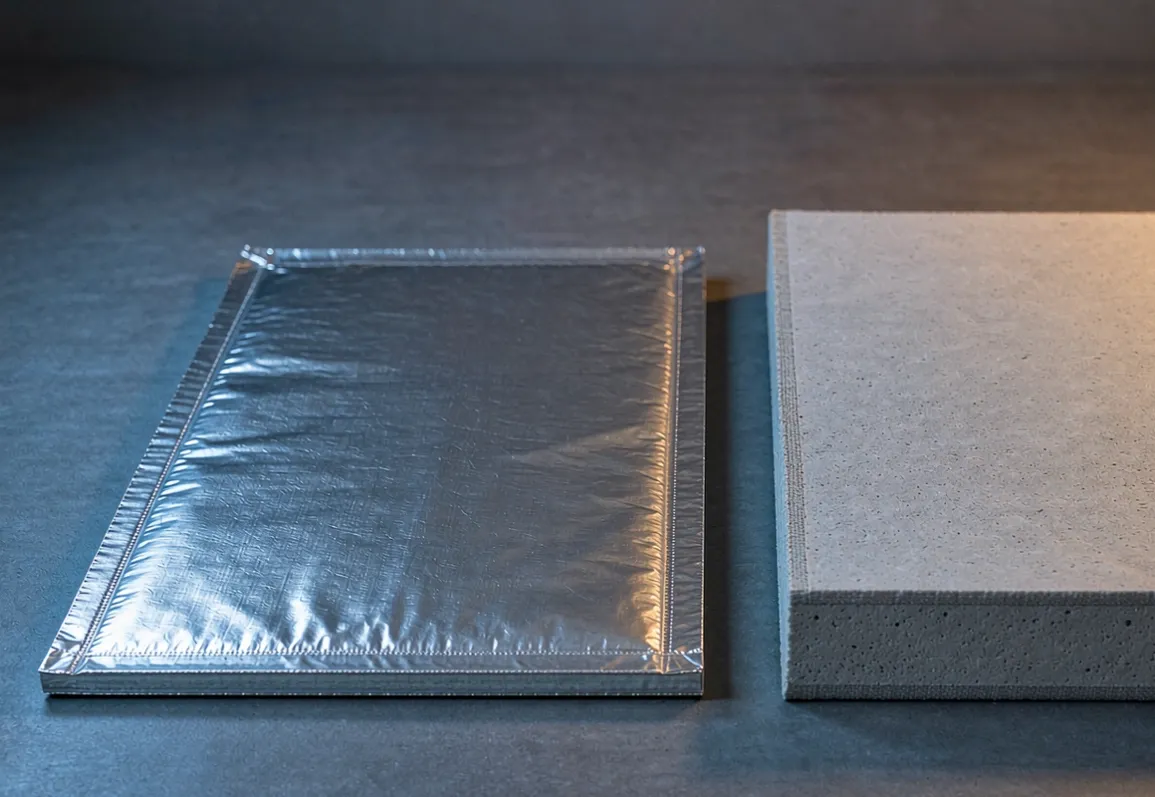
A microporous nano board delivers something around 0.02 W/mK at room temperature. A vacuum insulation panel — the evacuated, foil-wrapped board used in cold-chain boxes — delivers roughly 0.004 to 0.008 W/mK. That is a three-to-five-fold difference, and in a low-temperature application where the requirement is "keep the contents below X for as long as possible in the thinnest possible wall," the vacuum panel wins outright.
So that is what goes into cold-chain applications: medical and vaccine transport boxes, insulated containers for perishables, and the portable coolers used for fishing and outdoor use. The requirement there is maximum hold time in minimum wall thickness at temperatures near ambient, and a vacuum panel is purpose-built for exactly that.
What a vacuum panel cannot do is go hot. The barrier film that holds the vacuum does not survive furnace temperatures, and once the vacuum is lost the panel is an ordinary, rather poor insulator. So the boundary is hard, not gradual:
Near-ambient and low-temperature duty → vacuum panel.
Elevated temperature duty → microporous nano board.
There is a middle ground worth naming. Between roughly 200 and 600 C the vacuum panel is already out, and the nano board is working well below its ceiling — which means it will last essentially indefinitely and can be specified on thermal performance alone with no service-temperature margin to worry about. If the application also has a service-life requirement measured in decades rather than campaigns, the nano board's advantage is that it has no vacuum to lose. A vacuum panel has a finite life determined by how fast gas permeates the barrier; a microporous board does not.
Band 4 — the fire case: energy storage enclosures
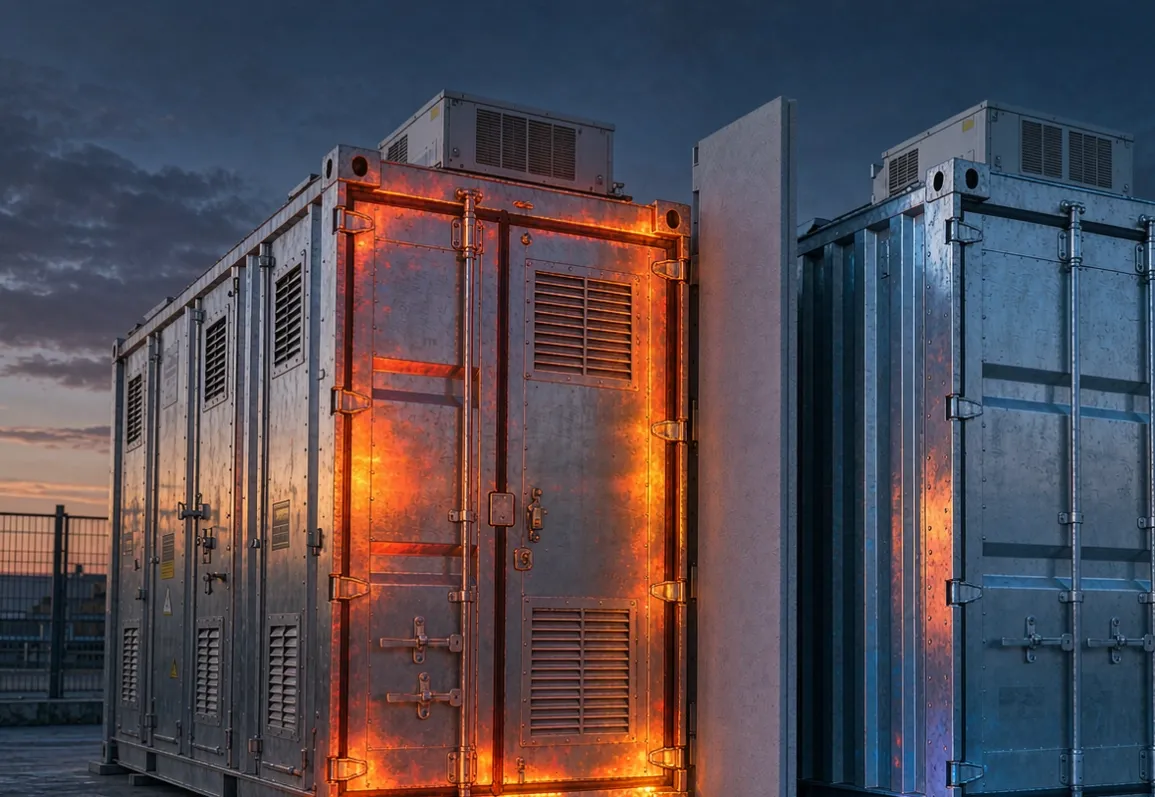
The fastest-moving application right now is fire protection in battery energy storage, and it is worth separating two levels that are often discussed as one.
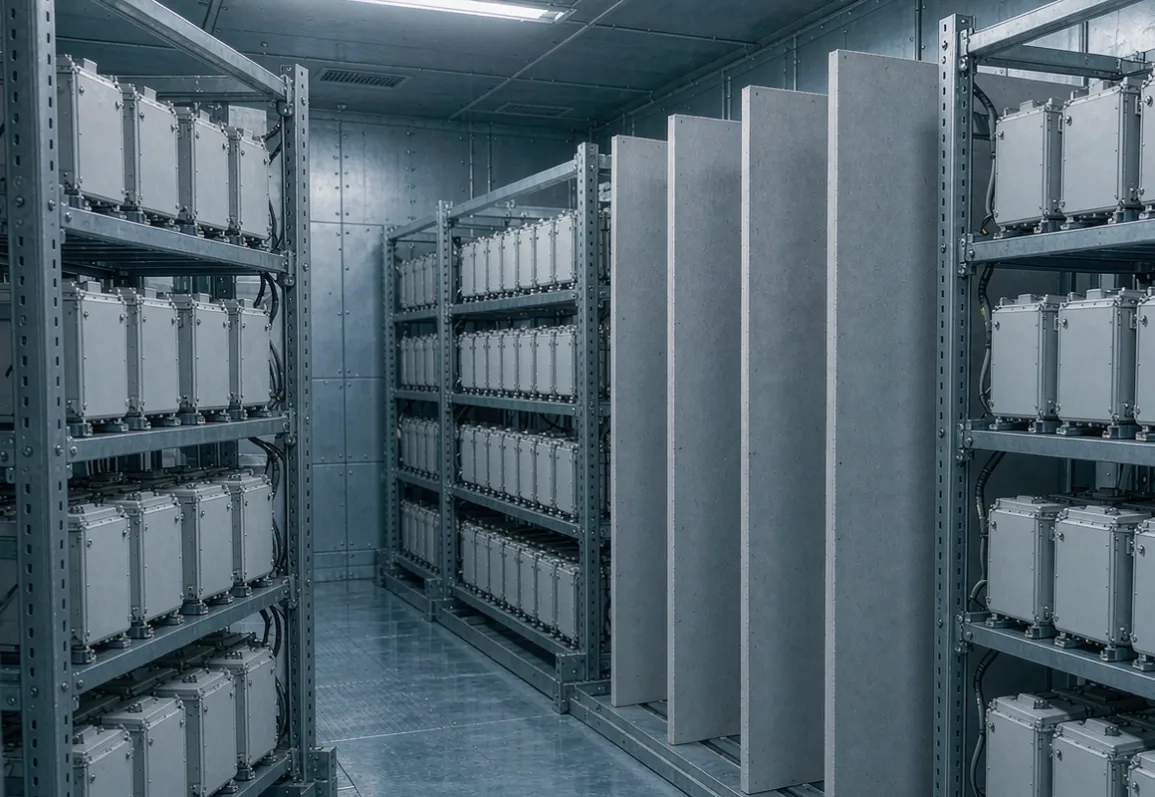
Cell level. Thin barriers between individual cells or modules, designed to slow or stop propagation when one cell goes into thermal runaway. The 2 mm barrier between cells is a different product problem from bulk insulation — the constraint is thickness, not conductivity, and the material has to hold together at temperatures far above anything in bands 2 or 3.
Enclosure level. Fire-rated partitions between battery compartments, and between the battery space and the rest of the container or cabinet. Here the requirement is different again: the partition has to stay in place and keep the far side below its ignition or damage threshold for a defined period, buying time for detection and suppression to work. That is a fire-rating problem, and the useful properties are non-combustibility, no shrinkage or cracking under rapid heating, and low smoke — not the lowest possible conductivity.
The thermal storage vessel case sits alongside both: long-duration energy storage that holds heat at high temperature, where the constraint is outer diameter for transport rather than energy cost. All three are the same underlying product family solving three different problems, which is why the specification questions differ so much between them.
Aluminium: the case that behaves differently from steel
Aluminium is the largest gap in most insulation discussions, and it behaves differently enough to be worth its own note.
The temperatures are lower — molten aluminium sits around 700 to 760 C rather than the 1500 C and above of steel — which tempts people into assuming the insulation problem is easier. It is not easier, it is different:
Holding time dominates. An aluminium holding furnace keeps metal at temperature for long periods, often continuously. Energy consumed holding temperature is a larger share of the total than in a steel ladle that cycles, so insulation performance shows up more directly in the bill.
Penetration is the failure mode. Aluminium and aluminium alloys are notably mobile and will penetrate refractory pore structure, and the associated reactions can destroy a lining that would have been fine in steel service. This is a refractory problem, but it is the reason the refractory layer in aluminium duty is specified as carefully as it is — and the reason the insulation behind it must not be asked to do any of that work.
Wall thickness is often constrained. Transfer launders, filter boxes and small holding units have limited envelope. Where you cannot add thickness, the only lever is a lower-conductivity board at the same thickness, and that is exactly the case where a microporous board earns its price against conventional calcium silicate.
The practical summary is that aluminium duty is usually an easier temperature case and a harder chemical case, and the insulation specification should be set by the holding-time economics rather than by the peak temperature.
What stays constant across all four bands
Only two things, and both are worth stating because they are where specifications go wrong:
Insulation is never the hot face. Every band, every industry, every geometry. If the board can see the process, the design is wrong.
The specification is set by the temperature the board sees, not the temperature of the process. Those differ by the whole thermal resistance of the working lining, and confusing them is how boards end up running at their ceiling.
Selection summary
| Duty | Band | Material | Deciding factor | |---|---|---|---| | Ladle, tundish, torpedo car | >1000 C | Microporous nano board | Interface temperature sets the grade | | Sintering, heat treatment, reheat | 600–1000 C | Microporous nano board | Steady-state saving; wall thickness | | Holding furnace, launder (aluminium) | 600–800 C | Microporous nano board | Holding-time energy; envelope limit | | Cold-chain box, medical transport, portable cooler | ambient | Vacuum insulation panel | Hold time per mm of wall | | BESS cell barrier | fire case | Thin microporous barrier | Thickness constraint, survival at temperature | | BESS enclosure partition | fire case | Non-combustible board | Fire rating period, no shrinkage | | LDES thermal storage vessel | >1000 C | Microporous nano board | Transport envelope (outer diameter) |
Three specification mistakes worth naming
Specifying on process temperature. The board does not see the process. It sees what the working lining lets through, and sizing against the wrong number is the most common route to a board that runs at its limit.
Using a vacuum panel because the conductivity number is better. It is better, at ambient, until the day the barrier fails or the temperature rises. Above roughly 600 C it is not a slower option, it is not an option.
Using nano board where a vacuum panel is the right answer. In a cold-chain box, microporous board will work and will be three to five times thicker for the same hold time. That is a worse product, not a more robust one.
Where the numbers on a data sheet are the thing causing the confusion, the datasheet guide walks through which lines are load-bearing and which are decoration.
Where to start
Send the duty — process, peak and steady temperature, what the hot face material is, and whether the constraint is energy cost, wall thickness or a fire rating — and the answer is usually a grade and a thickness in a single pass. If you want to see how a back-up assembly is actually built up before you specify, the anchored ladle back-up assembly page shows the layer stack in context.
Applications outside the ones listed here are welcome; most of what we have learned about this material came from a plant describing a duty we had not considered. sales@slmthermal.com