Oct 9, 2026
Vacuum Insulation Panels vs Microporous Board: Where the Temperature Line Actually Sits
A VIP declares 0.007 W/mK and a microporous board declares 0.023, so the panel looks three times better until you fix the temperature. Standard VIPs are rated to 80 °C, stainless-film panels to 400 °C
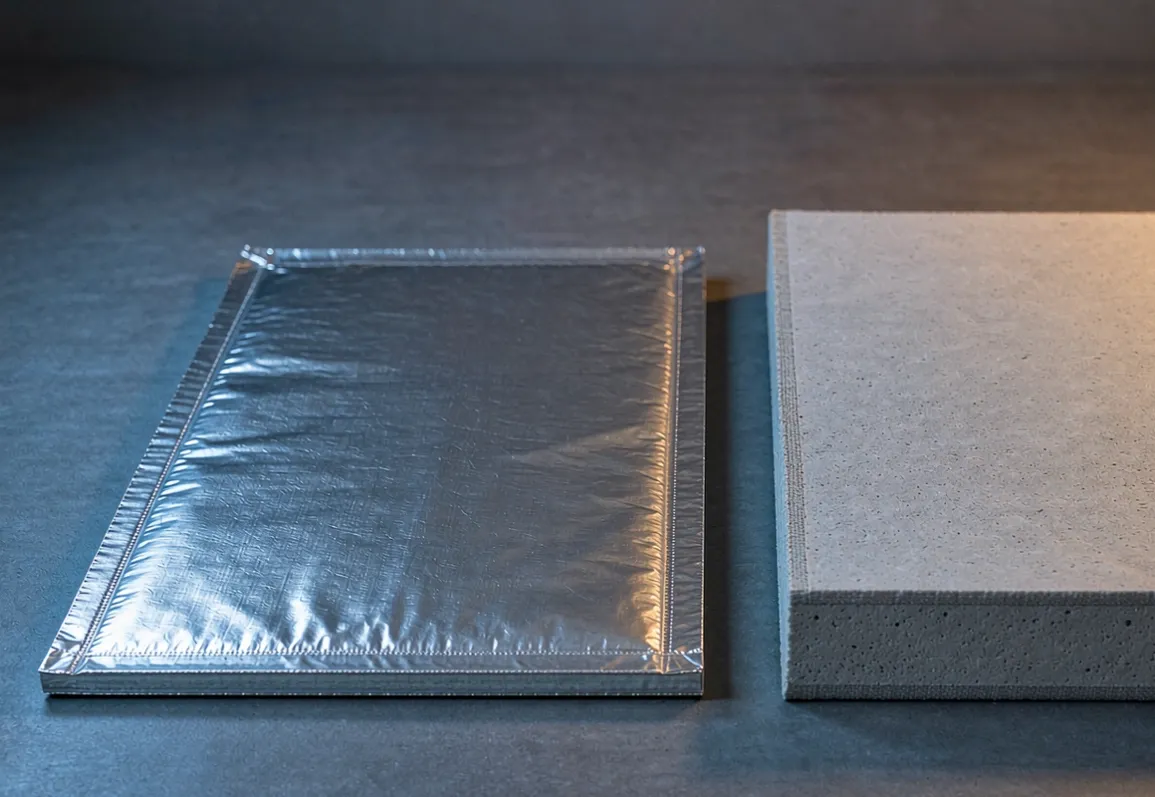
Put two datasheets side by side and the choice looks obvious. A vacuum insulation panel declares 0.007 W/mK. A microporous nano insulation board declares 0.023 W/mK. The panel is three times better, so the panel wins. Except that at 600 °C the panel is not a candidate at all, and in a cold-chain box the board is not either. The comparison only means something once you fix the temperature, and the temperature decides it before either number does.
This article is for anyone choosing between a VIP and a microporous board for a real duty. It sets out the conductivity of each across the temperature range, the three mechanisms that make a VIP lose its advantage, the two temperature bands where each one is the correct answer, and the cost position behind them. Figures from manufacturer datasheets are labelled as such; figures from academic work, UK government analysis and WHO specifications are labelled by source. Where a number could not be located in a published source, that is stated rather than filled in.
The comparison that matters is at service temperature
| Temperature | VIP, standard (foil film) | VIP, stainless steel film | Microporous board | Aerogel blanket | |---|---|---|---|---| | −170 °C | not rated | rated to −196 °C | 0.015 (Promat) | — | | 20 °C | 0.0043 initial, 0.0065–0.0071 design | 0.0045–0.006 | 0.019–0.023 | 0.0136–0.019 | | 100 °C | above rated limit | ≤0.006 | 0.021–0.023 | — | | 200 °C | above rated limit | ≤0.008 | 0.023–0.025 | ~0.030 | | 400 °C | above rated limit | at rated limit | 0.026–0.032 | ~0.045 | | 600 °C | above rated limit | above rated limit | 0.030–0.036 | ~0.068 | | 800 °C | above rated limit | above rated limit | 0.038–0.044 | above rated limit |
Sources: va-Q-tec and Kingspan datasheets for the VIP figures; Promat MICROTHERM and Unifrax Excelfrax datasheets for the microporous figures; the aerogel column from published comparisons. Conductivity measured to EN 12667 for the panels and ASTM C518 for the Min-K grade.
Two things jump out. The panel's advantage is real but it lives entirely below 100 °C. And the board's conductivity rises gently — roughly 0.023 at 200 °C to 0.039 at 800 °C for the Promat 1000 grade, under a factor of two across the whole range — while the panel has no numbers above its limit because it has no service above its limit.
The application map splits insulation duties into temperature bands for exactly this reason. The two materials in this article sit in different bands and are rarely in competition, which is the point most sourcing mistakes miss.
Where the line sits
Below about 80 °C, the panel wins outright. Standard VIPs are rated −75 to +80 °C by va-Q-tec and −40 to +80 °C by Kingspan. Within that band nothing else is close: at 20 mm, a VIP delivers the thermal resistance of roughly 50 to 80 mm of microporous board, 100 to 150 mm of mineral wool and 150 to 200 mm of calcium silicate, according to thickness-equivalency figures circulated by insulation suppliers. If the duty is a cold box, a refrigerated container wall, or building insulation where wall thickness is money, that is the answer.
From about 80 °C to 400 °C, it depends on the film. A stainless-steel-film VIP such as va-Q-steel is rated −196 to +400 °C and holds ≤0.008 W/mK at 200 °C, which is better than any microporous board at that temperature. But it is supplied in 10 to 20 mm thicknesses, cannot be cut, and carries a cost premium on top of an already expensive product. Whether that trade is worth it depends on whether thickness is your binding constraint.
Above 400 °C, the board is the only one of the two on the field. Microporous board is rated to 1000 or 1200 °C and is used as the back-up layer behind refractory in ladles, torpedo cars, aluminium holding furnaces and sintering kilns. There is no vacuum panel in this band.
How a VIP loses its advantage
Three mechanisms, all with published numbers.
Temperature. Araki and co-authors, writing in the Journal of Materials Processing Technology in 2009, put the upper limit of ordinary VIPs at about 70 °C and note that reaching 105 °C requires a different heat-seal layer. Their summary of the failure mode is direct: at high temperatures the vacuum is lost and performance degrades sharply. The mechanism is the barrier film. va-Q-tec's own FAQ notes that the fumed silica core would survive 900 °C while the plastic barrier laminate does not, and that sustained operation above 40 to 50 °C accelerates gas and moisture ingress and shortens service life.
Puncture. This is the number that should stop anyone specifying a VIP on conductivity alone. va-Q-tec publishes a "ventilated" design value of 0.020 W/mK for its panels — the conductivity once the vacuum is gone. That is the same figure a microporous board declares at room temperature. A punctured VIP performs like a microporous board and costs what a VIP costs. Brunner and Simmler's 2008 work puts the same point in sequence: about 4.5 mW/mK fresh, plus 2.9 mW/mK over 25 years of ageing giving a design value of 7 to 8, and 20 mW/mK after puncture. Turvac's datasheet is blunt about the consequence — no drilling, cutting, milling or nailing, with dimensional tolerances of several millimetres on length and width.
Edges and ageing. A panel is not a slab of 0.004 W/mK; it is a slab with a highly conductive skin. IEA EBC Annex 39 measured a linear thermal bridge coefficient of 0.006 W/(m·K) for a three-layer metallized film, moving effective conductivity from 8.0 to 8.7 mW/mK on a 1.0 × 0.5 × 0.02 m panel, and 0.033 W/(m·K) for an 8 μm aluminium foil, moving it to 10.0. Ghazi Wakili's 2004 measurements on 20 mm panels found effective conductivity 14% above the core value for a 90 nm aluminium layer and 19% above for 300 nm. On ageing, va-Q-tec's patent filing gives an internal pressure rise of 0.2 to 2 mbar per year, with conductivity doubling at the earliest after 50 years.
Then there is cost. The UK government's BEIS innovation report prices VIP at £125/m² against £100 for aerogel, £17 for phenolic, £16 for PIR/PUR, £5 for mineral wool and £4 for EPS. The panel is roughly 25 times the price of the commodity insulations and eight times PIR. That is a rational purchase where thickness is the constraint and irrational where it is not.
Where the VIP is unambiguously right: cold chain
If the duty is keeping a payload between 2 and 8 °C, the panel is the correct material and the published performance data makes the case without any argument.
WHO PQS specification E004/CB01.2 for short-range vaccine cold boxes sets a minimum cold life of 48 hours, and 96 hours for long-range boxes. Cold life is defined rigorously: in a constant +43 °C environment, the time from closing the lid until the warmest point inside the vaccine compartment first reaches +10 °C. Cool life ends at +20 °C.
Against that yardstick, published box data splits by insulation type. A polyurethane cold box with 90 to 105 mm walls reports 134.6 hours of cold life. A VIP-and-PCM system reports 80 to 152 hours in summer profiles and 166 to 168 hours in winter. An 18-litre VIP-and-PCM box reports 120 hours in summer, 65 hours at the extreme summer 45 °C profile, 300 hours in winter and 150 hours at extreme winter. ISTA 7D defines those profiles: 22 to 35 °C summer, −10 to 18 °C winter, with extreme profiles at 45 °C and −20 °C.
A microporous board does not compete here. On conductivity it is three times worse at room temperature, and the wall thickness penalty in a box that has to be carried is decisive. This is the band the panel owns, and specifiers who bring a nano board into it are solving the wrong problem.
Where the board is unambiguously right: above 400 °C
The board's case rests on three things rather than one.
It holds its conductivity. The datasheet guide makes the same point for any material — ask for the curve, not the headline. For the Promat 1000 grade the curve runs 0.023 at 200 °C, 0.026 at 400 °C, 0.031 at 600 °C and 0.039 at 800 °C. Unifrax's Excelfrax 1800 board starts lower at 0.019 at 20 °C and reaches 0.038 at 800 °C. Neither degrades; they drift upward, and the drift is small enough to design against.
It converts thickness into cold-face temperature predictably. Published hot-face to cold-face figures for microporous board give, at a 600 °C hot face, roughly 210 °C at 3 mm, 161 °C at 5 mm, 112 °C at 10 mm, 74 °C at 20 mm and 66 °C at 25 mm; at a 1000 °C hot face, 183 °C at 10 mm, 111 °C at 25 mm and 71 °C at 50 mm. Those numbers are the basis of a sizing calculation, which is what the thickness sizing method turns into a specification.
It is a construction material, not a sealed component. Densities run 240 to 400 kg/m³, compressive strength 0.12 to 0.76 MPa depending on grade, linear shrinkage below 0.5% on single-sided exposure to 1000 °C for 12 hours, A1 non-combustible, encapsulated in glass cloth, and cuttable on site. It can be drilled, notched and fitted around penetrations, which matters because the joint problem is where most installed performance is lost. It also carries no respirable fibre classification, whereas refractory ceramic fibre is classified Carc. 1B H350i under CLP and sits on the REACH SVHC list with a binding occupational exposure limit of 0.3 fibres/ml — a difference that shows up in installer PPE, site waste handling and the customer's own ESG review.
Common errors in this comparison
Comparing at 20 °C and applying the result at 600 °C. The panel has no 600 °C number. Any comparison above 100 °C is not a comparison.
Specifying a VIP where the panel will be punctured, drilled or trimmed. Post-puncture conductivity is 0.020 W/mK, equal to a microporous board's room-temperature value, at VIP prices.
Ignoring the edge bridge. A quoted 0.0043 W/mK is a centre-of-panel figure. Effective values on a real panel run 9% to 19% higher depending on the film, and worse on small panels where the perimeter is a larger share of the area.
Assuming the vacuum lasts. Pressure rise is 0.2 to 2 mbar per year, conductivity roughly doubles on the longest published horizon, and sustained heat above 40 to 50 °C accelerates it.
Putting a microporous board in a cold box. Three times the conductivity of a panel at room temperature, and the thickness penalty lands directly on payload volume.
Putting a VIP behind refractory. It will lose its vacuum, and the failure is not gradual: the published ventilated value is a step change, not a slope.
Questions that come up
Is there a high-temperature VIP that changes the answer?
Up to a point. Stainless-steel-film panels are rated to 400 °C and hold ≤0.008 W/mK at 200 °C, which beats microporous board at that temperature. At least one Chinese manufacturer advertises a metal-film panel rated to 800 °C. The constraints are thickness range, the inability to cut, and cost. For a thin, geometrically constrained slot below 400 °C, they are worth pricing. Above that, the board is the default.
What does a VIP cost relative to a board?
The BEIS report gives £125/m² for VIP against £100 for aerogel and £16 for PIR. Published prices for microporous board are not quoted openly by manufacturers, so treat any specific figure as a quotation exercise rather than a benchmark. The structural point holds regardless: the panel's premium is paid for thickness saved, and it is only worth paying where thickness is actually scarce.
Which one should I use for a refrigerated container or a fishing cooler?
The panel, if the geometry allows uncut panels and the service stays below 80 °C.
Which one for a ladle back-up layer, an aluminium launder cover, or a sintering kiln wall?
The board, without qualification. These are 400 to 1200 °C duties.
How do I qualify a supplier?
The supplier audit checklist covers the field list. For this comparison specifically, ask for conductivity at four temperatures, the permanent linear change at your maximum exposure, the encapsulation method, and whether the quoted value is centre-of-panel or effective. On delivery, the checks in the storage and cutting guide apply.
---
SLM supplies high-strength nano insulation boards in 1000 °C and 1200 °C grades for the band where vacuum panels are not an option: ladle and torpedo car back-up linings, aluminium holding furnaces and launders, sintering and heat-treatment furnaces, and BESS enclosure barriers. Send the hot-face temperature, the target cold-face temperature or heat flux, and the available build-up thickness, and we will return a thickness and grade. The RFQ template lists the remaining fields. Stack arrangements are shown under anchored ladle back-up assembly, or write to sales@slmthermal.com.