Sep 13, 2026
How Many Nano Insulation Boards Fit in a 40ft Container: A Buyer's Guide to Packaging, Loading and Freight
A practical freight and packaging guide for importing microporous nano insulation boards — realistic piece counts per 20GP, 40GP and 40HQ container, packaging options and their volume cost, moisture c

Freight is the line item that quietly decides whether an insulation upgrade looks cheap or expensive on the landed-cost sheet. We have quoted buyers who compared two suppliers on board price alone and then discovered that one of them could ship almost twice as much material in the same container, simply because the packaging was designed for it.
This guide is for procurement teams and plant engineers who need to plan a shipment of high-strength nano insulation boards and want real numbers rather than a promise that "it will fit".
Why container planning belongs in the purchase decision
On a typical export order, sea freight and inland handling add 8 to 18 percent to the delivered cost of the material, depending on the route and the season. If your supplier's packaging wastes 20 percent of the container volume, you are paying that 20 percent twice: once in freight and once in the number of containers you need.
The two questions worth asking before you sign anything are:
How many boards of my size fit in the container I am paying for?
Is the limit volume or weight?
For microporous board the answer is almost always volume, which is good news — it means you can usually fill the container before you hit the weight limit, and the freight per board drops as the quantity rises.
Start with the numbers that drive everything
Every calculation below starts from three figures you should confirm on your order.
Board size. The common ladle back-up format is 1200 x 600 mm, in thicknesses from 20 mm to 60 mm, with 50 mm being the usual choice for 100 to 150 ton ladles.
Bulk density. Microporous board for this service typically runs 220 to 300 kg per cubic metre depending on grade. Take the value from the certificate of analysis, not from a brochure.
Single board weight. A 1200 x 600 x 50 mm board at 250 kg per cubic metre has a volume of 0.036 cubic metres and weighs about 9 kg. At 25 mm thick the same board weighs about 4.5 kg.
Those two numbers — 0.036 cubic metres and 9 kg — are what you divide into the container.
Container reference figures
Internal dimensions vary slightly by carrier and container age, but these are the working figures we use:
GP: about 5.9 x 2.35 x 2.39 m, roughly 33 cubic metres usable, payload around 28 tonnes.
GP: about 12.0 x 2.35 x 2.39 m, roughly 67 cubic metres usable, payload around 26 tonnes.
HQ: about 12.0 x 2.35 x 2.69 m, roughly 76 cubic metres usable, payload around 26 tonnes.
The extra 30 cm of interior height on a high-cube container is worth about 13 percent more volume for the same freight rate, which is why 40HQ is the default choice for this material whenever the route and the port allow it.
The realistic loading calculation
Now the part most suppliers skip: packaging takes space. Crates, pallets, corner protection and the gaps you cannot avoid between stacks typically add 15 to 25 percent to the theoretical volume. A realistic planning factor is 1.2 times the bare board volume, and a realistic volumetric efficiency for a well-loaded container is about 85 percent.
For 1200 x 600 x 50 mm boards at 250 kg per cubic metre:
Effective volume per board: 0.036 x 1.2 = 0.043 cubic metres.
GP: 33 x 0.85 = 28 cubic metres usable → about 650 boards, weighing roughly 5.9 tonnes.
GP: 67 x 0.85 = 57 cubic metres usable → about 1,320 boards, weighing roughly 11.9 tonnes.
HQ: 76 x 0.85 = 65 cubic metres usable → about 1,500 boards, weighing roughly 13.5 tonnes.
Note the weight in every case: comfortably under the payload limit. Volume is the constraint, not weight. That has a practical consequence — if you are shipping 25 mm board instead of 50 mm, you roughly double the piece count per container and halve your freight cost per square metre of coverage.
If your project can accept a thinner back-up layer, this is worth modelling before you order. Where mean service temperature runs above 1000 C, SLM-1200 is the necessary grade regardless of what the freight maths suggests. Our SLM-1000 vs SLM-1200 comparison guide covers how thickness and grade interact for your specific conditions.
Packaging options and what they cost you in space
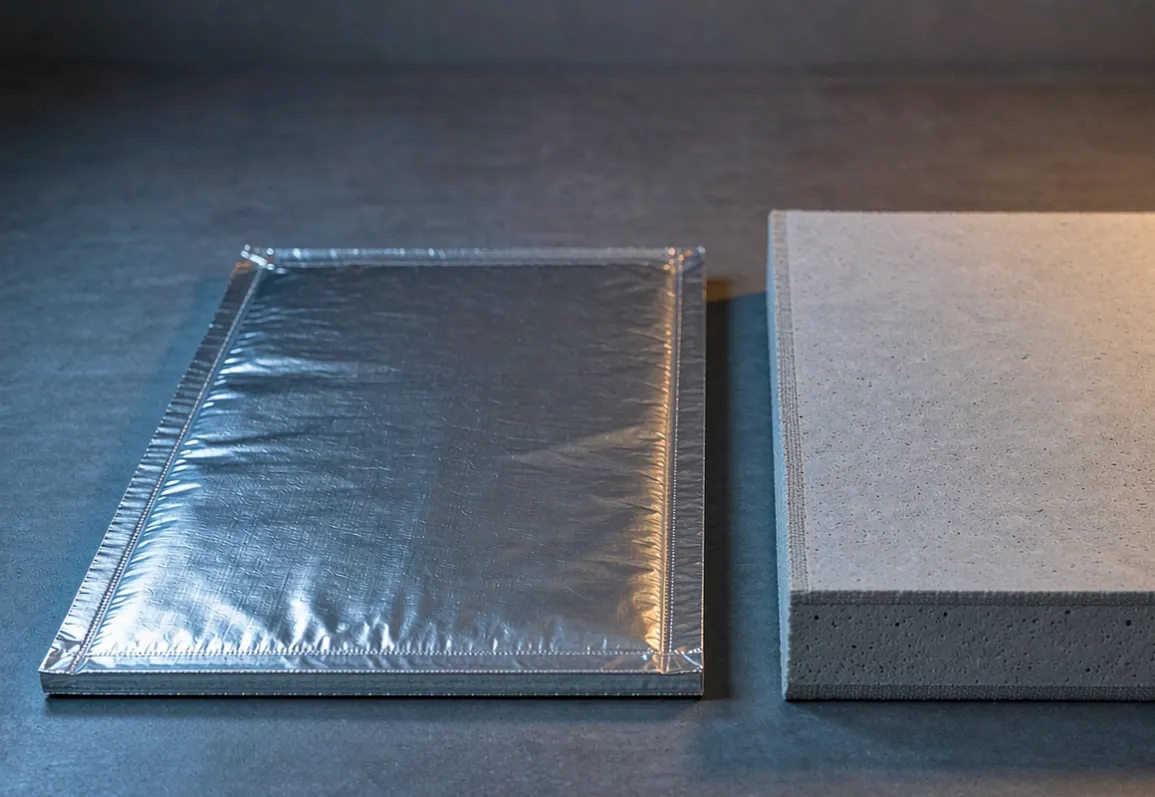
Palletised and stretch-wrapped. The most space-efficient option and the cheapest. Boards are stacked on a treated timber pallet, corner-protected, wrapped and strapped. Best when the destination has covered unloading and a dry store.
Crated in timber. Better protection for multi-handling routes and long inland legs. Costs about 12 to 18 percent of container volume in crate structure and void space.
Sealed in moisture-barrier film with desiccant. Worth the cost for humid routes or long transit times. The film adds very little volume; the desiccant adds none.
All timber used in export packaging needs to be heat-treated or fumigated to ISPM 15 and stamped with the IPPC mark. Without that stamp the container can be held at destination, and the cost of that delay dwarfs any saving on packaging.
Moisture is the real transit risk
Microporous board is not fragile in the way glass is, but it is hygroscopic, and a container is a humid place — especially on a long sea leg through tropical waters, where the internal temperature swing produces condensation on the container ceiling that then drips onto the load.
What works:
Desiccant at a rate of roughly 1 kg per 10 cubic metres of container volume for a voyage under 30 days, more for longer routes or very humid seasons.
A moisture-barrier liner or shroud over the whole stack, sealed at the base.
Humidity indicator cards in at least two crates, readable without unpacking.
Never load against a wet container floor. Check for standing water before loading starts.
This matters because moisture damage is the single most common claim we see, and it is also the one that a good incoming inspection catches immediately — the humidity card tells the story before anyone opens a crate.
Lead time: plan backwards from the reline date
A realistic schedule for a made-to-order shipment from China:
Production: 10 to 20 days depending on grade and quantity.
Inland transport and export clearance: 3 to 7 days.
Booking to vessel departure: 3 to 10 days, longer in peak season.
Sea transit: 25 to 35 days to most of Europe, 15 to 25 days to the US west coast, 10 to 18 days within Asia.
Import clearance and inland delivery: 5 to 10 days.
Call it 50 to 70 days door to door for a first order to Europe. Plants that order against a reline date and leave 90 days of margin sleep well; plants that leave 45 days do not.
The five buying mistakes guide covers the order-side traps that compound with freight risk — particularly the habit of confirming the grade late, which pushes production into a peak-season booking window.
LCL or FCL: where the break-even sits
Less-than-container load makes sense for samples, trial quantities and small top-up orders. Above roughly 15 cubic metres — about 350 boards of 50 mm — a full container is usually cheaper per board and much lower risk, because your material is not being consolidated and deconsolidated with other people's cargo.
There is also a damage argument: LCL cargo is handled more times. For a rigid but brittle board, every extra handling is another chance to chip an edge.
What to put in the purchase order
Spell these out and you will not be arguing later:
Board dimensions, thickness and the accepted density range, with a reference to the COA.
Packaging method, including whether timber is ISPM 15 stamped.
Desiccant quantity and the number of humidity indicator cards per container.
Loading photographs before the container is sealed, and the seal number recorded on the documents.
Insurance covering moisture damage, not just loss.
Once the container arrives, the process hands over to the receiving team. The dimensional tolerance and defect criteria in our installation guide tell you what is still usable after cutting, and the ROI calculation tells you what a short shipment actually costs you in campaign terms when the reline date slips.
A quick sanity check you can do yourself
Before you accept any loading figure, ask the supplier two questions:
How many boards of my exact size did you load in the last container of this type — not a theoretical calculation, the actual number?
What did that container weigh at the gate?
A supplier who ships regularly will answer both immediately from their records. One who answers with a spreadsheet and no shipping history is guessing, and the guess usually turns out optimistic by 10 to 20 percent.
Planning a shipment now
Send us your board size, thickness, quantity and destination port, and we will tell you the container type, the realistic piece count, the gross weight and the current transit time for your route. We will also flag whether your service temperature points to SLM-1000 or SLM-1200, and how the anchored ladle back-up assembly should be laid out once the material lands.
For background on how the boards are made — which explains the density and the handling requirements above — see How SLM nano insulation boards are manufactured.
— The Suleiman Refractory Engineering Team