Sep 13, 2026
The Real ROI of Switching to Nano Insulation Boards: Energy Savings, Cycle Time, and Maintenance Windows
A line-item ROI breakdown for switching from calcium silicate or ceramic fibre to microporous nano insulation boards in steel ladle back-up lining — shell temperature drop, preheat time saved, working
Buyers of microporous nano insulation boards rarely object to the chemistry. The question we hear every week from melt-shop managers and procurement teams is simpler: how fast does it pay back, and what numbers should I put in front of the CFO. The answer is the reason we wrote this article.
Across the steel plants we have worked with over the last decade, high-strength nano insulation boards consistently return the investment inside the first campaign. If you are evaluating a switch from calcium silicate or ceramic fibre for the first time, our article on why steel mills are switching gives the strategic case; this guide gives you the line-item economics and the assumptions behind them.
The three numbers that drive the business case
Every ROI calculation for ladle back-up insulation comes back to three measurable quantities:
Shell temperature drop, in degrees Celsius, on the outside of the ladle during a steady pour.
Ladle preheat time saved, in minutes, between a cold lining and the first heat.
Working lining life extension, measured in additional heats per campaign before reline.
Get those right and the rest is arithmetic. Miss any one of them and the case falls apart.
Shell temperature drop: where the energy saving comes from
Heat loss through a ladle wall is dominated by radiation at steel-making temperatures, and radiation scales with the fourth power of absolute temperature. Cutting the hot-face to shell thermal gradient by even a few per cent shows up immediately on the outside.
Typical measured numbers from 100 to 150 ton ladles lined with SLM-1000 nano back-up behind a 150 mm working lining:
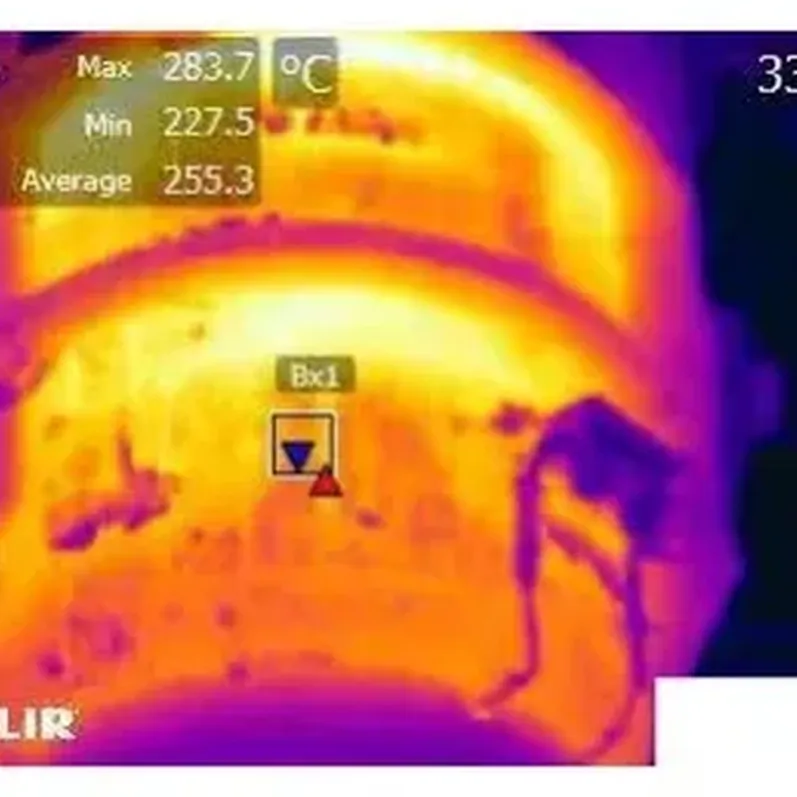
Shell temperature during peak pour drops 20 to 30 C compared with the same lining using calcium silicate.
The drop is consistent on the side wall, the slag line and the bottom cone.
On the slag line the drop is usually larger, because that is where the working lining is thinnest and the original heat flux was highest.
Translate that into energy: a 25 C shell drop on a 130 ton ladle running three heats per shift is roughly 60 to 90 kWh per heat of avoidable shell loss. At a typical shop energy cost that is real money every day, and it is before any carbon pricing or heat-balance credits.
Ladle preheat: the hidden saving on every shift
Preheat is where most plants underestimate the saving. A cold lining on a heavy ladle takes 90 minutes or more on a gas burner before the first ladle of steel. Microporous board heats through faster than calcium silicate, and the difference is not small.
In our field data the typical preheat time savings break down as follows:
ton ladle, gas burner preheat to 1100 C: from 90 minutes to about 55 minutes on nano back-up.
ton ladle, gas burner preheat to 1100 C: from 120 minutes to about 70 minutes.
ton ladle, gas burner preheat to 1100 C: from 150 minutes to about 90 minutes.
The savings come from two effects working together. Microporous board has very low thermal mass because its density is roughly a quarter of calcium silicate, so less energy is needed to bring it up to temperature. The low thermal conductivity also means the heat stays where it is needed at the working face instead of bleeding outward through the wall. Combined, the burner can be turned off earlier and the first heat can go in sooner.
Where the working lining reaches higher mean temperatures — typical in secondary refining or in SLM-1200 service above 1000 C — the preheat saving is even larger, because the burner has to push more heat through a denser insulating layer in a conventional build.
Lining life extension: more heats per campaign
Back-up insulation is not the working lining, but it directly controls how long the working lining survives. Three mechanisms are at work:
Lower hot-face temperature. Every 10 C drop at the back of the working lining roughly doubles the time to chemical degradation for magnesia-based bricks.
Less thermal cycling at the back face. A stable back-up temperature means the working face sees a smoother thermal gradient, not the spike that a low-mass calcium silicate layer allows through.
Better joint stability. A rigid, dimensionally stable back-up layer does not slump, so the working lining sits on a true surface for the whole campaign.
Combined, plants moving from calcium silicate to nano back-up typically see working lining life extend by 40 to 60 per cent on standard dolomite or magnesia working linings. That is the difference between 80 heats and 115 heats on a 130 ton ladle, which is the difference between relining every 18 days and every 26 days on a busy shop.
Maintenance windows and ladle availability
A reline takes the ladle out of service. Every extra day between relines is a day the ladle is available to the melt shop. On a two-ladle shop, gaining six days between campaigns means roughly 20 additional heats per ladle per quarter, which is the same as running a third ladle for half a shift every day.
The maths at the melt-shop level is straightforward:
Working lining life extension of 40 per cent on two ladles: about 35 additional heats per week available.
Reduced preheat time of about 35 minutes per heat: roughly 3 additional heats per shift across the fleet.
Lower shell temperature: about 0.5 per cent less specific energy consumption per ton of steel produced, an immediate input to the plant energy balance.
For CFO-level reporting, the most defensible number is the lining-life extension, because it is auditable from the reline log. The shell-temperature and preheat numbers reinforce the case but should be presented as supporting evidence rather than primary savings.
Payback period: a worked example
Take a 130 ton ladle in a 2 million ton per year shop. Assume a current calcium silicate back-up layer that costs 28,000 USD per reline in board material and installation, and a working lining life of 85 heats.
Switch to SLM-1000 at 50 mm thickness:
Board cost is roughly 2.4 times the calcium silicate cost, so about 67,000 USD per reline in board material and installation. The five buying mistakes we published earlier this year cover the price-quotation traps to watch out for here.
Working lining life extends from 85 to 120 heats, a 41 per cent gain.
At three heats per day on the ladle, the gain is about 12 extra days of ladle availability per campaign.
Preheat saving is 35 minutes per heat, worth about 1.4 additional heats per day in fleet throughput.
Shell-temperature drop of 25 C is worth about 75 kWh per heat in avoidable loss.
Add the value of the extra heats, the gas saving from the shorter preheat and the energy credit from the lower shell loss, and the annual saving on this single ladle is in the 180,000 to 220,000 USD range. Against an incremental insulation cost of roughly 39,000 USD per reline, the payback period is six to eight weeks of operation. Over a 12-month window, the net saving on a single 130 ton ladle is comfortably above 1 million USD.
The same calculation on a 200 ton ladle running five heats per day returns the investment inside four weeks. Plants running six or more large ladles typically reach payback in the first month after the reline schedule is converted, and from that point every quarter is net saving.
What changes the answer
The numbers above hold for typical carbon steel ladle service. A few applications move the answer in either direction:
Stainless steel or high-alloy production. Tapping temperatures are higher and holding times are longer, so the shell-temperature and lining-life numbers both improve. SLM-1200 is the right grade for these conditions.
Tundish dry board. The thermal mass benefit is smaller because the tundish is preheated once per shift rather than per heat, but the lining-life number is still strongly positive.
Torpedo ladle and iron ladle service. Lower tap temperature but much longer holding time. Shell-temperature drop is smaller, lining-life extension is the dominant saving.
Reheat furnace and forge furnace walls. See the anchored ladle back-up assembly family for the installation details; the energy numbers scale roughly linearly with the wall area.
If you are deciding between SLM-1000 and SLM-1200 for a particular service, our SLM-1000 vs SLM-1200 comparison guide walks through the specification logic.
How the savings compare with ceramic fibre
Plants coming from ceramic fibre rather than calcium silicate see a smaller but still meaningful gain. The economics differ because ceramic fibre is closer to microporous board on density and conductivity, but still loses on dimensional stability and high-temperature shrinkage.
Shell temperature drop is typically 8 to 15 C rather than 20 to 30 C, because ceramic fibre already gives a reasonable thermal envelope.
Working lining life extension is still 20 to 30 per cent, because the dimensional stability benefit remains.
Maintenance cost is lower because ceramic fibre is more easily damaged during relining and tends to need patching every campaign.
The full comparison is in our Nano insulation board vs ceramic fiber board article; the short version is that ceramic fibre is rarely the cheapest option once the maintenance hours are added in.
Implementation: where the savings come from in practice
Three implementation choices determine whether the plant actually captures the numbers above:
Board thickness. A 50 mm nano back-up is standard on 100 to 150 ton ladles. On larger ladles, or where the working lining is thinner than 150 mm, the thickness should be designed against the temperature gradient rather than a fixed rule. Our installation guide walks through the sequence in detail.
Anchor pattern. Six stainless anchors per 1200 x 600 mm board is the starting point. The pattern and the stainless grade of the hardware directly affect whether the lining survives the first campaign without hot spots. Field fabrication is covered in the How SLM nano insulation boards are manufactured article.
First heat-up discipline. A controlled first heat ramp matters; if the lining is heated too fast, the working face spalls before it ever sees steel, and the lining-life gain above is lost. The preheat numbers above assume a properly controlled first heat.
The short version is that the material is necessary but not sufficient. The savings show up when the lining is designed, installed and brought up to temperature correctly.
A simple checklist for the CFO presentation
If you only have time for one page in front of finance, the minimum useful set is:
Shell temperature drop in degrees Celsius, measured on the actual ladle before and after conversion.
Working lining life extension in heats per campaign, taken from the reline log.
Preheat time saving in minutes per heat, timed on the burner.
Annual incremental insulation cost per ladle, board material plus installation.
Payback period in weeks of operation.
With those five numbers the calculation is transparent, auditable, and almost always points to the same conclusion: the insulation upgrade is one of the shortest-payback capex items in the melt shop, and the only reason it is not approved faster is that it has historically been a small line item on the refractory budget rather than an energy and availability lever.
If you would like a worked calculation for your specific ladle size and operating window, send us your current shell temperature log and the working lining life you are seeing today. We will return the payback period, the annual saving, and the recommended SLM-1000 or SLM-1200 grade for your service.
— The Suleiman Refractory Engineering Team