Oct 26, 2026
Coke Oven Linings Run at 1300 C for 30 Years: Why the Backup Layer Is a Compliance Problem, Not Just an Energy One
A coke oven is a vertical, wall-dominated structure that runs a combustion chamber at 1300 to 1400 C for 25 to 30 years, so the backup lining is not mainly an energy saving - it is the easiest lever o
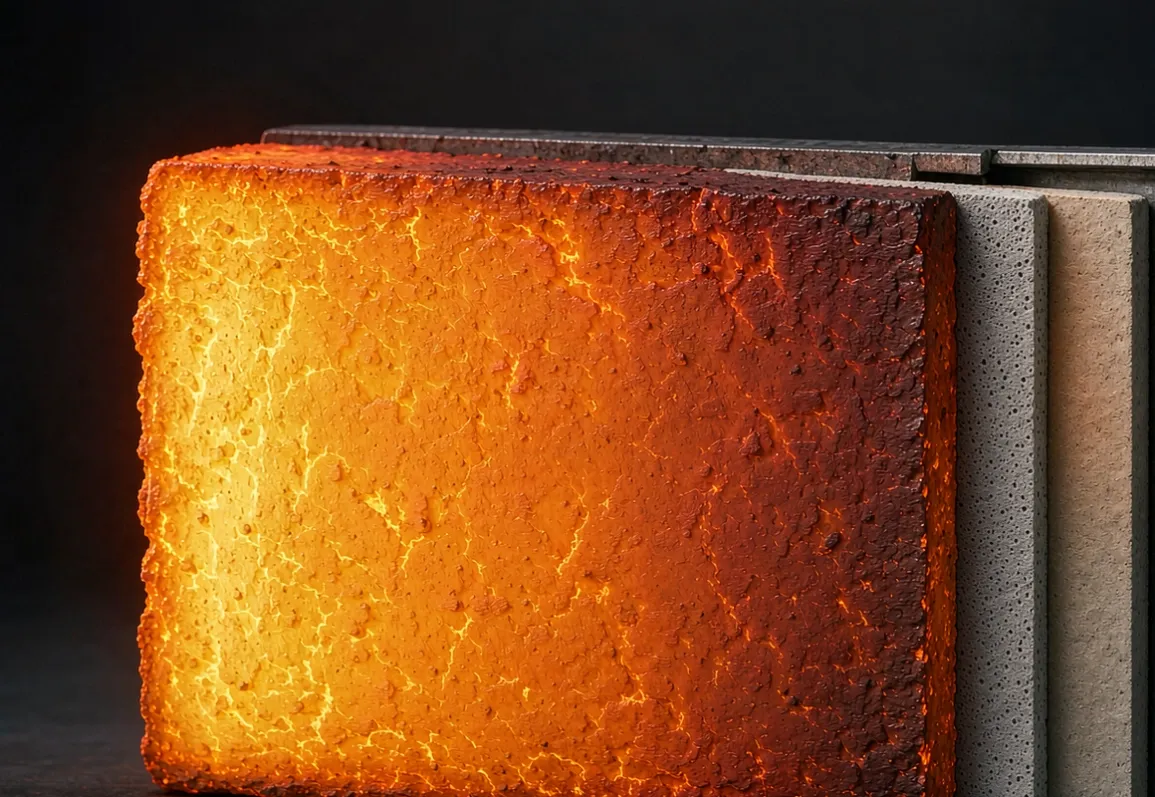
A coke oven is not a reheating furnace with a different name. It is a vertical, wall-dominated structure that runs a combustion chamber at 1300 to 1400 °C for twenty-five to thirty years without a cool-down, and the surface it loses heat through is enormous and almost entirely exposed. That single fact changes how you should think about the backup lining. On a coke oven the thin microporous board you bolt or glue onto the cold face of the refractory is not mainly an energy saving. It is the easiest lever you have on door leakage, on shell temperature, and on the part of your emissions permit that inspectors actually look at. The same logic, applied across every industry where a refractory has a cold face, is what the application map collects. The data below shows where the board pays back, where it does nothing, and where it fails if you install it the way people install it on a ladle.
What a coke oven actually loses, and where
A modern large coke oven converts about 70 to 75 percent of its fuel into usable heat (Angang case, industry report). The rest is accounted for in a heat balance that looks different from a rolling reheating furnace. The four large terms are:
| Heat sink | Share of heat input | Source | |---|---|---| | Red-hot coke sensible heat (pusher, quenching) | 37 to 42 percent | NDRC energy planning case | | Raw and lean gas sensible + latent heat | 30 to 35 percent | NDRC energy planning case | | Flue gas leaving the regenerator | 18 to 20 percent | NDRC energy planning case | | Oven body surface radiation and convection | 9 to 11 percent | NDRC energy planning case |
Notice the last line. On a continuous reheating furnace the walls carry only 4 to 8 percent of the loss. On a coke oven the standing shell, doors, oven-frame, ascension pipes and regenerator walls carry 9 to 11 percent, because the structure is a tall, thin, hot box that never gets a chance to cool. The combustion-side temperatures are constant for the life of the campaign:
| Location | Typical temperature | Source | |---|---|---| | Carbonizing chamber wall, charge side | 600 °C at charge rising to 1000 to 1100 °C at push | allchemforum refractory reference | | Burner flue (combustion chamber) | 1300 to 1400 °C | allchemforum refractory reference | | Ascension pipe raw gas | 650 to 800 °C | Yunnan energy report, patent CN115574631B | | Door and oven-frame outer shell | up to about 300 °C in natural convection | European patent EP4240808A1 |
The important consequence is steady state. A batch furnace heats and cools every cycle, so part of your lining loss is stored heat you never recover. A coke oven burns at a fixed flue temperature for decades. The backup layer sits under a constant heat flux, and its conductivity at the real operating temperature is the only thing that decides the cold-face temperature. There is no thermal-mass argument to hide behind. If the cold face is hot, the material is wrong for the temperature.
Compare the materials at the temperature they actually see
This is where the room-temperature number misleads buyers. A microporous board and a ceramic-fibre blanket look close on a datasheet at 25 °C. They are not close at 800 °C, which is the temperature the carbonizing-chamber backup layer lives at for thirty years. Measured conductivity from manufacturer data sheets:
| Material | Density kg/m³ | λ at 400 °C | λ at 800 °C | λ at 1000 °C | Source | |---|---|---|---|---|---| | Microporous board, 1000 °C grade | 240 to 320 | 0.021 to 0.026 | 0.030 to 0.039 | n/a | Promat, UNICORN, Wedge, Luoyang Sanhe | | Microporous board, 1200 °C grade | 360 to 480 | 0.033 to 0.038 | 0.044 to 0.062 | 0.042 | Wedge, Luoyang Sanhe | | Ceramic fibre blanket, 1260 class, 128 kg/m³ | 128 | 0.086 | 0.120 | 0.186 | Jinshi refractory data sheet | | Light fireclay brick, NG-0.5 | ~500 | 0.14 | 0.18 | 0.20 | Chinakiln product table | | Floating-bead (cenosphere) brick | 400 to 800 | 0.10 to 0.20 range | same range | same range | industry summary |
At 800 °C a microporous board runs 0.030 to 0.044 W/mK. A 1260-class ceramic-fibre blanket runs 0.120. That is roughly a four-times difference, and it is the difference between a 25 mm board and a 150 mm blanket for the same cold-face temperature. At the cold face of a carbonizing-chamber wall the 1000 to 1100 °C hot face means the backup layer does real work, and the four-times gap is what lets you hold the shell under the 300 °C shell figure quoted in EP4240808A1 without rebuilding the whole wall thickness. For the product grades and their rated service temperatures, see the SLM-1000 vs SLM-1200 comparison guide.
For the full set of high-strength nano insulation boards we supply, the 1000 °C grade covers the carbonizing-chamber backup and most door applications, and the 1200 °C grade covers the hotter regenerator and flue-adjacent zones.
Where the board belongs, and where it does not
A coke oven has four zones that get discussed for insulation. Only three of them are good homes for a microporous backup layer, and one of them is a trap.
The door is the best case, not the worst. A coke-oven door is a thin, weight-limited, frequently opened panel, and it is also the single most inspected emission point on the battery. A thin backup layer is exactly the scenario where the board wins: you cannot add 150 mm of blanket to a door, but you can add 20 to 40 mm of board. Foundry Service lists coke-oven door insulation among the standard applications of microporous boards. A Chinese patent (CN103224800A) describes casting a door body with a nanoporous board inside: the door surface temperature dropped about 20 °C, and the citation calculates roughly 74,000 m³ of gas saved per year on a 42-oven battery, worth about 52,000 RMB per year. We treat that as one vendor-cited figure, not a guarantee, but it is in the right order of magnitude for a thin-door retrofit.
The regenerator and flue walls benefit through the air preheat. Regenerator exhaust enters the checker above 1100 °C and leaves around 200 to 300 °C. The wall between the regenerator and the battery structure is a standing loss, and keeping the regenerator shell and the surrounding walls cooler protects the structure and holds the preheated-air temperature that sets your heating-gas consumption. A measured case from Shanxi Zhongke (manufacturer white paper) recovers 260 to 300 °C flue gas into a waste-heat boiler on a 1.3 Mt/a plant, producing 138,000 t/a of steam worth about 23.46 million RMB per year. That is the flue, not the wall, but it shows what the same temperature range is worth when you stop throwing it away.
The standing oven body wall is the obvious case. This is the same logic as a reheating furnace wall, applied to a much larger and longer-lived surface. A measured retrofit cited by Firebird (manufacturer case summary) reports a 100 °C shell-temperature drop and about 7 percent annual energy saving after applying microporous board to the carbonizing-chamber outer wall.
The ascension pipe is the trap. The raw gas in the ascension pipe is at 650 to 800 °C and carries roughly 36 percent of the oven's outgoing heat as sensible energy. You do not want to insulate that pipe to keep heat in. You want to recover it. Modern ascension-pipe heat recovery drops the outer wall from over 200 °C to under 60 °C while making steam; an Ankun case (Yunnan energy report) on two 70-oven 6.8 m batteries produces 113.5 kg of steam per tonne of coke and pays back in about one year. Treat ascension-pipe insulation as a heat-recovery engineering problem, not a backup-lining problem, unless you are building a dedicated insulated jacket for a non-recovery section.
Use the right grade and the right thickness
The thickness sizing method we published for other furnaces applies directly here. You fix the hot-face temperature (carbonizing-chamber backup: about 1000 to 1100 °C; regenerator wall: about 1100 °C on the hot side), set the cold-face target (shell under 300 °C, or door surface under your plant limit), and read the board thickness from its conductivity curve, not from the 25 °C number. A board that declares 0.023 W/mK at room temperature but 0.039 at 800 °C needs a thickness sized on the 0.039, and the datasheet guide explains how to read that curve off a real manufacturer sheet. The joint problem matters more here than on a ladle: a coke oven wall is huge, so joint area is huge, and an unsealed cutting gap becomes a thermal bridge that locally defeats the board. Seal cut edges with aluminium-foil tape per the manufacturer installation note, and keep joints staggered.
What actually breaks a coke-oven installation
Most failures are not the board. They are the environment around it.
Water and steam are permanent. A Chinese manufacturer data sheet (UNICORN) states plainly that water and other liquids irreversibly destroy the microporous structure. A coke oven charges wet coal and runs condensation and steam everywhere near the door and the charge hole. If the board can see moisture, specify a hydrophobic grade or encapsulate it, and never leave a cut edge exposed.
Impact and load crush it. Board compressive strength is 0.15 to 0.67 MPa depending on grade. That is fine as a non-load-bearing backup layer and fatal if you use it where a brick carries load or where a door slam transfers point load. Keep it behind a protective course.
Cold-face temperature is set by the hot-face temperature, not the brand. At a 1000 °C hot face, a 25 mm board lands around 65 °C cold face and a 10 mm board around 50 °C cold face in one manufacturer's published table (KLNH, industry source). Those numbers are only reachable if the board is the last layer and the joints are sealed. A thinner board with open joints runs hotter than a thicker board done properly.
Do not put it in the working face. The board is a backup lining. The carbonizing chamber and combustion chamber working faces see 1100 to 1400 °C and chemical attack; the board goes on the cold side of the refractory, never in contact with the coke or the flame.
Common mistakes buyers make
Selecting on the 25 °C number. A board at 0.023 and a blanket at 0.086 look like a modest gap at room temperature and a four-times gap at 800 °C. Size and specify on the service temperature.
Insulating the ascension pipe. That pipe is a heat-recovery asset, not a loss to be buried. Insulating it blindly can interfere with recovery and hide a leaking pipe.
Skipping the hydrophobic grade near doors. The door zone is wet by definition. A standard board there is a countdown to a ruined panel.
Treating the board as structural. It is a thermal layer with low compressive strength. Where the wall or door carries load, the board is a fill, not a course.
Forgetting the joints. On a battery wall the joint length is long enough that unsealed gaps erase a meaningful fraction of the saving.
FAQ
Can the board go in the carbonizing chamber working face? No. The working face sees 1100 to 1400 °C and coke-side chemical attack. The board is a backup layer on the cold side of the refractory course.
Is a coke-oven door a good application? Yes, and it is the strongest one on the battery. The door is thin, weight-limited, opened constantly, and inspected for leakage. A 20 to 40 mm board is the only practical way to add insulation without rebuilding the door, and leakage control is an emissions-permit issue, not a comfort issue.
What if the board gets wet? With a standard grade the damage is irreversible per the manufacturer data sheet. Use a hydrophobic grade or a sealed encapsulation in any zone that sees moisture, which on a coke oven is most of them near the door and charge hole.
How long does payback take? Published payback for the oven body or door backup lining specifically is limited; we were unable to locate a openly published coke-oven wall payback figure. Comparable industrial-furnace retrofits using the same board class report 8 months to 4 years depending on fuel cost and surface area, and ascension-pipe heat recovery on coke ovens pays back in about one year. Treat door and wall payback as a site-specific calculation, not a catalog claim.
Does this help with the emissions permit? Indirectly and directly. Directly, a cooler, better-sealed door reduces visible leakage, and the Chinese standards (GB 16171.1-2024, effective for new batteries in 2025 and existing in 2027) and the EU BAT conclusions (2012/135/EU) both set visual door leakage limits (roughly under 5 to 10 percent of doors, under 1 percent for ascension pipes and charge holes). Indirectly, the China Society of Metals reported in 2024 that combined elastic sealing, nano insulating coating and glazed door castable raised thermal efficiency from 75.5 to 77 percent, cut door leakage by 0.5 percentage points and reduced fugitive emissions by about 10 percent. The board is one input to that kind of program, not the whole answer.
What we need to quote
If you are specifying a backup lining for a coke-oven door, battery wall, or regenerator, send the hot-face temperature, the cold-face temperature you are allowed to hold, the thickness you can spare in that location, and whether the zone sees moisture or load. Those four numbers let us propose a grade and a thickness instead of a generic panel. See the storage and cutting guide for handling on site, the performance verification note for how to confirm the installed conductivity, and the supplier audit checklist for what to ask any board supplier before you buy. For a direct quote, use the RFQ template and our team will return a grade, thickness and layout for the specific wall. For the wider set of industries where the same board is used, see the anchored ladle back-up assembly overview.