Sep 29, 2026
Aluminium Holding Furnaces and Launders: What Changes When the Metal Is Not Steel
Aluminium runs at half the temperature of steel, which makes it look like the easy case — it is not. Three properties of molten aluminium change the design: it penetrates joints, it reacts with silica
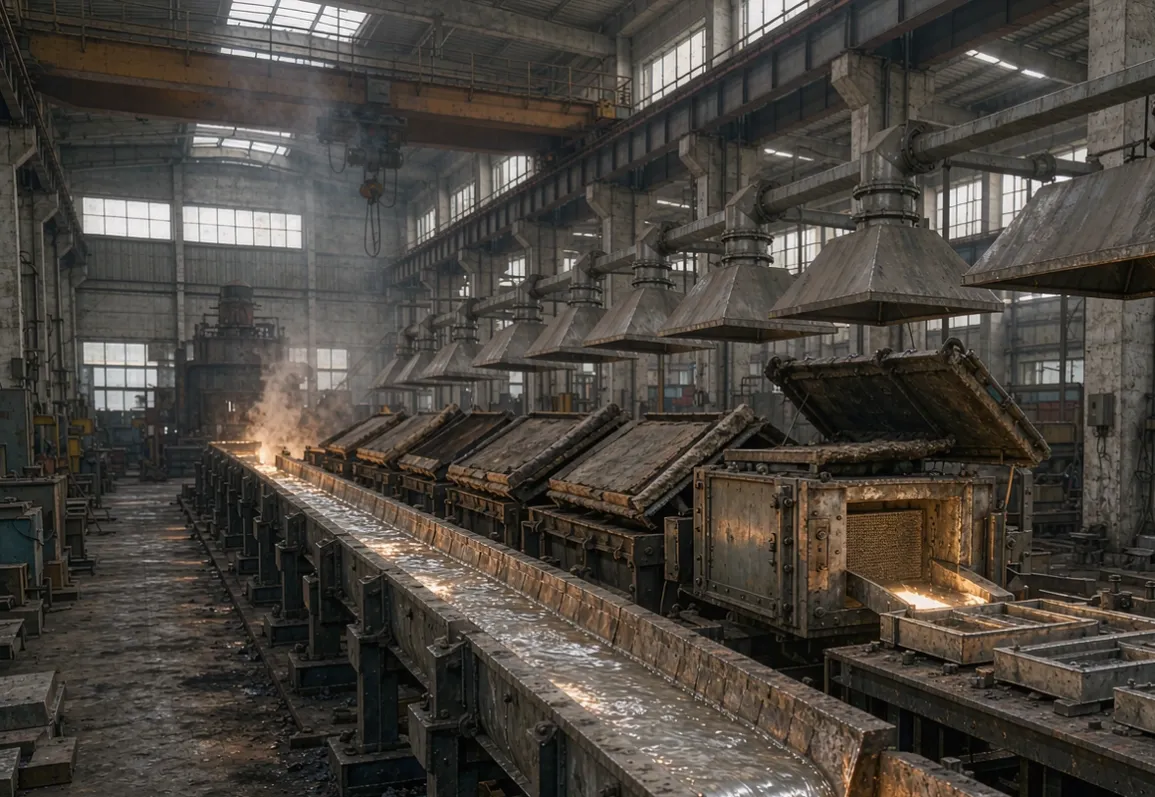
Aluminium runs at roughly half the temperature of steel. The instinct is to treat that as the easy case — lower temperature, easier materials problem, take the same nano insulation board and specify it thinner.
That instinct is wrong in an interesting way. Aluminium is not an easier version of steel. It is a different problem wearing a friendlier number, and the specification mistakes made in aluminium plants are different from the ones made in steel plants. This is what changes.
The number that misleads
Molten aluminium leaves the furnace at 720–760 °C. Steel taps at 1550–1650 °C. On the face of it, aluminium should be a relief: every material limit you worried about at steel temperatures has enormous margin here.
And it does — in one specific sense. A microporous board rated for 1000 °C working in a 750 °C aluminium furnace is nowhere near its ceiling. It will not shrink, it will not lose structure, and its service life is effectively the life of the equipment. That is a genuine advantage, and it is why the application map puts aluminium in the band where the board can be specified on thermal performance alone, with no service-temperature margin to hold back.
But the temperature number tells you what the insulation can survive. It tells you nothing about what the molten metal will do, and that is where aluminium differs.
Three properties of molten aluminium that drive the design
It penetrates
Molten aluminium has low viscosity and low surface tension. It finds brick joints, cracks, and porosity that molten steel would never enter. It wicks. Given a joint and enough time, aluminium goes through a working lining and keeps going until it freezes.
This is the single most important difference from steel, and it changes what the insulation layer is for. In a steel ladle, the back-up layer's job is thermal. In aluminium plant, the back-up layer also sits in the path of metal that may eventually arrive — and a microporous board will not stop molten aluminium. Nothing porous will.
It reacts
Aluminium is a strong reducing agent, and magnesium-bearing alloys are stronger still. Magnesium attacks silica-bearing refractories, reducing SiO₂ and leaving a voluminous reaction product that cracks and spalls the lining from behind. The classic aluminium-plant failure is not wear from the front; it is structural disruption from a chemical reaction happening inside the lining.
The practical consequence for insulation: silica-containing products are a poor choice anywhere they can be reached by alloy vapour or infiltrated metal. This is a materials-compatibility question, not a thermal one, and it is worth raising explicitly on the inquiry rather than assuming the supplier's standard grade is appropriate.
It spends most of its time being held, not melted
This is the one that decides the economics, and it is the reason aluminium is in some ways a better insulation case than steel.
A melting furnace spends a minority of its cycle melting and the majority holding metal at temperature. A holding furnace does nothing but hold. During holding, the furnace is at steady state, and essentially every kilowatt-hour going into it is replacing heat lost through the walls — there is no productive load absorbing it.
Compare that with a steel ladle, where the thermal cycle is dominated by filling, emptying, and the heat stored in the refractory itself. In aluminium, the loss is continuous, steady, and directly proportional to wall conductance.
That makes the return unusually easy to calculate and unusually reliable. There is no campaign-to-campaign variation to argue about, no thermal-mass cycling to confuse the measurement. A holding furnace at steady state losing 2 kW per square metre loses that every hour it is at temperature, which is most hours of the year.
Where the board goes, position by position
Holding furnace walls
The clearest case. Walls see metal-line temperature on the hot face, the board sits on the cold face behind the working lining, and the duty is mild enough that high-strength nano insulation boards run far below their limit.
Where the interface temperature sits below roughly 950 °C — which it should in a well-designed wall — the 1000 °C grade is the right specification and the 1200 °C grade buys nothing. The SLM-1000 vs SLM-1200 comparison guide sets out the boundary and the cost difference either side of it; in aluminium the answer is usually the lower grade, and the saving is real money on a full reline.
Sizing the thickness is the same calculation as anywhere else, and the thickness sizing method applies directly. What differs is the confidence: in a continuous holding furnace the inputs are stable, so the answer is more trustworthy than in a cycling unit.
Melting furnace
Higher gas-side temperature, more thermal cycling, more mechanical abuse from charging. The board still goes on the cold face, still sees a mild temperature, and the same grade logic applies.
The caveat is charging impact. Melting furnaces get charged with solid ingot and scrap, and that load goes into the lining structure. Mechanical anchoring matters more here than in a holding furnace, and the insulation layer needs to be supported in a way that survives it.
Launders and transfer troughs
This is where aluminium differs most from steel, and where insulation earns the most per kilogram.
A launder is a long, shallow refractory channel carrying metal from furnace to caster. It has two properties that make it unusual:
The wall is thin. There is very little room for insulation, because the trough has to fit inside an existing support structure and under an existing cover. You cannot simply add thickness the way you can on a furnace wall.
The loss is mostly from the top. An open launder loses heat by radiation from the metal surface, and that loss dwarfs what goes through the walls. A well-insulated trough under an uncovered metal surface is solving the smaller half of the problem.
So the priority order in a launder is inverted compared with a furnace:
Cover it first. An insulated launder cover typically does more for temperature drop than any realistic amount of wall insulation. If the trough is open, close it.
Then insulate the walls, within the thickness the geometry allows — and here the low thermal conductivity of a microporous board is worth more than anywhere else in the plant, precisely because available thickness is the binding constraint. Ten millimetres of nano board can outperform forty millimetres of a conventional material, and in a launder that difference is the whole design.
This is the position where the value proposition is easiest to sell: not energy saved per year, but temperature drop avoided across a given transfer distance, in a space you cannot enlarge.
Filter boxes and degassing units
Smaller vessels, same logic, tighter geometry. The vessel wall is often the constraint on how much refractory and insulation can be fitted around a fixed internal volume, and again the material with the lowest conductivity per millimetre wins.
These units also get opened and closed far more often than a furnace, which means the insulation sees more thermal cycling and more mechanical disturbance during cleaning. Specify for that: the datasheet guide covers which property lines actually predict performance under cycling, and permanent linear change is the one to read.
Transfer ladles and crucibles
Closest to the steel case — a moving vessel, cyclic duty, insulation on the cold face of the shell. The difference is temperature margin: plenty of it, so the board is not the limiting component and the grade question is usually answered on cost.
The failure mode to design against
In steel, a nano back-up layer fails thermally: too thin, wrong grade, or a preheat that drove moisture out too fast. In aluminium, the dominant failure is mechanical and chemical, and it arrives from the front.
If aluminium infiltrates through the working lining and reaches the insulation, the board is lost regardless of how well it was specified. The defence is not a better board. It is:
Joint design — infiltration follows joints. The joint problem article covers why back-up linings fail at the seams, and in aluminium the seams are the metal's route in as well as the heat's route out.
A working lining chosen for aluminium chemistry, not just for temperature — and specifically, one that is not siliceous where magnesium alloys are involved.
Accepting that the insulation is not a containment layer. It is a thermal layer that happens to sit behind a containment layer. Design the containment to hold, and the insulation to insulate.
There is one useful side effect worth knowing. Because a microporous board produces a steep temperature gradient, infiltrated metal travelling outward cools faster than it would through a more conductive back-up, and freezes sooner. A well-insulated wall pushes the freeze plane closer to the hot face — metal that gets through the working lining solidifies before it travels far. That is not a design strategy, and it should not be relied on, but it is part of why well-insulated aluminium linings often survive infiltration events better than expected.
What to put in the inquiry
Aluminium duty changes the fields that matter on an RFQ:
Alloy range, not just temperature. Magnesium-bearing alloys change the materials-compatibility question for everything in the stack.
Hold time as a fraction of cycle time. This is the number that drives the energy case, and most inquiries omit it.
Available thickness, not desired thickness. In launders and filter boxes the geometry is fixed; say what fits.
Whether the unit is covered. It changes which insulation investment pays.
Cycling frequency for anything opened regularly — it drives which property lines you hold the supplier to.
And on delivery: the incoming inspection routine matters just as much here as anywhere, because microporous board that arrived wet will give up its moisture in the first heat-up regardless of which metal is in the furnace.
Where nano board is the wrong answer in aluminium plant
Being explicit about this, because the board is not universal:
Anywhere it could contact molten metal directly. It is not a containment material and never should be specified as one.
As the hot face of a melting furnace. It goes behind the working lining, always.
Where mechanical abrasion is the dominant wear mechanism — charging areas, skimming zones, trough bottoms subject to cleaning tools.
In contact with aggressive fluxing fumes without a barrier. Fume path design matters more than board selection in those positions.
---
SLM supplies high-strength nano insulation boards for aluminium melting and holding furnaces, launders, filter boxes and transfer ladles. If you are specifying a reline or a new trough, send the geometry, the alloy range and the hold-time fraction, and we will size the back-up layer against the temperature drop you actually need. See the anchored ladle back-up assembly for typical stack build-ups, or reach us at sales@slmthermal.com.