Electric Arc Furnaces Are Water-Cooled by Design: Where Microporous Backup Actually Fits
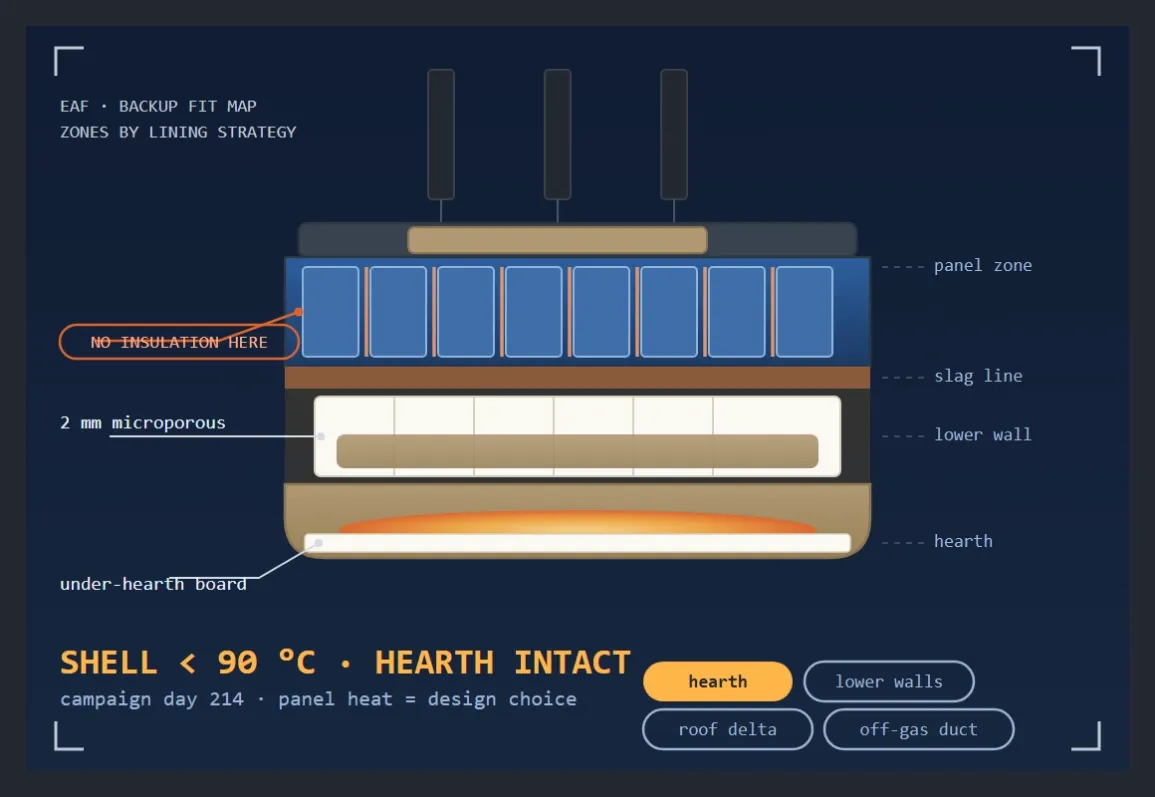
An EAF zone map before any insulation pitch: the upper walls are water-cooled copper panels by design and get no insulation, while the hearth, lower walls, roof delta and off-gas duct are where a micr
The most common bad pitch in refractory sales starts with an electric arc furnace: "your walls radiate heat — insulate them." It misreads the machine. The upper walls of a modern EAF are water-cooled copper panels on purpose, and the heat they carry away is heat the operators chose to remove: it buys slag-line control, panel life and the right to run a hot, aggressive bath at all. Insulating against those panels is not an upgrade; it is a misunderstanding.
But an EAF still has places where a microporous back-up layer earns its thickness honestly — the hearth, the lower walls, the roof delta, and the off-gas system that everyone calls the fourth furnace. This article maps where a back-up board fits in an arc furnace, and — just as important — where it does not.
The zones, and what each one is doing
An EAF divides into thermal zones with opposite jobs, and the lining strategy has to follow the map.
The panel zone (upper walls). Water-cooled copper panels run the upper shell deliberately hot-faced. No insulation goes here. The panels are consumable cooling, protected by slag splashing, and their heat pick-up is part of the design.
The slag line and lower walls. Below the panels, the shell transitions to refractory — and this transition zone is where the campaign is won or lost. A thin microporous layer between the safety lining and the shell keeps the steel temperature in the paint-safe range while adding almost nothing to the wall thickness the door and gantry need.
The hearth. The bottom stack — working lining, permanent lining, then back-up insulation before the shell — is where a board layer changes the maintenance math. Every hearth campaign ends with the pit dug out; how deep the dig goes depends on how much protection the back-up provided.
The roof delta and roof ring. The centre delta sees the arc directly and is usually water-cooled or rammed; the roof ring and elbows around it are conventional refractory — and candidates for a thin back-up layer.
The off-gas system. The duct from the fourth hole runs dust-laden gas well past 1000 C, with dew-point condensation when it cools. Duct walls and elbows take a microporous layer exactly like any furnace duct: cold face control, dew-point management, shell protection.
The hearth arithmetic
A hearth is judged by two numbers the maintenance team actually tracks: shell temperature under the hearth, and how deep the dig is at relining. A microporous back-up layer improves both, and the mechanism is the same one the /posts/nano-insulation-board-thickness-sizing-guide works through for ladles: resistance added where the temperature gradient is steepest buys the biggest temperature drop per millimetre.
Under a hearth, the gradient is steep at the working face and flattens through the permanent lining — which is why the back-up layer belongs directly under it, full-coverage and jointed tight, per the rules in the joint and gap control guide. A hearth is the one place in the furnace where a gap under the lining has nowhere to announce itself on a shell survey until the dig; fit-up discipline is the whole game.
What a board must survive down there
The lower walls and hearth of an EAF do not see the arc directly, but they see the machine's worst mechanical duty: scrape of charge buckets, slag splashing, roof swings, and thermal shocks on every power-off. The back-up board's job list:
Stay dimensionally stable through repeated power-on/power-off cycles, which is a shrinkage specification — the permanent linear change line on the data sheet, checked at the temperature the zone actually reaches.
Be chemically quiet if the working lining opens and slag or melt finds the interface. A fully oxidised, fibre-free board neither reacts into the bath nor feeds fume into the off-gas analysis.
Dry out cleanly on commissioning. A new hearth takes its first power-on hot; the controlled ramp logic of the preheat and dry-out curve applies to the EAF hearth exactly as to a ladle.
For the hot zones above 1200 C — delta centres, duct elbows, door jambs — the grade to specify is SLM-1200; the lower walls and hearth below 1000 C sit in the 1000 C class. The grades exist because those zones genuinely differ.
Verification around water-cooled panels
The IR survey works in an EAF, with one adjustment: the panel zone reads cold by design, so the survey is aimed at the non-cooled zones — lower walls, tap pad, roof ring, duct shell — and taken at consistent rest positions between heats. The method is the performance verification guide; in an arc furnace the hot streaks to watch are at panel edges and around penetrations, where a fitting crosses the insulation plane.
Two procurement habits keep the campaign honest: arrival checks under the incoming inspection protocol (a hearth board with a chipped edge is a gap with a delay on it), and the supplier questions in the supplier audit checklist — batch certificates above all, because the hearth is the last place anyone wants a surprise.
Where the energy case honestly lands
An EAF's power bill is dominated by process: melting scrap is the point. Back-up insulation does not move the melting number much, and pitching it that way will cost credibility with the melt shop. What it moves: shell temperature and shell life under the hearth and lower walls, the stability of the refractory stack between campaigns, the roof ring and duct shell temperatures, and the standing losses of a furnace that idles hot between heats. Those are maintenance-line savings and shell-line savings — real, trackable through the survey file, and they compound over a campaign the same way every other back-up installation does in the ROI model.
For the completed lining build-ups these boards produce, the anchored ladle back-up assembly page shows the assembly in place.
If you run arc furnaces and want a back-up specification for the hearth, lower walls, roof ring or duct — mapped to the zones where it fits rather than the ones it does not — send us the shell geometry and the zones in question.
Questions on grades, hearth stack-ups or duct applications: sales@slmthermal.com