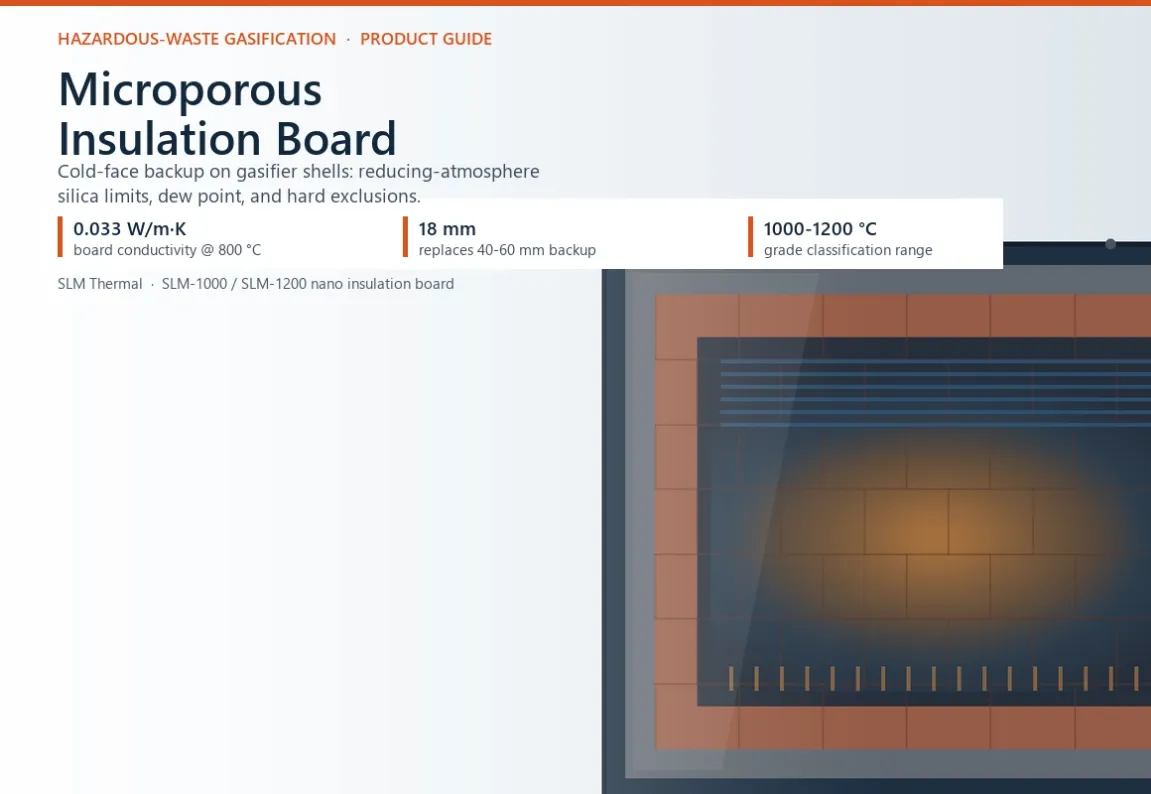
Microporous Insulation Board in Waste-to-Energy Grate Incinerators: Cold-Face Backup on Fixed Walls, Dew-Point Limits, and Where It Must Not Go
A product guide to SLM-1000/1200 microporous insulation board as cold-face backup on fixed walls and roof of waste-to-energy grate incinerators: conductivity at 200-800 C and its high-end data gap, si
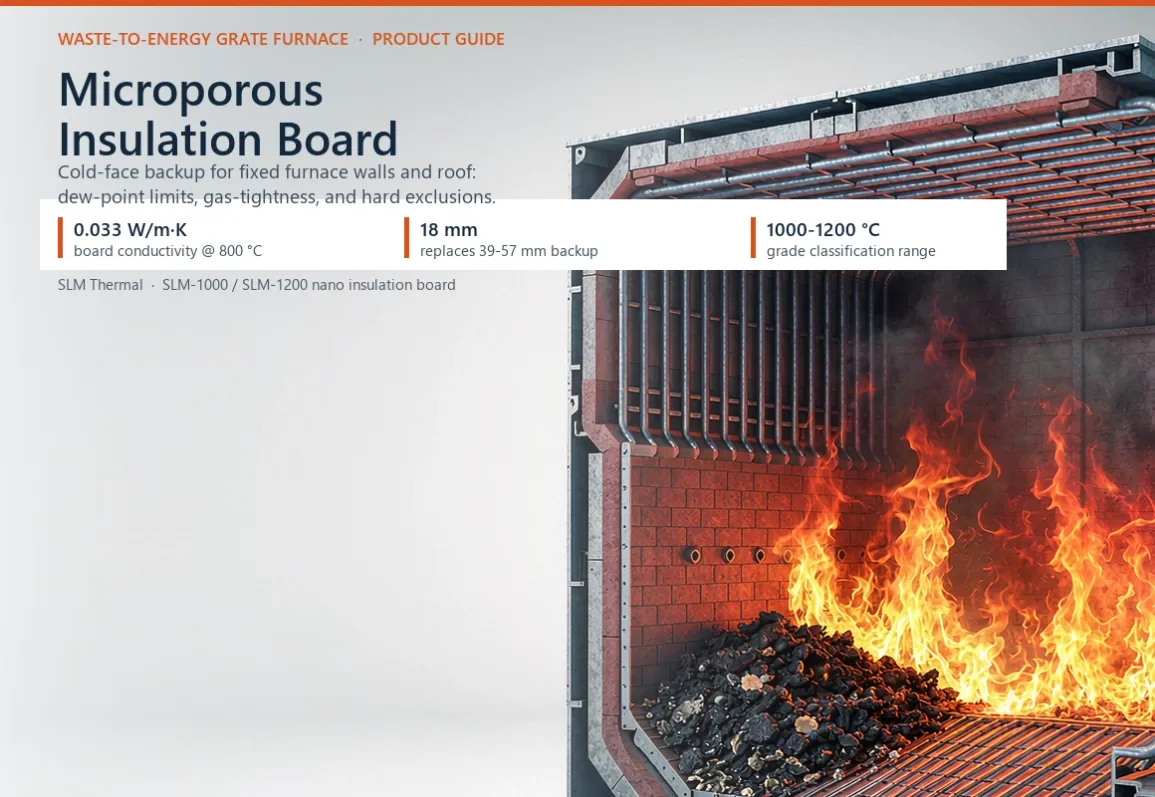
Municipal solid waste burns on a moving grate inside a water-cooled, box-shaped chamber that runs at 850 °C or hotter for at least two seconds — a legal floor in the EU, not a design preference. That puts the fixed sidewalls and roof of a waste-to-energy (WtE) grate furnace squarely in the 800–1,200 °C band where a thin microporous board has a job. The board never lines the grate, takes the flame, or touches the ash. It sits at the cold face of a refractory wall, against the steel casing, and closes the last few hundred watts per square metre of shell loss. This guide covers where the board belongs in a grate furnace, how to size it from the lining interface, what the gas and the dew point do to it, and the places where it is the wrong material.
What the board is, and where it sits in a grate furnace
SLM microporous boards in the 1000 and 1200 grades are rigid silica panels: a fumed-silica matrix with infrared opacifiers and fibre reinforcement, built so most of the pore space is smaller than the mean free path of air. Measured conductivity runs from about 0.022 W/m·K at 200 °C to roughly 0.034–0.044 W/m·K near 800 °C — below still air across that band. Vendor tables generally stop at 800 °C even when the grade is classified to 1,100 or 1,200 °C, so read the high end as a classification, not a measured curve point.
A grate furnace wall is built in courses. A dense working refractory — high-alumina brick, SiC-bearing castable, or a precast block — faces the fire and the fly ash. Behind it a lighter backup course drops most of the temperature. The board is the final thin layer at the cold face, laid against the steel shell and held by studs or the overlying course. It carries almost no load and stores almost no heat, so it trims the shell temperature and shortens heat-up without moving the steel envelope.
The board's value here is thickness. A furnace cell is a box with a fixed outer shell; every millimetre spent on backup is a millimetre unavailable to the chamber or the tube bank. Fibre blanket does the same job but needs two to three times the thickness at an equal shell temperature. That recovered space is the reason to specify a board rather than add another blanket course.
Why a grate furnace puts the board on fixed walls, not on the grate
A grate furnace burns waste on a moving grate at the bottom of a rectangular chamber; the sidewalls and suspended roof above it are static. The EU's incineration rule (Directive 2010/75/EU, Article 50) sets the base line: waste gases must be held at 850 °C for at least two seconds under controlled, uniform conditions, rising to 1,100 °C for hazardous waste with more than 1 % halogenated organics measured as chlorine. Equipment and refractory suppliers place the working zone of a municipal-waste grate at roughly 1,000–1,200 °C, with SiC brick or castable on the grate-side walls. Those numbers describe the fire side, not the board.
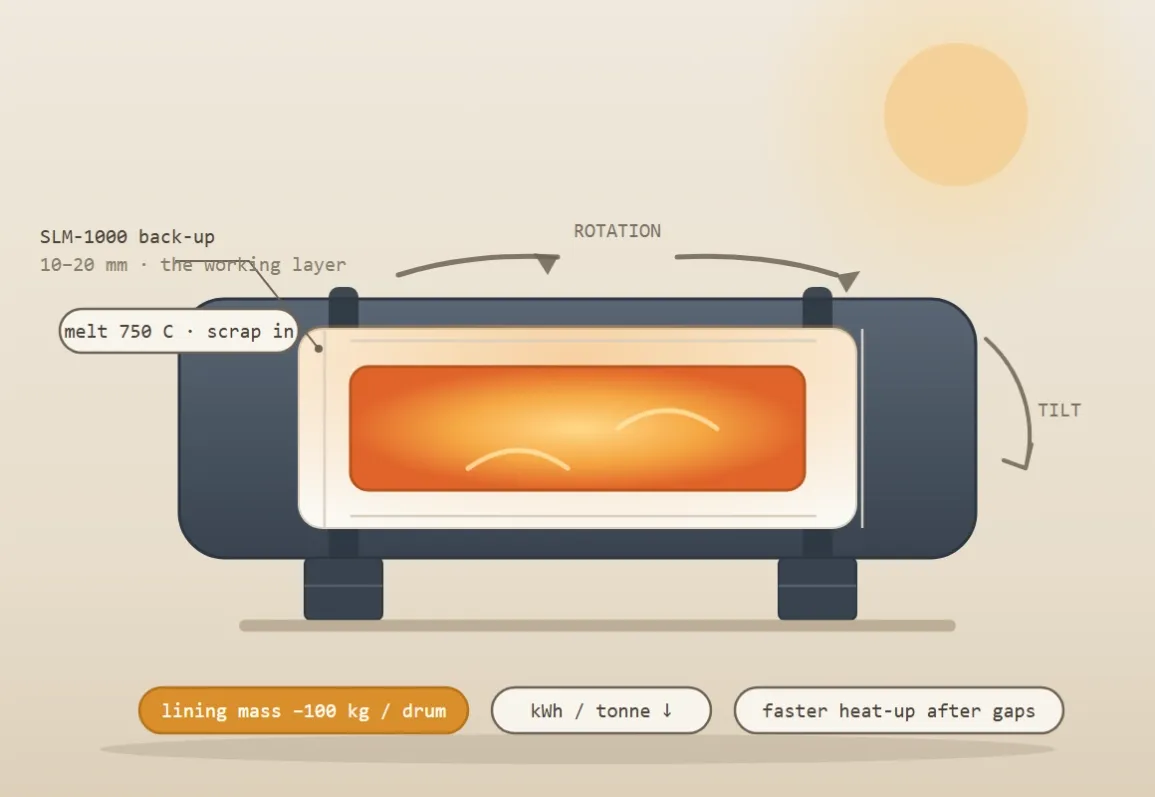
That static geometry is the whole point. On a fixed wall the board can be laid on a flat, rigid course and mechanically retained; its brittle edges are not asked to survive rotation, tumbling burden, or centrifugal movement. This is the sharpest difference from the rotary kiln covered in our companion incinerator discussion: in a rotating drum the cylinder turns a few revolutions per hour, the brick is held by its own geometry, and any rigid board placed inside would be loosened and crushed by the rolling charge and the thermal cycle. The grate furnace gives the board a stationary plane; the rotary kiln does not. A fixed plane is a prerequisite, not a bonus.
The roof deserves the same discipline. A suspended or flat roof can carry the board on a rigid course, retained by the modules above it. It must never be hung as a free span that can sag and crack under its own weight plus the movement of each start-up and shutdown.
Conductivity at the temperatures the board actually sees
The board's hot face is the cold face of the refractory backup, not the 850–1,200 °C chamber. In a typical grate-furnace wall — a dense working layer plus a lighter insulating course — that interface at peak commonly lands near 300–400 °C. At those temperatures the board sits in the flat part of its conductivity curve, where the published figures are most reliable and least sensitive to grade.
Across one-inch and metric vendor data sheets the 200/400/600/800 °C points cluster tightly: roughly 0.022–0.031 W/m·K at 200 °C, 0.025–0.033 at 400 °C, 0.029–0.039 at 600 °C, and 0.035–0.044 at 800 °C. A few older data sheets add single points above 800 °C, but the mainstream international sheets do not, so do not extrapolate a curve to a 1,000 °C interface. Ask the supplier for a measured point at your actual interface temperature, or specify from the grade's continuous-use limit with a margin.
What matters at the interface is stability, not a single number. A board whose classification temperature is close to the interface temperature will be nearer its shrinkage and strength limits, so the grade is chosen from that interface with headroom — a rule that applies equally to the hard-carbon and cathode kilns described elsewhere.
Sizing the layer from the interface, and the dew-point floor
Worked example, steady one-dimensional, illustrative only: board hot face 340 °C, target shell 75 °C, so ΔT ≈ 265 °C. An 18 mm board at a representative 0.035 W/m·K gives R = 0.018 / 0.035 ≈ 0.51 m²·K/W and q ≈ 520 W/m². To pass the same flux you would need roughly 39 mm of calcium silicate (≈0.075 W/m·K) or about 57 mm of ceramic-fibre blanket (≈0.11 W/m·K). The board recovers about 20–40 mm of wall depth for the same shell temperature. This is a conduction comparison only; it excludes radiation and contact resistance in the courses ahead of the board and must be checked against the real build-up. No public, third-party measurement of heat flux or shell temperature on a microporous-backed WtE grate furnace was found, so treat every number here as a physics bound, not a field result.
The shell side carries a lower bound the board cannot fix on its own. Flue gas carries water vapour and acid species; if porous linings let those components reach the steel and the metal falls below the acid dew point, condensate forms on the inside of the casing. Sulphuric-acid dew points are commonly cited in the 120–160 °C range for flue gas, well above the plain-water value, and engineering practice keeps the metal surface roughly 10–20 °C above the expected dew point. Low-load operation and frequent starts and stops are the worst cases because the metal cools repeatedly. Pushing the shell ever lower with more insulation is therefore a trade, not an unqualified gain: the board helps hit the target, but the working lining, casing seals, and operating profile have to keep the metal above condensation. The structural upper limit — commonly taken near 400 °C for carbon steel — forms the other end of the window.
Selecting the 1000 or 1200 grade
Grade from the board hot face. Where the refractory cold face stays at or below about 1,000 °C at peak, the 1000 grade is sufficient. Where the backup interface can reach 1,000–1,200 °C — for instance next to the peak combustion zone with a thinner working course — specify the 1200 grade. Most grate-furnace walls run the interface well below 1,000 °C, so the 1000 grade is the common call, with the 1200 grade reserved for the hotter zones. The continuous-use rating of the board, never the chamber peak, is the line not to cross.
Alkali and chlorine: a real cold-face mechanism, without board-level numbers
Municipal waste brings sodium and potassium salts, PVC-derived chlorine, and fly ash into the chamber. The refractory literature describes the mechanism plainly: volatile Na₂O and K₂O penetrate the porous lining and condense in the cooler zone set by the temperature gradient, where they react with silica to form low-temperature silicates; the reaction products expand and can spall the host material. Fly-ash calcium adds further low-melting phases. This is a normal feature of the fuel, not an upset condition.
That puts the board's position in focus. It sits in the coldest part of the wall — exactly where a vapour that has crossed the working lining would find a place to condense. Fumed silica is attacked by alkali; the underlying chemistry of alkali–silica reaction and volume expansion is documented for dense silica refractories. What is missing is the board-specific evidence: no long-term, quantitative compatibility study of fumed-silica microporous board against Na/K vapour or HCl at WtE cold-face temperatures was located. The honest conclusion is that the risk is mechanistically plausible and unmeasured on this product, so the working lining and its seals must stay gas-tight, and an ash-rich or high-chloride feed calls for a barrier course between the refractory and the board. Treat this as a design precaution, not a proven failure mode.
Water, hydrophobic treatment, and what it does not buy
Liquid water irreversibly collapses the nanoporous structure of a fumed-silica board: the pores densify and conductivity rises permanently. The same is true of oil and other wetting liquids. Manufacturers are explicit that boards must be kept dry in transit, in storage and during installation, and protected until the wall is closed.
Hydrophobic grades help with short-term wetting, but their limit is often misread. The water-repellent treatment in commercial boards is rated to roughly 250 °C continuously (Morgan's hydrophobic data and ASTM C1676 Grade 2B agree on the ceiling), after which the treatment degrades and the board behaves like the standard grade. That makes hydrophobicity a storage, handling and cold-face-condensation measure — not a hot-face feature and not a licence to let condensate sit on the panel. In a grate furnace the cold-face interface may run above that ceiling during operation, so the real protection is a sealed casing, a vapour-barrier facing where condensation is credible, and a dry shutdown procedure.
Anchoring, joints and shutdown practice
Microporous board compressive strength is on the order of 0.1–0.4 MPa for most grades — a small fraction of a firebrick's. Its edges chip if unsupported. Lay it on a flat, rigid bed and retain it with studs or the overlying course; never ask it to bridge a gap or carry the weight of the lining above. At the joints, keep gaps tight and stagger them between courses so no straight path cuts through the backup.
A waste-to-energy unit is not a continuous kiln. Load changes, weekend turndown and annual outages move the wall repeatedly, and the fixings must tolerate that travel without ratcheting against a brittle board edge. Inspect the fasteners and the joints at each outage rather than assuming a board installed five years ago is still seated. Most field damage happens in the last few metres to the wall — during handling, not in transit — so corner guards and a dry, covered staging area matter more than a faster crew.
Receiving the boards and verifying the batch
Check delivered boards against the order on grade, thickness, facing and dimensions, and take a conductivity or density reading at incoming inspection. Reject crushed corners, delamination and torn facings: once the wall is closed those defects become permanent thermal shortcuts and cannot be repaired in place. Record the batch and the measured values so a shell hot-spot years later can be traced to a delivery. Store boards flat, off the floor, away from heavy material, and keep the wrapping on until the moment of installation.
What the published evidence actually supports
The application evidence for microporous board in incineration is thinner than the marketing suggests. Of the major international data sheets reviewed, one composite board sheet lists "Incineration" among power-generation applications and one lists "Various Incinerator" generically; a Chinese producer shows grate-furnace project photographs with its SH550 board. No first-party data sheet reviewed explicitly names grate furnace, municipal solid waste, or WtE boiler, and the project photographs carry no shell-temperature, heat-flux or thickness-substitution figures.
The savings numbers that circulate for incineration and cement — lower shell by 20–70 °C, heat loss down 30 %, one thin board replacing a much thicker calcium-silicate course — are supplier or distributor calculations, typically without stated measurement points, duty boundaries, instrumentation or a control case. Independent measurement on a WtE grate furnace was not found: the nearest academic work concerns thermal protection of instrumentation probes, not wall heat loss. If a bid depends on a saving, arrange your own trial with shell thermocouples, a heat-flux meter and a fuel baseline on an identical unit.
Where the board is not the answer
Not the hot face. It never sees flame, grate contact, flying ash or the direct furnace atmosphere. The working refractory does that job.
Not on the grate, at the feed opening, or at the ash discharge. These zones take moving waste, impact and molten-ash attack and need dense SiC or Si₃N₄-SiC. At roughly 0.1–0.4 MPa the board cannot carry load or survive a knock.
Not on water-cooled surfaces or in the first boiler pass. There the lining must pass heat into the tubes; a low-conductivity board works against the duty. Those surfaces use higher-conductivity SiC castables instead.
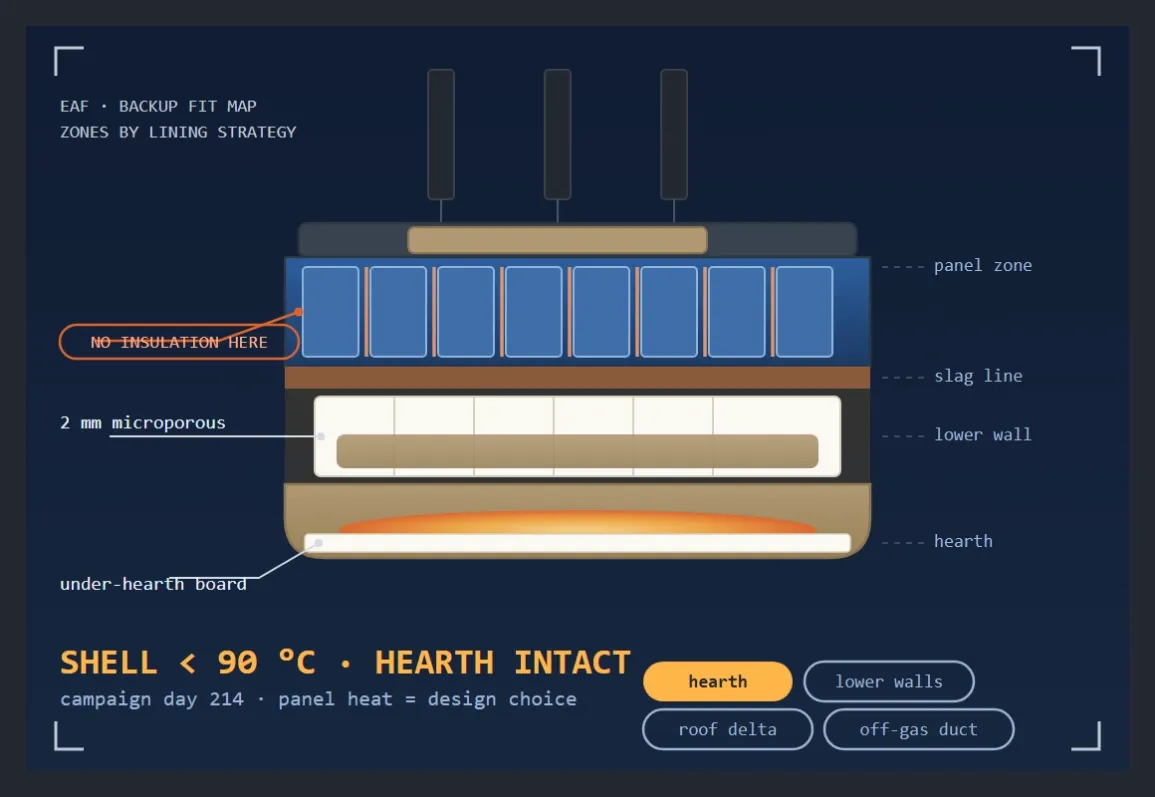
Not inside a rotating kiln shell. A rotary kiln's cylinder turns and tumbles its charge; a rigid board cannot be that working lining. This is a motion and geometry failure, distinct from the impact and heat-transfer exclusions above.
Not a barrier to alkali or chlorine by itself. The condensation mechanism is documented for silica-based refractories, but no board-level long-term data exists. Keep the working lining gas-tight and add a barrier course for ash-rich or high-chloride waste.
Not a waterproof layer. Liquid water destroys the pore structure permanently; the hydrophobic grade only survives to around 250 °C and does not tolerate standing condensate indefinitely.
Not a fix for a shell running below the acid dew point. Extra insulation can push metal into condensation during low load. Keep the shell between the dew-point floor and the steel's upper limit.
Not a lever on dioxin formation — a common misreading. PCDD/F de novo synthesis happens on fly-ash surfaces in the post-combustion gas path, mainly around 200–400 °C, and is controlled by how fast the gas is quenched; the EU BAT conclusion requires cooling flue gas from above 400 °C to below 250 °C before particulate collection. The furnace shell is not that surface, and a well-insulated shell normally sits below it. No source found links wall backup thickness, board selection or shell temperature to dioxin formation; the lever is quench rate in the heat-recovery train.
Frequently asked questions
Can the board line the grate or the hopper? No. Those take abrasion, impact and ash contact and need dense SiC-based refractories. The board is a cold-face backup on the fixed walls and roof only.
Why is a grate furnace a better home for the board than a rotary kiln? The walls and roof are stationary, so the board can sit on a flat rigid course and be mechanically retained. A rotary kiln's turning cylinder and tumbling burden make a rigid board impractical as the working lining.
1000 or 1200 grade for an 850 °C chamber? Size from the board hot face, not the chamber. If the refractory cold face stays below ~1,000 °C, use the 1000 grade; if the backup interface reaches 1,000–1,200 °C, use the 1200 grade.
Does the board solve low-load condensation? No. It lowers shell temperature, which can make condensation more likely. The metal must stay above the acid dew point; manage that with the lining, seals and operating profile, not by adding board.
Does alkali in the waste attack the panel? The mechanism exists and favours cold surfaces, but no board-specific long-term study was found. Keep the working lining gas-tight and use a barrier course for high-alkali or high-chloride feed.
How much wall depth does it save? In the example above, 18 mm of board replaces roughly 39 mm of calcium silicate or 57 mm of fibre blanket at the same shell temperature — about 20–40 mm recovered, before any radiation or contact-resistance effects.
Bottom line
In a waste-to-energy grate furnace, the microporous board is a cold-face backup for the fixed sidewalls and roof: thin, low-mass, graded from the refractory interface temperature. It is not the hot face, not a grate or ash-discharge material, not waterproof, and not supported by third-party furnace measurements. Its real constraints are mechanical exposure, gas-tightness against alkali and chlorine, and the dew-point floor on the shell. Size it from the interface, keep it behind a dense working lining, hold the shell between condensation and the steel limit, and confirm any energy saving on your own unit. A post-mortem on returned boards after an outage is the fastest way to learn what your furnace actually asks of the material.
For the wider picture across furnace types, start with our application map and how the board is manufactured; read the datasheet guide and the SLM-1000 and SLM-1200 comparison, then the tunnel kiln guide and the thickness-sizing method. For field reality, see the failure analysis, the roller kiln guide and the cathode kiln guide; the installation guide, joint-gap control and incoming QC checklist cover putting it in well, and the high-strength nano insulation boards product page and the RFQ template close the loop on supply.