Tunnel Kilns Burn 30-40% of Their Fuel Through the Structure: Where a Microporous Backup Board Quiets the Roof, the Cars, and the Doors
A tunnel kiln is a 60-150 m continuous thermal machine where product rides kiln cars from a preheat zone through a firing zone that peaks near 1,260-1,320 C and into cooling — and because it never sto
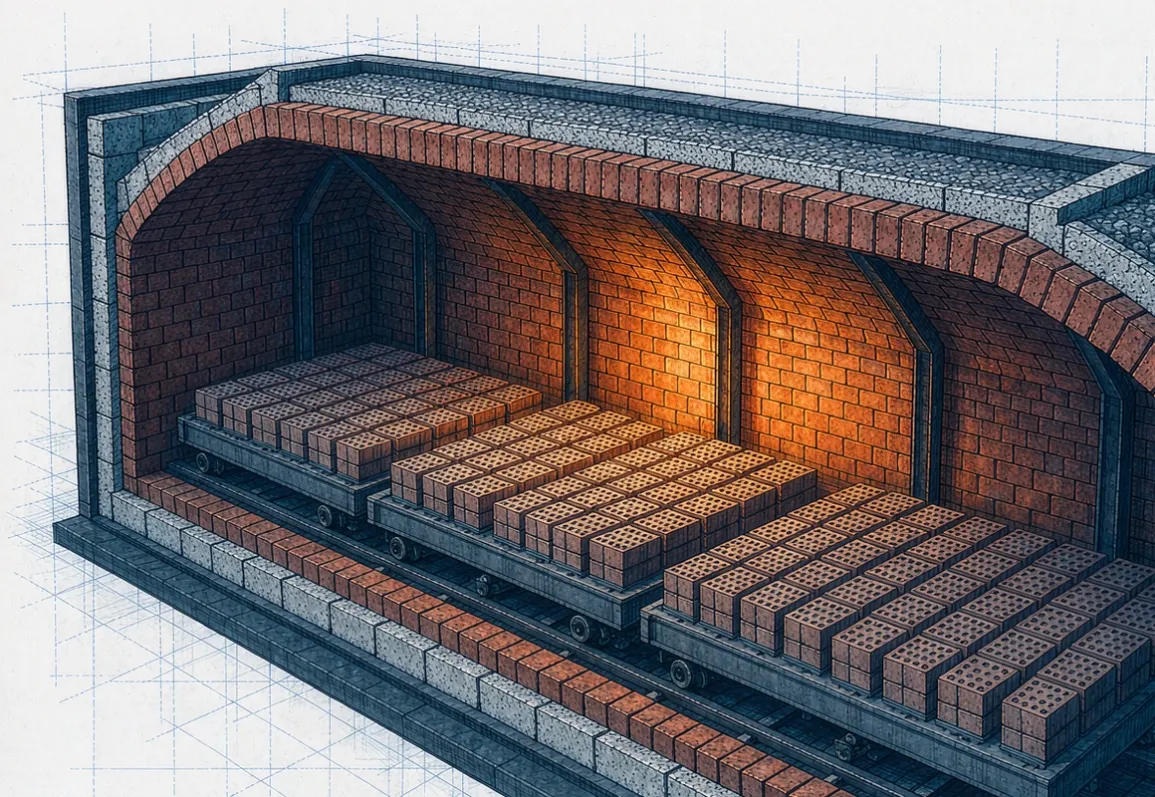
A tunnel kiln is a 60-150 m continuous thermal machine: product rides kiln cars from a preheat zone, through a firing zone that peaks near 1,260-1,320 °C, into a rapid-cool and final-cool zone, and out the far end. Because it never stops, the heat it loses through the shell, the roof, the kiln cars, and the doors is a fixed annual cost, not a one-off event. Field data puts that structural loss at 30-40% of the heat fired — in many lines more than the product itself absorbs — and the roof is the single largest path. This guide maps the real zone temperatures, the heat-loss ledger, why a tunnel kiln is a different insulation job than a batch furnace, the conductivity of a microporous backup board at 600-1,300 °C against ceramic fibre and insulating firebrick, the 1,000 °C vs 1,200 °C class choice by zone, a thickness-sizing method, and the mistakes that quietly raise your gas bill.
The zone map: where the heat actually is
A tunnel kiln runs in four bands, each at a different temperature and each demanding a different lining. The numbers below are real operating values reported across ceramic, brick, and refractory kilns. The body itself is typically 60-150 m long, 2-3 m internal width, 1.5-2.5 m internal height, and the preheat zone alone is 30-40% of that length.
| Zone | Operating temperature | Backup-layer interface (typical) | What the lining fights | |---|---|---|---| | Preheat | 200-850 °C (up to ~1,000 °C at the top end) | 600-900 °C | Thermal shock, uniform heat-up, flux-vapour condensation, suspended dust | | Firing / soak | 850-1,320 °C; soak 1,200-1,400 °C | 900-1,100 °C | Hot-face erosion, glaze/flux vapour, steady radiant load | | Rapid cool | 1,320 → 750 °C | 700-950 °C (cold face of wall) | Controlled cooling, thermal cycling, crystal growth control | | Final cool | 400 → 80 °C | ≤600 °C | Shell stress, workshop environment |
Peak firing temperature is commonly around 1,260 °C but varies by product, curve, and soak time; high-fire lines (technical ceramics, some refractories) reach 1,400 °C at the soak. The dominant design fact for the insulation spec: the firing-zone backup interface sits at 900-1,100 °C, which is exactly where the 1,000 °C vs 1,200 °C class decision gets made. Preheat-zone wall backups run cooler at 600-900 °C, and the final-cool and door zones sit at or below 600 °C.
The heat-loss ledger: 30-40% leaves through the structure
Four losses make up a tunnel kiln's heat bill. The first is structural and steady; the last two are unique to continuous, car-fed kilns and are easy to overlook.
Kiln-body surface radiation. A kiln body is tens to hundreds of metres long with a huge shell area. Even with insulation, 800-1,400 °C conducts and radiates out through the wall. The roof is the largest single path because it is hard to thicken and carries the most exposed surface per metre of length.
Kiln-door and gap leakage. Charging and discharging doors open for cars; segmented joints, view ports, and thermocouple holes age and leak hot gas. This is "structural leakage," and it pulls cold air in, disturbing the curve and the atmosphere.
Wasted cooling-zone residual heat. Cold air enters the cooling zone to harden the ware and leaves as hot air. Without a recuperator — to preheat combustion air, dry green bodies, or heat the shop — that heat is dumped outdoors.
Kiln-car and furniture heat absorption. The unique "mobile loss." Cars and kiln furniture soak up heat, then bleed it into the shop as they exit and stand. Under-car temperatures reach 300 °C, which also cooks the bearings and causes frequent failures.
Published figures anchor the scale: a continuously run brick line loses 30-40% of its heat into the kiln structure; national standards cap shell temperature rise at ≤15 °C on walls and ≤25 °C on the roof (above a 25 °C ambient); and adding proper wall and roof backup can cut energy by more than 50 kcal per kg of fired product versus an uninsulated wall. For a 4.6 m-wide kiln, the insulation upgrade runs about RMB 100,000-120,000 — usually paid back in fuel savings well inside a year.
The takeaway for a buyer: in a tunnel kiln you are not fighting a one-time heat event, you are fighting a permanent, always-on heat leak, and the roof, the cars, and the doors are where the money goes. The application map puts this in the context of the other high-temperature plants we cover.
Why a tunnel kiln is not a batch furnace
The other guides in this series cover ladles, reheating furnaces, coke ovens, glass furnaces, cement kilns, and hot blast stoves. A tunnel kiln shares the temperature range but differs in three ways that change the insulation specification.
Steady state, not cycles. A batch furnace heats and cools; a tunnel kiln holds its profile 24/7. That means the backup layer is always loaded, so its conductivity at 800-1,200 °C matters every hour, not just at peak. A material that is merely "acceptable" at 600 °C but climbs fast above 800 °C will cost you all year.
A moving heat sink. Kiln cars and furniture are refractory mass that enters cold and leaves hot. No stationary lining decision fixes this; you address it with lightweight car linings and edge sealing, and with a thin microporous board in the space-limited door and car-edge zones.
Roof-dominated loss. Wall thickness is easy to add; roof thickness is not, because of hanger load and structural limits. The highest-leverage upgrade is often a low-conductivity backing layer on the crown, where shell temperature runs hottest.
For the same "duty layer versus insulation layer" principle applied to a different continuous plant, the hot blast stove guide shows how a blast-furnace stove separates the 1,300 °C dome from a cool shell with the same layered logic.
What the backup layer does — and why microporous
The lining is built in layers so one material does not have to do everything at once.
Hot-face (duty) layer: dense high-alumina, mullite, or silicon-carbide brick and castable. It carries load, abrasion, and chemical attack. It is also a good conductor — which is precisely the problem at the hot face.
Backup (insulation) layer: lightweight insulating firebrick (IFB) or ceramic-fibre blanket and modules. It drops the temperature toward the shell and reduces heat storage.
High-efficiency backing (where needed): a thin microporous board added behind the backup in hot-spot areas where the shell temperature will not come down with fibre alone.
The reason to add a microporous board specifically is its conductivity at the temperatures a tunnel-kiln backup actually sees. Ceramic-fibre modules are rated ≤0.195 W/m·K at a 600 °C mean; IFB sits around k < 0.3 W/m·K at 600 °C; calcium-silicate board is heavier and climbs faster with temperature. A microporous board runs roughly 0.034 W/m·K at 800 °C — an order of magnitude below fibre at the same temperature — because nano-pores suppress both gas convection inside the material and high-temperature radiation across the pores. Compare the products directly in the SLM-1000 vs SLM-1200 comparison guide and the high-strength nano insulation boards data sheet notes.
The practical win is geometry, not just numbers. In a roof or wall where you cannot add another 100 mm of fibre without overloading the steel or the hangers, a 20-30 mm microporous board buys back the same shell-temperature drop that 80-100 mm of fibre would. That frees internal cross-section — more ware per car — and cuts the roof's steady radiation. In door frames, car edges, and roller openings, the thin flexible board fits where thick fibre physically cannot.
Conductivity at the temperatures a tunnel kiln backup sees
The "use temperature" on a data sheet is not the number that sets your shell temperature — the backup interface does. Here is the realistic comparison at the temperatures a tunnel-kiln backup actually operates.
| Material | ~600 °C | ~800 °C | ~1,000 °C | ~1,200 °C | |---|---|---|---|---| | Microporous board (1000 °C class) | ~0.024 W/m·K | ~0.034 W/m·K | ~0.045 W/m·K | — (use 1200 °C class) | | Ceramic-fibre module | ≤0.195 W/m·K | ~0.25 W/m·K | ~0.32 W/m·K | ~0.40 W/m·K | | Insulating firebrick (IFB) | <0.30 W/m·K | ~0.38 W/m·K | ~0.50 W/m·K | ~0.62 W/m·K | | Calcium-silicate board | ~0.13 W/m·K | ~0.17 W/m·K | ~0.22 W/m·K | ~0.28 W/m·K |
The gap is widest exactly where tunnel kilns live: above 800 °C, the microporous board stays near 0.034-0.045 W/m·K while fibre and IFB climb past 0.3-0.5 W/m·K. That is why, in a firing-zone roof, a thin microporous backing holds the shell down where 100 mm of fibre would not. The datasheet guide explains how to read classification temperature versus continuous-use temperature so you do not over-spec or under-spec, and the thickness sizing method turns an interface temperature into a board thickness.
Class choice by zone: 1,000 °C vs 1,200 °C
| Zone | Board class | Why | |---|---|---| | Firing / soak backup | 1,200 °C class | Interface 900-1,100 °C; needs the 100-200 °C margin over a 1,000 °C board | | Preheat, upper end | 1,000 °C class (1,200 °C where it runs hot) | Interface 600-900 °C; 1,000 °C board has margin | | Preheat, lower end | 1,000 °C class | Interface 400-700 °C | | Rapid-cool wall cold face | 1,000 °C class | 700-950 °C interface; margin holds | | Final-cool / door / car edge | 1,000 °C class, foil-encapsulated | ≤600 °C; thin board in space-limited, dusty, abraded zones |
The cement-kiln and glass-furnace lines covered in the cement kiln guide and the glass-furnace article use the same class logic, but a tunnel kiln is more roof-weighted and more car-weighted, so the seal and the crown get more of the budget than they would in a static furnace.
Sizing the backup: a worked method
Measure first. Infrared-map the shell, find hot spots, and read the zone curve (set versus actual). You cannot size what you have not measured — see the performance verification notes on on-site checks and how to separate a true lining defect from a sealing leak.
Set the shell target. Aim for wall rise ≤15 °C and roof rise ≤25 °C above a 25 °C ambient (the cited national limits). Hot spots above that are your upgrade list.
Pick the class from the zone table above.
Compute thickness from the board's conductivity at the interface temperature and the allowed heat flux. Where you cannot thicken the fibre, insert a thin microporous board to hit the target without adding mass or overloading hangers.
Seal the path, not just the wall. Door inflatable seals, kiln-car edge seals, and expansion-joint fibre packing cut the leakage losses that a thicker wall cannot fix. The joint-gap control guide covers seam sealing and why a 2 mm joint at 1,000 °C leaks more than people expect.
A numerical sketch: if a firing-zone wall currently runs a shell rise of 40 °C (roof limit is 25 °C) and you cannot add fibre, a 25 mm microporous backing at the backup interface lowers the effective conductivity enough to pull the rise back under the limit — while freeing roughly 75 mm of internal diameter that was previously taken by fibre. That diameter is ware you can now fire per car, every cycle, forever.
Mistakes that quietly raise the gas bill
Insulating the wall but forgetting the roof. The roof is the biggest loss path; a wall-only upgrade leaves the worst leak open and the shell stays hot.
Using heavy backup where thin is required. Car edges, door frames, and roller openings are space-limited; forcing thick fibre there blocks the car or the door. A thin flexible microporous board fits and still performs.
Ignoring the kiln car. Under-car temperatures of 300 °C are routine; without lightweight car linings and a two-stage edge seal, you lose heat and burn bearings on a schedule.
Buying on classification temperature alone. A board rated "1,200 °C" can still have poor continuous-use behaviour if its permanent-linear-change and compressive strength are wrong for the position. Match the material to its lining position, not its headline number.
Skipping the dust and abrasion check. Tunnel-kiln atmospheres carry flux vapour and suspended dust; in the firing and soak zone the microporous board must be protected by the duty layer and, where exposed, foil-encapsulated.
Treating the board as the hot face. Microporous board is a backing material. Put dense brick or castable on the hot side; the board belongs behind it, not in the flame.
On receiving material, run the storage and cutting guide so the board is not chipped or saturated before it is laid, and keep the supplier audit checklist handy to confirm third-party test reports rather than self-declared numbers.
What to measure before you quote
Before issuing an RFQ, capture: the zone curve (set versus actual per zone), the shell infrared map with hot-spot locations, the current lining build-up (hot-face plus backup thickness and material), the kiln-car under-car temperature, and the door and seal condition. Those five items turn a vague "make it more efficient" into a comparable specification you can send to more than one source. The RFQ template formats that specification so vendors quote the same scope.
FAQ
Can a microporous board replace the ceramic-fibre module in a tunnel-kiln roof? Usually not as the primary hot-face. The roof still needs the fibre or IFB for thickness and hanger compatibility. The board is added as a thin backing layer where the shell runs hot, or in space-limited zones. It complements fibre; it does not replace it.
Is 1,000 °C class enough for the firing zone? The firing-zone hot face runs 1,200-1,400 °C, but the backup interface is 900-1,100 °C. At that interface a 1,000 °C board has only a thin margin, so the firing and soak backup should be 1,200 °C class; reserve 1,000 °C class for preheat, cool, and door and edge zones.
How much can roof backing actually save? It depends on the starting shell temperature, but the cited field data shows structure-level upgrades cut energy by more than 50 kcal per kg of fired product versus uninsulated, and the shell-rise limits (≤15 / ≤25 °C) are the design target. Validate against your own line's base load and firing curve.
Does the board handle the kiln-car vibration? In the wall and roof it is static. Only at car edges and doors does it see motion, and there it should be foil-encapsulated and mechanically protected. The duty layer, not the board, takes the load everywhere else.
Which standard governs the refractory build-up? Chinese lines reference GB/T 2992.1 and GB/T 16544 for dimensional tolerance, and GB/T 3995 and GB/T 10325 for physical and chemical properties; international supply is usually quoted to ISO or ASTM equivalents. Confirm the acceptance basis before the lining is laid.
The short version
A tunnel kiln wastes 30-40% of its heat through the structure — roof first, then cars and doors — and because it runs nonstop, that leak is a fixed annual cost. A thin microporous backup board, 1,200 °C class at the firing and soak zone and 1,000 °C class everywhere the interface stays below 1,000 °C, drops the shell temperature, frees internal diameter, and pays for itself in fuel — provided the roof is addressed, the cars are sealed, and the board is protected from dust. For the same board behind a different hot face, the anchored back-up assembly case notes show the worked build-up.