Oct 28, 2026
Cement Kiln Shells Radiate 10-15% of Fuel: Why the Backup Board Faces Alkali Dust, Not Just Heat
A 5,000 tpd dry cement line loses 10-15% of its fuel straight through the steel kiln shell (40-60 kg coal-equivalent per tonne of clinker), yet the insulation job in cement is defined less by heat tha
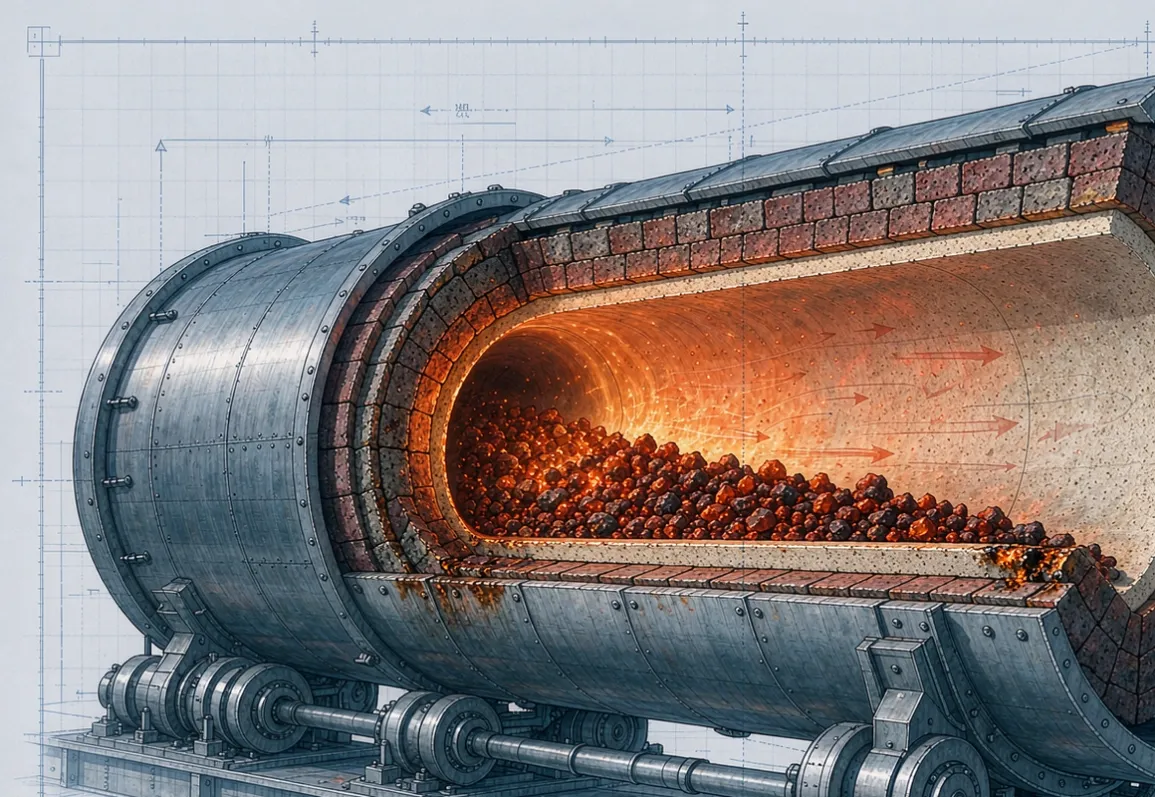
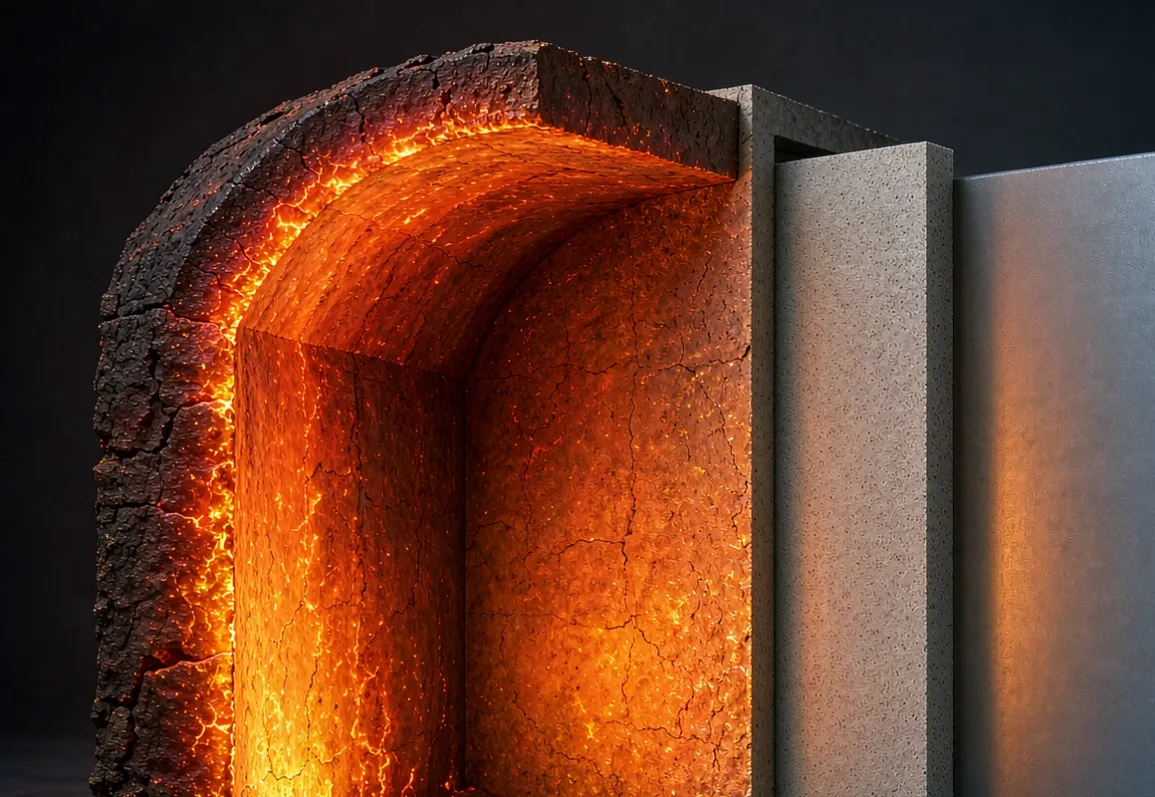
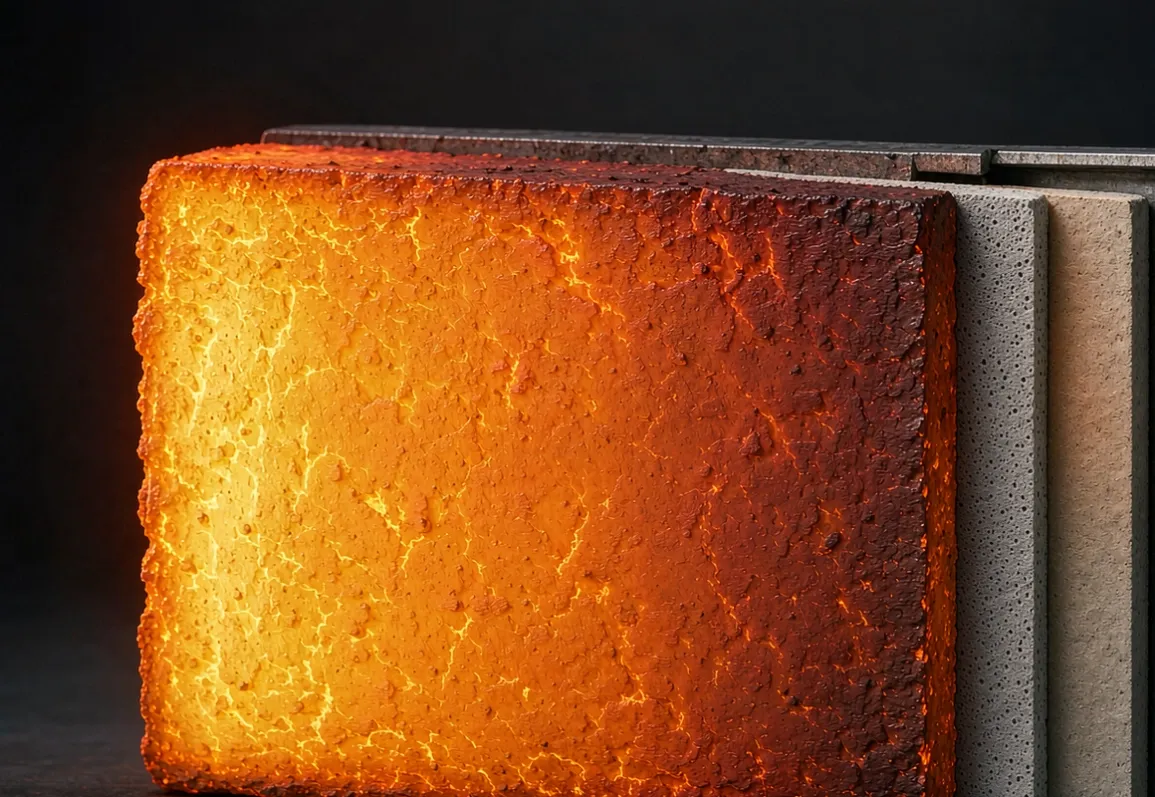
A 5,000 tpd dry-process cement line burns roughly 3,000-3,500 MJ of thermal energy per tonne of clinker, and 10-15% of that energy escapes straight through the steel kiln shell. On that size of line, an uninsulated shell throws away 40-60 kg of coal-equivalent per tonne of clinker — heat that did nothing but warm the surrounding air and accelerate corrosion of the very shell it left behind. The fix is not exotic: a thin microporous backup board behind the refractory working lining. But cement is a harder insulation job than steel, and the reason has nothing to do with temperature alone.
This guide maps the real temperatures by kiln zone, the heat-loss ledger from measured plants, why the backup board in a cement kiln fights alkali/sulfur circulation and by-pass dust rather than just radiant heat, the conductivity of a microporous board at 800-1100 °C against calcium silicate and ceramic fibre, how to choose between the 1000 °C and 1200 °C classes by zone, a step-by-step thickness method, and the installation detail that prevents a cement-specific failure: alkali dust jacking the lining off the shell.
The heat-loss ledger: what an uninsulated shell actually costs
The numbers below come from cement-equipment references and insulation-supplier project data; treat them as order-of-magnitude, not a guarantee for any specific line.
A 5,000 tpd dry line loses 10-15% of total energy input through the kiln shell (cement-equipment.org process references; Mingfa project data).
That equates to 40-60 kg of coal-equivalent lost per tonne of clinker (Mingfa cement-industry page).
Uninsulated burning-zone shell temperatures run 250-350 °C; transition and preheater zones 180-280 °C (Mingfa).
Carbon steel oxidizes at an accelerated rate above 250 °C. Uninsulated shells show oxidation of 0.5-1.5 mm per year, plus distortion from uneven thermal expansion that shortens refractory life and increases kiln ovality (Mingfa; cement-equipment refractory guide).
The temperature gradient across bare brick — 1,400 °C hot face to ~300 °C cold face — induces spalling stress that can cut brick campaign life by 20-30% (Mingfa).
A measured retrofit on a Shandong cement kiln (Mingfa LG-High-Temperature board, rated 1,100 °C) delivered a verified 12.7% fuel reduction; a Turkish lime kiln reached 15.3%. A Saudi cement plant combining backup insulation across multiple zones exceeded $600,000/year in combined savings (Mingfa project data). These are vendor-reported figures and should be validated against your own line's base load.
To make the scale concrete, a 3,000 t/day line burns roughly 12,000-22,500 tonnes of coal-equivalent per year; at a 300 °C shell, each square metre of surface loses about 3,000 W continuously, or over 26,000 kWh per year. A 4 m diameter × 60 m long kiln presents about 750 m² of shell, so the annual heat loss through that shell alone can reach ~19,500,000 kWh (Mingfa insulation-economics analysis). Pulling the shell from 300 °C down to 65-80 °C with a 50 mm backup layer cuts that loss by 75-85% — which is why the IEA flags kiln insulation as the highest-return efficiency measure available to heavy industry, with simple payback of 6-18 months for equipment running above 800 °C.
Zone-by-zone: the temperatures the backup board actually sees
The backup board never touches the process. It sits on the cold face of the refractory, so what matters is the temperature at the brick/board interface — not the 1,450 °C burning-zone hot face. Here is the working range by zone:
| Zone | Hot-face (process) temp | Brick/board interface temp | Backup board job | |---|---|---|---| | Burning zone | 1,400-1,500 °C | 900-1,100 °C (can approach/exceed 1,000 °C) | Keep shell ≤250 °C, protect MgO-spinel brick | | Transition / upper transition | ~1,200-1,400 °C | 700-950 °C | Cut gradient, stabilize coating | | Preheater (lower stages) | 800-900 °C | 500-750 °C | Insulate riser & cyclone, resist alkali | | Calciner | 850-980 °C (1,600-1,800 °F) | 600-850 °C | Insulate walls, resist alkali/sulfur | | Kiln hood / cooler | 1,000-1,200 °C (clinker) | 600-900 °C | Withstand abrasion + dust | | Tertiary air duct | 900-1,050 °C | 600-850 °C | High-velocity dust erosion |
Sources: ITC Coatings (burning zone >2,600 °F / ~1,427 °C process; coating protects transition + upper burning zone); cement-equipment.org (calciner walls 1,600-1,800 °F; alkali condensation window 750-1,100 °C); METHERM M 1100 note (cement rotary kiln backup exposed to 900-1,100 °C at the brick/board interface, recommends the 1,100 °C grade when interface approaches/exceeds 1,000 °C).
Two things stand out. First, the burning-zone backup sees 900-1,100 °C — a temperature that pushes past the 1,000 °C continuous limit of a standard board, which is exactly why the 1,200 °C class exists. Second, the preheater, calciner, hood and tertiary duct all sit in the 600-900 °C interface band where alkali salts condense.
Why cement is a different job than steel
In a steel reheating furnace the backup board mostly fights radiant heat and thermal cycling. In a cement kiln it fights chemistry. The difference is the volatile cycle.
Raw meal and alternative fuels carry sulfur, chlorine, and alkali metals (sodium, potassium). These evaporate in the burning zone, ride the gas up to the preheater, condense on cooler feed in the lower cyclones, fall back into the kiln, and re-evaporate — circulating endlessly (cementequipment.org circulation phenomenon; ECRA sulfur/chloride cycles). Concentration can build to 50× the raw-feed level. The salts condense in and on the lining predominantly in the 750-1,100 °C window (Harder 2008, via DTU cement-kiln thesis).
That chemistry attacks the working refractory, not the silica-based backup board — but it creates two failure modes that reach the backup layer:
Dust penetration and jacking. Kiln dust particles average under 48 microns. They behave like a fluid and migrate through any open joint, crack, or shrinkage gap in the lining (cement-equipment refractory guide). When the insulation shrinks, dust deposits build up between the shell and the lining, or between the insulating and dense layers, building head pressure that in some cases pulls the anchor clean off the shell. The remedy is to seal the entire lining at junctions, corners and expansion joints, and to fit metal dust trays at section ends.
Salt-driven lining destruction. Potassium reacts with alumina-containing castables and causes 30% volume expansion on shutdown, destroying the lining (cement-equipment refractory guide). Sulfur forms anhydrite/gypsum that weakens the matrix. Both push operators toward bauxite-based castables and alkali-resistant ceramic coatings — measures taken on the working lining, which in turn protects the backup.
The practical takeaway: a microporous backup board is chemically compatible (fumed-silica matrix, inert to solid alkali at temperature), but only if you keep the sub-48-micron dust out of the joint plane. Sealing is not optional in cement; it is the difference between a 5-year install and a 5-month one.
For the alkali/heat comparison with another silicate-melting process, see our glass furnace guide; for a sulfur/coke-oven environment, the coke oven guide covers a similar volatile cycle.
Material comparison at real kiln temperatures
Brochure conductivity is always measured near room temperature. What matters for a cement kiln is conductivity at the interface temperature — 600-1,100 °C. The table below compiles published datasheet values (Sanhe SH950/SH1150; Anchor-Tech Grade 1000/1100; Isoleika microporous vs calcium silicate; Mingfa calcium silicate; Laurel microporous). All W/(m·K):
| Material (grade) | 200 °C | 400 °C | 600 °C | 800 °C | 1,000 °C | |---|---|---|---|---|---| | Microporous 950/1,000 °C class | 0.020-0.022 | 0.023-0.024 | 0.027-0.030 | 0.026-0.032 | ~0.026-0.035* | | Microporous 1,100/1,200 °C class | 0.022 | 0.025 | 0.030-0.031 | 0.035-0.037 | 0.042 | | Calcium silicate (1,000-1,100 °C) | 0.065-0.080 | 0.091-0.10 | 0.112-0.12 | 0.135-0.14 | ~0.145 | | Ceramic fibre board | 0.044-0.055 | 0.080-0.096 | 0.12-0.16 | 0.16-0.19 | — | | Rock wool | 0.033-0.055 | 0.120 | 0.180 | — | — |
*Some 1,000 °C-class boards are not rated for continuous 1,000 °C; verify the continuous-service limit on the datasheet guide.
The spread is the whole story: at 800 °C a microporous board conducts roughly one-quarter to one-fifth of what calcium silicate does, and a third to a quarter of ceramic fibre. In concrete terms, the documented "25 mm microporous = 106 mm ceramic fibre" equivalence (Sanhe; Laurel) means you recover 80 mm of shell diameter — real money on a 4 m kiln where every millimetre of internal diameter is production capacity.
Standards note: microporous boards are typically verified per ASTM C177 / EN 1094 (refractory insulating products), with conductivity reported per ASTM C518 / C1114 and Chinese plants cross-checking against GB/T 10294 (guarded hot plate) and GB/T 10297 (hot-wire). Request batch test certificates — the only number that applies to your order is the one on the cert, not the brochure average.
Choosing the 1,000 °C vs 1,200 °C class by zone
Our SLM-1000 vs SLM-1200 comparison guide covers the two products in detail; for cement the zone rule is simple:
| Zone | Recommended class | Reason | |---|---|---| | Burning zone / upper transition backup | 1,200 °C class | Interface 900-1,100 °C; needs the 100-200 °C margin over a 1,000 °C board | | Preheater, calciner, riser, cyclones | 1,000 °C class | Interface 500-850 °C; 1,000 °C board has full margin | | Kiln hood, cooler, tertiary air duct | 1,000 °C class, foil-encapsulated | 600-900 °C interface; abrasion + dust demand encapsulation | | Kiln shell (transition, colder inlet) | 1,000 °C class | Interface 700-950 °C; margin holds |
METHERM states the same principle for its M 1000 vs M 1100: for cement rotary kiln backup exposed to 900-1,100 °C at the brick/board interface, use the 1,100 °C grade; do not use the 1,000 °C grade when the interface may approach or exceed 1,000 °C. The 1,200 °C class gives that margin without any conductivity penalty at the low-to-mid temperature range.
Explore the high-strength nano insulation boards product line for densities, sizes and encapsulation options.
Step-by-step thickness sizing
The goal: pick the thinnest board that holds the shell below ~250 °C (the carbon-steel oxidation threshold) at each zone's interface temperature. Full method in our thickness sizing method; condensed for cement:
Fix the interface temperature per zone from the table above (use the upper bound — kilns run hot).
Set the shell target at 230-250 °C max. Below 250 °C, oxidation and distortion drop sharply.
Read the board conductivity at the interface mean temperature from the datasheet (not the room-temp number).
Solve the 1-D conduction Q = ΔT / (t_board/λ_board + t_brick/λ_brick). Because λ_board is ~1/4 of λ_brick-equivalent, a 25-40 mm board usually does the job where 80-110 mm of calcium silicate would be needed.
Check the diameter budget. On a 4 m kiln, choosing microporous over calcium silicate recovers ~80 mm of internal diameter per side — weigh that against any marginal cost.
The alkali-proofing detail that makes or breaks the install
This is the one step steel-furnace crews skip and cement crews cannot. After the board is cut and fitted:
Seal every joint. Dust under 48 microns will find any gap. Use high-temperature mortar at junctions, corners, ceilings and expansion joints (cement-equipment refractory guide). Our joint-gap control article covers the gap spec.
Encapsulate the board. Foil or vacuum-foil wrapping blocks both moisture and fine dust ingress; it also protects the fumed-silica matrix during handling. Cutting and fitting details are in the /posts/nano-insulation-board-storage-cutting-guide.
Fit dust trays. Metal trays supported by cantilevers at the start and end of each section catch migrating dust before it builds head pressure against the anchors.
Coat the working lining. An alkali-resistant ceramic coating on the hot-face refractory seals open pores and slows sulfur penetration — protecting the backup indirectly.
Common mistakes when insulating a cement kiln
Specifying a 1,000 °C board for the burning zone. The interface hits 900-1,100 °C; use the 1,200 °C class or watch the board shrink and the shell stay hot.
Leaving joints unsealed. The single most common cause of dust jacking and anchor pull-out.
Quoting room-temperature conductivity. A board that reads 0.020 W/(m·K) at 25 °C reads ~0.035 at 1,000 °C. Size for the interface temperature.
Treating backup as a substitute for the working lining. The microporous board carries no process load; pair it with the correct MgO-spinel or bauxite-based refractory.
What to measure before you request a quote
A retrofit quote is only as good as the shell data behind it. Before contacting a supplier, walk the kiln during a stable production window and record:
Shell temperature per zone with an IR gun or thermal camera, at the burning zone, transition, preheater riser and kiln hood. Map the hot spots; they tell you where the gradient is steepest.
Current lining build-up — brick type, thickness, and any coating/ring formation — so the backup thickness can be sized against the real brick conductivity.
Dust and bypass configuration. If you run a by-pass or burn alternative fuels, the alkali/sulfur load is higher and the sealing detail becomes non-negotiable.
Diameter budget. Measure free internal diameter; the ~80 mm per side you recover by switching from calcium silicate to microporous is production capacity, not just insulation.
Bring those four data points and a supplier can return a thickness schedule and a payback estimate in days rather than weeks.
FAQ
Q: Will alkali attack the microporous board itself? The fumed-silica matrix is inert to solid alkali at operating temperature. The real risk is fine dust penetrating unsealed joints and mechanically jacking the lining — solved by sealing and encapsulation, not by a different board chemistry.
Q: How much shell-temperature drop is realistic? Cement-industry references report 60-140 °C shell reduction with calcium-silicate backup, and 80-120 °C with advanced boards. A measured Shandong cement kiln hit a verified 12.7% fuel saving. Your result depends on current shell temp and base load.
Q: 1,000 °C or 1,200 °C class for the preheater? Preheater interface is 500-750 °C, so the 1,000 °C class has full margin and is the economical choice. Reserve the 1,200 °C class for the burning zone and upper transition, where the interface pushes past 1,000 °C and a 1,000 °C board would slowly shrink and lose performance.
Q: Can I retrofit without a full reline? Yes — backup boards are added behind the existing working lining during a scheduled campaign. Use the RFQ template to scope dimensions, zones and encapsulation before you quote.
Conclusion
A cement kiln wastes 10-15% of its fuel through an uninsulated shell, but the insulation job is defined less by heat than by the alkali/sulfur volatile cycle and the sub-48-micron dust it sends into every joint. A thin microporous backup board — 1,200 °C class at the burning zone, 1,000 °C class everywhere the interface stays below 1,000 °C — recovers shell temperature, cuts the gradient that spalls brick, and frees internal diameter, provided the lining is sealed against dust. The payback is not theoretical: documented cement and lime retrofits returned 12.7-15.3% fuel savings and paid back in under a year, while the diameter recovered by thinning the backup is permanent production capacity. For a worked example of the same board behind a different hot-face, see the anchored back-up assembly case notes.
Ready to size a retrofit? Send us your zone temperatures and shell readings and we will return a thickness schedule — contact sales@slmthermal.com.