Microporous Insulation Board in Ceramic Roller Kilns: Cold-Face Backup, Glaze Volatiles, and Where It Must Not Go
A product guide to SLM-1000/1200 microporous insulation board as cold-face backup in ceramic tile roller kilns: conductivity at 200-800 C, classification and facing limits, sizing from the refractory
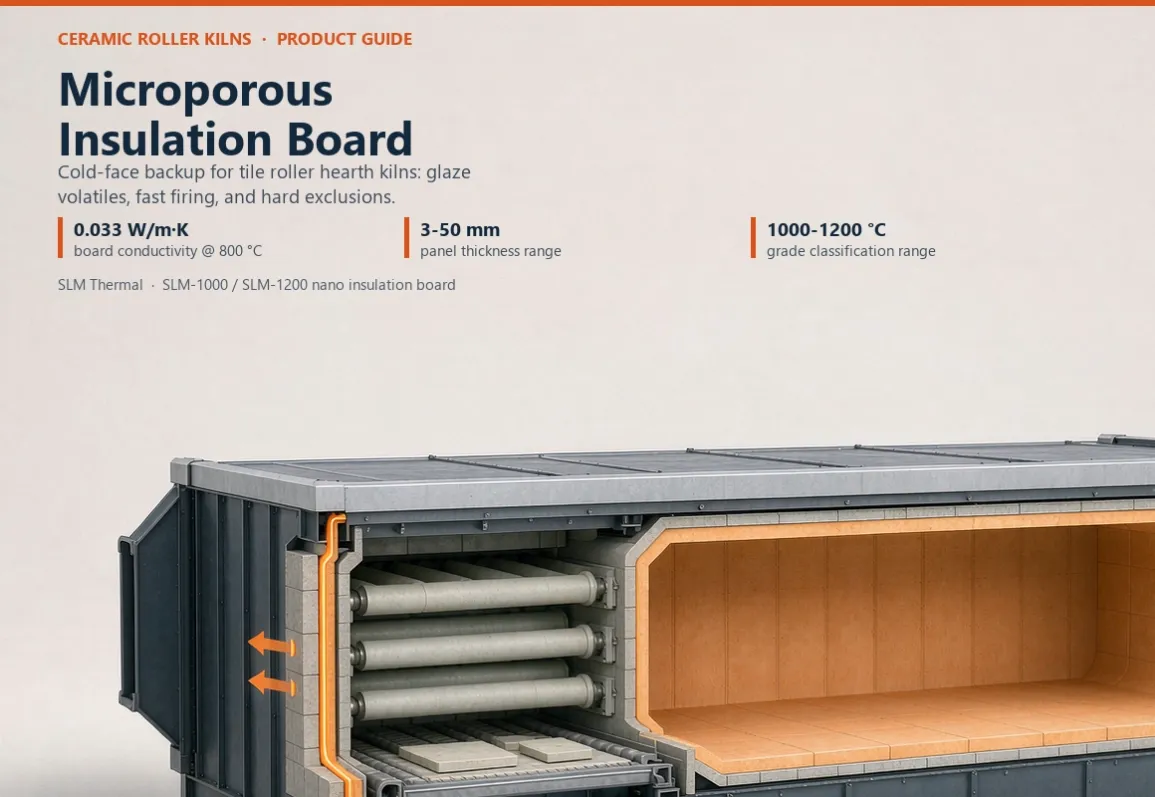
A modern tile roller hearth kiln runs 100–200 m long, fires porcelain tiles at 1180–1220 °C in 30–60 minutes cold-to-cold, and holds an oxidizing atmosphere carrying fluoride, chloride, alkali and boron vapours from the body and glaze. Those are process conditions, not our product. Our application map puts SLM-1000/1200 microporous insulation board on the cold side of the wall and roof refractory, behind a dense hot face, on flat stationary panels only — never at a roller hole, never against flame, never under a roof anchor.
This is a product guide: the board's conductivity at backup temperatures, its classification and facings, why the cold-face temperature sets the grade, and what fast firing and glaze volatiles demand of it. Two limits up front: no independent third-party retrofit measurement in a tile roller kiln was found, and no public quantitative HF, HCl or alkali-vapour exposure study on this pore network was found. The board is a backup course, never the hot face.
What the board is, and what it is not
The board is a pressed composite of fumed silica, reinforcing fibre and an infrared opacifier; pores smaller than the mean free path of air suppress gas conduction. The note on how the board is manufactured explains the difference from a fibre blanket: no network to settle, no binder to burn out.
Commercial grades carry 1000 and 1200 °C classifications. One-hand datasheets give 240–400 kg/m³ density, 0.12–0.67 MPa strength at 10 % deformation, 3–50 mm thickness, 1000×600 mm panels, and E-glass, PE film, foil or hydrophobic facings.
The product boundary follows. A cold-face board is not a working lining, a gas-tight barrier, a structural course or a substitute for mullite roller-hole brick. Manufacturers state that wetting by liquid water, oil or petroleum spirit irreversibly destroys the microporous structure, while non-condensed vapour does not; the defence is foil or PE encapsulation and dry handling.
Product conductivity at roller-kiln backup temperatures
Published SLM curves give roughly 0.020 W/m·K at 20 °C, 0.022 at 200 °C, 0.025 at 400 °C and 0.033 at 800 °C. One-hand datasheets sit in the same band: a 1000-grade panel lists 0.023 / 0.026 / 0.031 / 0.039 at 200 / 400 / 600 / 800 °C, a 1200-grade alumina-based panel 0.029 / 0.033 / 0.039 / 0.044, a second board 0.022 / 0.023 / 0.027 / 0.033. The datasheet guide explains how to read these mean-temperature values.
| Mean temperature | Microporous board | Ceramic-fibre blanket | Calcium silicate | Insulating brick | |---|---|---|---|---| | 200 °C | 0.022–0.023 W/m·K | ~0.06 W/m·K | ~0.06–0.10 W/m·K | ~0.12 W/m·K | | 400 °C | 0.023–0.029 W/m·K | ~0.09–0.12 W/m·K | ~0.095–0.10 W/m·K | ~0.14 W/m·K | | 600 °C | 0.027–0.039 W/m·K | ~0.12–0.17 W/m·K | ~0.12–0.13 W/m·K | ~0.18 W/m·K | | 800 °C | 0.033–0.044 W/m·K | ~0.16–0.23 W/m·K | ~0.12–0.15 W/m·K | ~0.20 W/m·K |
These come from different datasheets. The board sees the cold face, not the 1220 °C set point. A supplier's one-dimensional calculation reduces wall flux 16.5–18.2 % and outer-wall temperature 7–8 °C when 25 mm of nano board replaces 25 mm of fibre board — a handbook result, not a measurement.
Reading the datasheet before selecting the board
Classification temperature is a short shrinkage test, not a continuous working limit. One first-hand datasheet says classification is not an operational limit and continuous-use limits may be lower. A catalogue lists 950 °C continuous with a 1200 °C peak; one grade labelled 1100 carries a 1050 °C classification. One supplier quotes 0.5 % after a 12-hour single-face soak but 3 % after a 24-hour full soak. Ask which soak and which revision produced each number. The SLM-1000 and SLM-1200 comparison sets out where a higher grade pays; here the decision follows the calculated interface.
Facings need the same scrutiny. Hydrophobic grades address liquid water and short humidity upsets, not acid condensate or glaze volatiles; repellency is documented only to 250 °C continuous before the treatment degrades. A microporous-insulation standard directs buyers to obtain lifetime data above that threshold; no public curve was found. E-glass cloth becomes brittle above roughly 600 °C and facings may be sacrificial. No first-hand datasheet gives an HF, alkali-vapour or glaze-dust clause; several say only "resistant to most chemicals". A nominal 1200 °C grade also exceeds that standard's 1150 °C ceiling — ask for measured conductivity at the working interface. Request those values in writing.
Why the board is sized from the lining cold face
EU BAT figures cited by IFC give 1.9–4.8 GJ/t for single-fired tile in a roller kiln and 5.4–6.3 GJ/t for a single-fired tunnel kiln. A peer-reviewed energy and exergy analysis of a tile roller kiln reports that only 13.4 % of input drives reactions in the body, with 13.5 % lost through the walls and 12 % as unaccounted surface loss; its authors attribute this to insufficient insulation. That is a process benchmark, not a board claim. The tunnel kiln guide covers the slower predecessor furnace.
The grade is chosen at the interface, not at the flame. A published 415 mm wall for a 1250 °C slab roller kiln puts 303 mm of brick in front of the nano board. A one-hand kiln maker's specification calls for the external surface to be no more than 40 °C above ambient — an outer-skin bound, not an interface value. Ask for the lining drawing and a calculated interface temperature. The thickness-sizing method guide gives the full calculation.
Illustrative example, all inputs stated as design assumptions: a 300 °C refractory cold face, a 60 °C shell-metal target and 420 W/m² allowed by the designer. Required resistance is (300 − 60) / 420 = 0.57 m²·K/W — about 14 mm of board at 0.024 W/m·K, against 57 mm of calcium silicate at 0.10 or 71 mm of fibre blanket at 0.125. No public shell heat-flux measurement for a tile roller kiln was found, so the flux is a designer input. Where depth is generous, a conventional outer course behind a thin panel is more robust.
Over-insulating pushes the working-brick cold face hotter and can drop cold-side metal below the condensation point of humid, HF- and HCl-bearing gas on shutdown. General practice puts acid dew points at 130–180 °C, but no tile-kiln-specific lower shell-metal limit was found. State both limits in the RFQ.
What a published kiln-wall layer sequence proves
A 2024 utility-model patent from a Chinese kiln builder is the clearest public structural evidence here. For a slab roller kiln firing at 1250 °C it specifies a roughly 415 mm wall, from the hot face outward: two 114 mm lightweight mullite brick courses, a 75 mm nano insulating brick, two 25 mm nano insulation boards, a 25 mm fibre board, a 10 mm fibre blanket and a final 25 mm fibre board. The boards are the fourth course, behind 303 mm of refractory. They are flat, cold-side, and never see flame, glaze dust or a roller.
That is also the limit of what the patent proves. Its subject is an emergency-hole sealing structure — refractory brick, a plate frame, removable plugs and a cover plate with a fibre blanket seal. It discloses a layer sequence only, with no measured shell temperature, energy-saving rate or service life. Citing it as performance evidence over-reads a drawing.
Supplier application lists sit one step further back. One first-hand datasheet names "all types of kilns (roller, tunnel, shuttle)" and kiln cars; another uses almost the same wording, and a third maker lists roller kilns explicitly. Other international sheets stop at "ceramic kilns" or "glass and ceramics industry", and one maker's newer website dropped the ceramic line its older datasheet carried. An application list shows commercial intent, not measured suitability for flue gas, and no first-hand sheet couples the roller-kiln entry with a chemical-exposure clause.
The glaze-volatile and moisture constraint on the board
Tile kiln gas is not clean air. IFC and World Bank guidance states that chlorides and fluorides come from clay impurities, HCl from chloride-bearing additives and HF from decomposition of clay fluorosilicates; glazes and pigments are the main source of lead, cadmium and antimony volatiles. A peer-reviewed Italian tile review reports lead oxide from glaze decomposition and boron oxide replacing lead in frits; a Spanish study found HF and HCl the main firing-stage acid pollutants. These are existence proofs, not exposure tests on this board.
The chemistry must be described honestly. HF dissolves silica to form volatile silicon tetrafluoride, with surface condensation controlling. Alkali vapour work on aluminosilicates reports potassium and sodium species condensing in pores to form nepheline and leucite with 20–25 % volume expansion; a glass-furnace patent notes that fine-grained, high-porosity silica materials are particularly susceptible, and a factory investigation of corroded roller-kiln roof brick found leucite and sodalite with mullite decomposed. A second-hand account reports PbO at 6–14 % on rollers at 730–880 °C; the original paper was not found. Boric oxide forms low-melting borosilicate glass. None is a test on fumed-silica board. No public quantitative HF, alkali, boron or lead exposure study against this pore network was found, and no first-hand datasheet names them.
The engineering answer is separation, not a chemical claim. Keep a dense hot-face course in front, seal joints and penetrations, encapsulate every cut edge, store panels flat in sealed packaging and protect the kiln during shutdowns. The failure analysis notes describe what moisture, crushing and opened joints do — the usual causes before chemistry. One caution comes from a different product: a paper on microporous calcium-hexaluminate insulation reports over 400 kiln cycles with no detectable alkali and intact walls after 7 and 16 months, but states that above 1250 °C silica-free insulation is required. That CA6 result cannot be borrowed for a fumed-silica panel. Hydrophobic treatment is a water specification to about 250 °C, not an acid or alkali barrier. If glaze-laden gas reaches the panel, the lining has already failed.
Where the board sits in a roller kiln lining
Divide the wall by function. The working course faces tile, flame, gas velocity and glaze dust. The intermediate course — lightweight mullite brick, insulating brick or dense fibre module — drops the temperature reaching the insulation and acts as an emergency barrier. The insulation layer brings the outer skin down to a specified maximum. A panel belongs in that third position, on flat sidewalls and flat roof sections, fixed with adhesive, pins or light cold-side frames — not welded studs.
The cathode kiln guide describes the same roller-hearth geometry under a different duty: there a dense, gas-tight hot-face layer is mandatory because lithium vapour attacks silica, and the atmosphere is controlled rather than oxidizing. A tile kiln's hot face is porous lightweight brick, so the sealing burden shifts to joints, penetrations and outer encapsulation. A lithium-kiln build is not a tile-kiln build.
Keep the board out of roller-hole bricks, burner blocks, ports, emergency openings, expansion joints and roof anchors. Where the drawing shows a curve, a hole or an impact face, use a refractory system designed to carry it.
Why roller holes, ports and roof anchors exclude the board
A 1980 patent on roller-kiln insulation states that each roller hole must be larger than the roller to allow rotation despite thermal-expansion distortion, and that clearance leakage, accumulated over hundreds of rollers, becomes a serious problem. Its solution is a grooved journal-block brick packed with kaolin wool as a thermal seal, with an outer closing member for roller withdrawal and repacking. Two later patents describe emergency openings with step seals, removable plugs and cover plates. Openings are built from dense brick and replaceable mechanical parts, not a rigid panel.
Roller-hole bricks also carry load: refractory suppliers describe flat steel concentrating the upper wall's weight onto the hole brick until it cracks and the roller seizes, with hole centres aligned to the drive within ±1.5 mm. Roof modules hang from anchors welded to the shell; a patent warns that a loosened anchor lets the module slump, opens a gap and burns the anchor.
At 0.12–0.67 MPa the board is not load-bearing; a standard describes rigid microporous board as damaged when forced to a non-planar surface. The anode carbonization kiln guide gives the parallel rule for a roller hearth in reducing atmosphere: panels stay on flat fixed walls and never become roller seats or sagger supports. A flat-shell layout is a design requirement.
Fast firing, low thermal mass and cycling
A 30–60 minute cold-to-cold cycle, a peak near 1200 °C, a rapid quench through 900–600 °C and slow cooling through the 573 °C quartz inversion make this a cycling duty. Low thermal mass shortens heat-up but makes a stopped kiln cool fast: an operating note reports more than 200 °C per ten minutes after loss of power or gas, cracking walls and rollers. An industry interview puts a full cool-down and reheat at one to two days.
That is a product qualification question: the panel must hold thickness, pore structure and conductivity through tens of thousands of cycles, not merely survive one 1000 °C soak. Ask for permanent shrinkage at the design interface, cycling data with count and swing stated, and residual conductivity. Datasheets give shrinkage under a soak, not under fast firing, and no public thermal-cycling measurement of a fumed-silica board under tile-kiln cycles was found. A market report quotes 15 % strength loss after 50 cycles at 200–800 °C, but the underlying test report was not found. Fixing must tolerate differential expansion.
Installing the board: dry-out, joints and fixing
Castables and mortars release water through heat-up, and a foil-faced panel on the wet side traps it. Keep the board on the dry shell side, vent all courses and follow the heat-up curve. The installation guide covers handling sequence; the lining drawing governs where panels start and stop. During shutdowns, seal openings against humid air: a cold tile kiln is damp and carries residual fluoride and chloride.
A narrow open seam through a 14 mm panel bypasses the pore structure, and unfilled joints collect condensate. Fit panels tight, stagger joints, pack residual gaps with compatible fibre and leave the expansion allowance. The joint-gap control notes give tolerances; every cut edge must be sealed the day it is cut. Datasheets allow glue, anchors and pins, yet a fastener into the dense lining becomes a heat path and an over-tightened clamp crushes a panel rated below 0.7 MPa. Where the casing cannot be adapted, use a light cold-side frame. Above roughly 600 °C an E-glass cloth is sacrificial, not a permanent seal.
Inspection, acceptance and what a shell survey can prove
The incoming QC checklist covers tolerance, thickness uniformity, density, facing integrity, edge sealing, package moisture indication and certificates. Add a conductivity curve at 200/400/600/800 °C, strength at 10 % deformation, 24-hour full-soak shrinkage with its condition, written continuous-service confirmation at the interface, and hydrophobicity results. Standards for fibrous batts do not apply to a rigid board; name the guarded-hot-plate, soak-shrinkage, compression and leachable-ion methods rather than one room-temperature number, and ask which method produced each value.
Acceptance is a like-for-like infrared shell survey at fixed points, logged with fuel rate, throughput, zone temperatures and campaign age. Fix emissivity, angle and distance and trend values, not single images. Reconcile a falling shell temperature with metered gas per square metre; a colder shell is not better if cold-side metal drops below the dew point or the brick hot face rises beyond design. No public independently verified shell-temperature, energy or campaign-life result for a fumed-silica board in a tile roller kiln was found.
The published numbers that look relevant belong to other duties: a 2016 Chinese mill paper reports a 46 °C shell drop in a lime rotary kiln, a supplier case the same on an alumina calciner, and a six-month third-party wet-dry cycling test at 316 °C covered blanket on pipe, not rigid board at firing temperature. A plant-supplier calculation quotes 12.5 to 3.8 kW/m² without a protocol, and vendor pages claiming 12–18 % gas savings publish no fuel balance. Treat these as context, not product evidence.
Where the board is not the answer
The hot face or any gas-washed surface. Working brick must stop flame, gas velocity and glaze dust; a porous silica panel is neither wear lining nor barrier.
Roller-hole bricks, roller seats and emergency openings. Holes need rotational clearance, dense brick and repackable seals; a brittle panel serves none of these.
Burner blocks, ports, thermocouple sleeves and damper frames. Curved, penetrated, frequently opened positions that must be impact-resistant.
Suspended roof anchors and hanger assemblies. Welded studs, module slump and expansion-joint compensation are a fibre-module and steel system.
The wet side of a castable, an unsealed cut edge or an unprotected shutdown. Liquid water permanently destroys the pore structure; humid, fluoride-bearing air is the specific risk.
A hydrophobic grade used as acid or alkali protection. Repellency is documented only to about 250 °C and says nothing about HF, HCl or glaze volatiles. Encapsulation is the answer.
An over-insulated shell with no lower bound. Cold-side metal below the dew point invites acidic condensation; a tile-kiln-specific lower limit was not found.
Unverified shell-temperature, energy and life promises. No independent third-party retrofit measurement, no public HF or alkali compatibility study, no public cycling result and no published board life in this duty was found.
Buying the board: RFQ inputs and packaging
Specify grade, thickness, facing, hydrophobic treatment, dimensions and cut list, and call out sealed moisture-barrier packaging, edge-sealing material and the shrinkage condition. Ask for the current conductivity curve and written continuous-service confirmation at the design interface. High-strength nano insulation boards are listed on the SLM product page; use that reference so conductivity is compared at the same mean temperature and density, and ask whether the grade carries restrictions for fluoride-bearing or high-humidity atmospheres.
A workable RFQ states kiln type, tile format, peak and zone temperatures, cycle time, fuel sulphur and chlorine, whether lead or boron frits are used, flue-gas moisture and dew point, the full lining drawing, calculated cold-face temperature, upper and lower shell-metal limits, available backup depth, exclusion zones, heat-up curve and a measured shell baseline. An RFQ template keeps those fields consistent. Without the drawing, interface temperature and baseline, a thickness recommendation is a guess.
Frequently asked questions
Is a 1220 °C firing zone too hot for a 1000-grade board? Not at the board's position. Sizing uses the cold-face temperature; the 415 mm wall puts 303 mm of brick in front. An interface above the continuous-service limit still rules it out.
Can the board replace the working lining? No. Supplier clauses require a dense course in front and the patent layer sequence has the board in the fourth course. A worked example assuming otherwise is a calculation, not a qualified design.
Does a hydrophobic grade solve the glaze-fume problem? No. It addresses liquid water to about 250 °C, not HF or alkali vapour. A dense hot face and encapsulation are the defence.
Is there published tile-kiln field evidence? First-hand datasheets name roller kilns and one patent gives a layer sequence, but no independent third-party retrofit measurement was found.
Will a colder shell cut gas per square metre? It reduces one boundary loss in a kiln whose wall losses a peer-reviewed analysis puts at 13.5 %. Reconcile with metered fuel and cold-side metal above the dew point.
Bottom line
Microporous insulation board earns its place in a ceramic roller kiln by delivering large thermal resistance in a few millimetres at the cold side of a multi-course lining, against a flat stationary steel shell. It frees lining depth and cuts casing heat loss. It does not belong against flame or glaze dust, in roller holes, ports or emergency openings, under roof anchors, on the wet side of a castable or anywhere load and condensate can reach it. Size it from the cold-face temperature and both shell-metal bounds, confirm continuous service, shrinkage and cycling in writing, encapsulate every edge and verify with a like-for-like shell survey. Where fast cycling or fluoride-bearing gas dominates, the board is only one part of the answer.
Data levels: energy figures from EU BAT conclusions as cited in IFC/World Bank guidance; wall-loss shares from a peer-reviewed energy and exergy analysis; firing temperature, cycle time and outer-skin limits from kiln-maker literature; the 415 mm layer sequence from a 2024 patent that discloses construction only. Conductivity, density, strength, classification, shrinkage, facings and the 250 °C hydrophobic ceiling from commercial datasheets and a microporous-insulation standard, with SLM values from our own datasheet. Roller-hole leakage, load and roof-anchor behaviour from patents and supplier notes. HF, alkali, lead and boron mechanisms are analogy from glass-kiln and refractory literature — not tests on this product. The 46 °C figures are plant- or supplier-reported cases from other industries; the 16.5–18.2 % number is a calculation. The resistance calculation is a one-dimensional steady-state estimate with assumptions stated. No public independent third-party retrofit measurement in a tile roller kiln, no public quantitative HF/HCl/alkali compatibility study with fumed-silica board, no public fast-firing cycling result, no public shell heat-flux measurement or lower shell-metal limit, and no published board service life in this duty was found. Confirm all product values against the current SLM datasheet before specification.