Why Refractory Contractors Are Switching to Pre-Cut Custom Insulation Kits
The contractor economics behind pre-cut kits: the three costs of site cutting (hours, waste, joint quality) that only the first shows on a timesheet, what a numbered kit actually contains, the three c
Ask a refractory crew what they hate most about microporous board, and the answer is almost never the material. It is the cutting: a pallet of flat plates, a set of shell drawings, a dusty corner of the site, and the knowledge that every hour spent sawing is either unbilled or eating margin. Then multiply that by every vessel, every campaign, every crew member who cuts to their own tolerance.
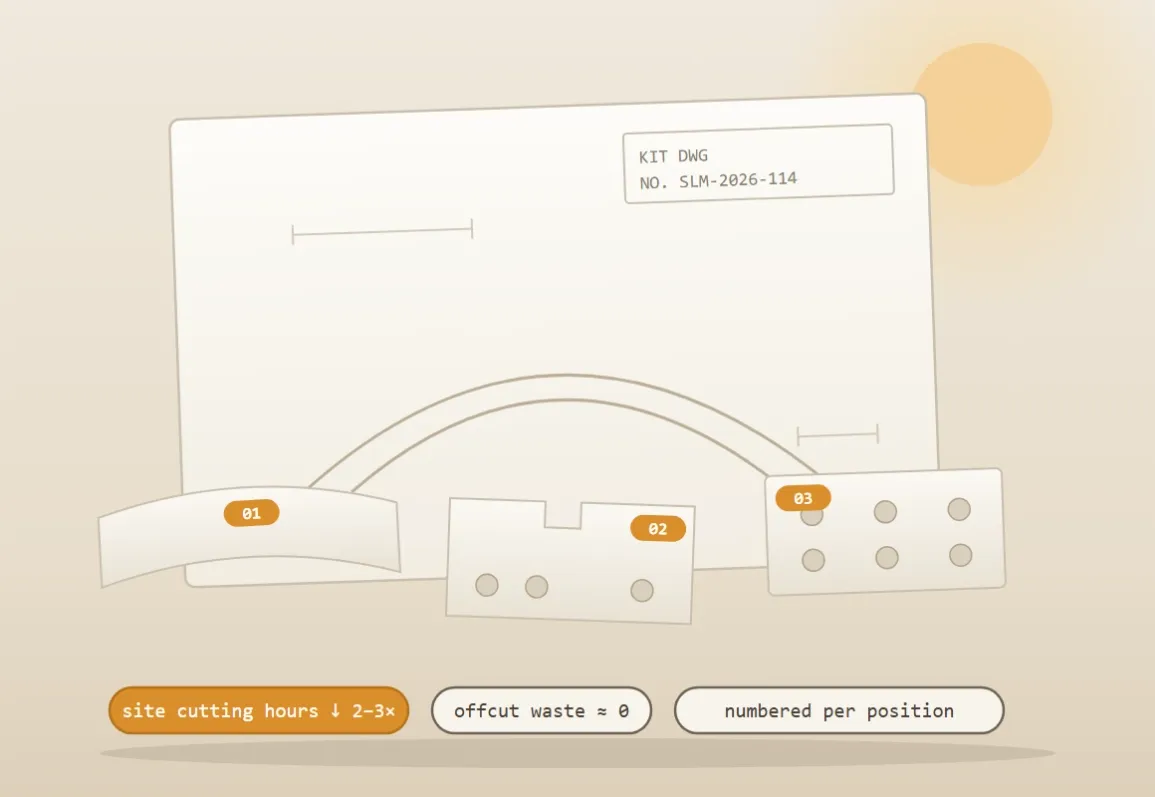
Pre-cut custom kits invert the workflow. The fabricator receives the shell geometry and returns numbered, shaped boards — curved segments, notched pieces around penetrations, anchor holes in spec — packed per installation sequence. The crew assembles instead of fabricating. This article is about why that switch is accelerating, what it changes in the contractor's own arithmetic, and what a buyer should check before ordering their first kit.
The site economics nobody invoices properly
Site cutting has three costs, and only the first is visible on a timesheet.
Hours. Cutting, fitting and re-cutting board on site runs two to three times the equivalent assembly time, and it lands on the crew's critical path — the days between shell handover and first heat that every project manager defends line by line.
Waste. Flat plates cut in the field give up 15 to 30 percent of their area to offcuts, bad starts and breakage, and the board is priced into the job. Factory-cut kits run the yield calculation upstream, where the offcuts are recycled into the next kit rather than a skip.
Quality. Every hand-cut edge is a fit-up variable. A sloppy edge becomes an open joint, and an open joint becomes the hot streak that the shell survey finds in month two — the failure chain set out in the joint and gap control guide. Kits close that chain at the factory, where cuts are made against a drawing by a machine, not against a template by whoever is free.
What a kit actually contains
A kit is not a pallet of boards with a note attached. A proper kit ships as:
Numbered segments matching an installation drawing — every piece labelled with its position, course and orientation, including the mirror-image pieces that site crews always mix up;
Penetration details — notched boards for nozzles, bosses and thermocouple wells, cut clean rather than field-gouged;
Anchor holes pre-punched to the shell's anchor layout, so the board seats over the welds instead of being forced;
Packing per sequence — cartons ordered by installation stage, so the third course is not buried under the first.
The fabrication behind this — pressing, curing, CNC cutting against the drawing, batch testing — is what how SLM nano insulation boards are made describes. The point for the buyer is that the kit is a manufactured product with a drawing number, not a favour the factory did with a saw.
Where kits move the needle most
Kits pay everywhere, but three cases are decisive.
Curved shells and drums. Rotary drums, ladles and torpedo vessels need curved segments; cutting flat board to a curve on site is where most breakage and most gap-fudging happens. Curved factory segments seat against the shell the day they arrive.
Penetration-dense linings. Furnace walls with nozzle arrays, burner quarls and instrument wells are 40 percent detail work. Pre-notched pieces turn that detail into placement.
Repeat vessels. The second and third vessel of a series are where kits compound: the drawing exists, the fitting errors of vessel one are already corrected, and each kit ships with the same batch traceability — checked on arrival under the incoming inspection protocol — so repeat orders get faster, not riskier.
The buyer's checklist before the first kit
Kits shift quality risk upstream, which means the supplier's factory discipline is now part of your site quality plan. Before ordering:
Send real geometry. Shell drawings, or survey measurements for aged shells — ovality and bulges belong in the kit drawing, not in the fitter's day.
Agree the tolerance. Thickness ±1 mm and segment dimensions to fit the drawing are specification items, not hopes; what to demand and why is part of the supplier audit checklist.
Keep the handling rules. Kits remove site cutting, not site care — support the pieces, protect edges, keep the wrap on. The storage and cutting field guide rules still apply to kit parts, just with far less cutting.
Verify as always. The shell survey after commissioning — the performance verification guide method — tells you whether the kit's tight fits held through bake-out and first campaign.
Contractors running the numbers on a second supplier should fold the kit arithmetic into the qualification method for direct alternatives: yield, labour and lead time are the three lines where kits change the comparison most.
The pattern across the industry
The switch is not ideological — it follows the same logic everywhere: fabrication belongs where the machine is, and assembly belongs where the crew is. It is the same reason furnace OEMs buy hot zones as machined assemblies, and the same reason twelve questions buyers ask now include "can you supply kits?" as a default. The crews who moved first are not working harder; they are working on the only part of the job that actually needs people on site.
For a completed build-up in place — the kind of lining a kit produces — see the anchored ladle back-up assembly page.
Send us the shell drawing or the survey data, and we will return a kit drawing with numbered pieces, thicknesses and a quotation — before your next shutdown is scheduled.
Questions on kits, drawings or repeat-vessel programs: sales@slmthermal.com