Sep 29, 2026
Cost and Thermal Equivalency: Qualifying a Direct Alternative to European Microporous Brands
A qualification method for distributors and refractory contractors pricing a second source: what thermal equivalence must mean curve-for-curve at real mean temperatures, the installed-cost arithmetic
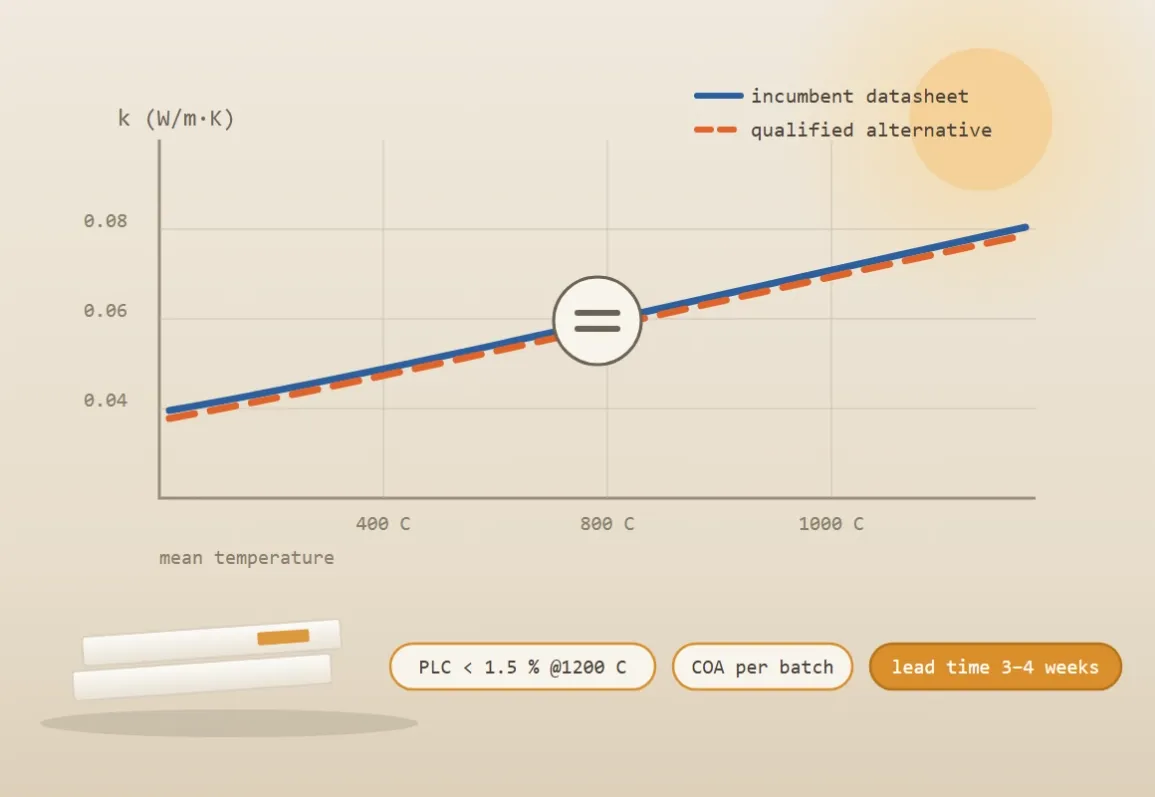
For most of two decades, buying microporous insulation meant buying European. The brands are excellent, and nobody who pays their invoices needs convincing of the material. What has changed is the arithmetic around them: twelve-to-sixteen-week lead times, single-source pricing, and standard plates that push every shaping cost onto the contractor's floor — while a generation of Asian manufacturers now publishes curves that look, on paper, like the same product.
"On paper" is where the decision belongs, and also where it usually goes wrong. Equivalence is not a feeling about a brochure, and it is not the lowest quote. It is a defined comparison — grade by grade, condition by condition — followed by a pilot that costs a fraction of the annual spend it protects. This article sets out the qualification a distributor or contractor can run before switching a single order, and the cost arithmetic that decides whether the switch is worth running at all.
What "equivalent" has to mean
Two boards are equivalent only if they match at the conditions the lining actually sees, which are almost never the conditions printed largest on the datasheet. Four properties carry the comparison, and two of them are routinely skipped.
Conductivity at your mean temperature. Every microporous board's conductivity climbs with temperature; brands differ most exactly where the lining is hottest. The comparison is curve against curve at 600, 800 and 1000 C mean — a single headline number (usually the room-temperature one) cannot rank two materials. How to read that curve, and the three questions that make a supplier pin it down, are in the conductivity curve discussion of the datasheet guide.
Permanent linear change at temperature. Shrinkage is what turns a good lining into a leaking one, and it is the property European brands have historically held tightest. Equivalence here means the same shrinkage limit, held to the same test standard, at the same temperature — not "also stable" with the temperature quietly raised. The permanent linear change line on a proper data sheet is the single most predictive number for how the joints will look in year two.
Density and thickness tolerance. Thermal resistance stacks with thickness; density drives handling life and press consistency. A substitute with a wider thickness band or a drifting density range will not fail a lab test — it will quietly underperform in the field and blame the crew.
Batch traceability. Equivalence on day one means little without a certificate of analysis tying every delivery to a measured batch. This is where low-cost suppliers historically separated into two kinds: those who test every batch and those who test the batch that made the brochure.
The arithmetic that actually decides
Distributors compare price lists. Contractors should compare cost per installed square metre — and once that is done honestly, the picture changes in three places.
Yield. Standard plates cut on site lose 15 to 30 percent to offcuts and breakage, plus the labour to cut them. Factory-cut kits — shaped per position, numbered per drawing, as SLM nano insulation boards are made and supplied for shaped linings — move that cost upstream where it is one machine instead of a hundred site hours. The handling rules for whatever does get cut in the field are in the storage and cutting field guide.
Lead time as inventory. A 16-week lead time is not just a calendar inconvenience: it forces the distributor to hold months of safety stock, financed at their own cost, for every grade they promise to supply. A 3-to-4-week source turns that working capital back into margin — often worth more per year than the unit-price gap. Freight economics help the same direction: board ships flat and dense, and how much of a container a given order consumes is set out in the container loading guide.
The comparison nobody prices: dual sourcing. Single-sourcing the incumbent has a cost that appears only when the incumbent cannot deliver. A qualified second source is insurance the balance sheet can actually see.
None of this makes the substitute automatically cheaper per square metre — Asian pricing typically lands 30 to 50 percent below the European list at equivalent grade, but the honest comparison is computed, not assumed. Compute it at your thickness, with your yield, against your inventory terms.
The questions that qualify a supplier
The full question set for vetting any new source is in the supplier audit checklist; three of the twelve matter most when the incumbent is European and the challenger is new to you:
Third-party test reports for the curve, not just the datasheet — conductivity measured by a named method at named mean temperatures, by a lab that is not the factory's own.
Batch COAs from recent production, not from the qualification batch three years ago.
The packaging and export spec — vapour barrier, carton construction, pallet protection — because a perfect board that arrives damp is a failed qualification, and the fix belongs in the purchase agreement.
A pilot that protects both sides
Qualification should cost a fraction of the annual spend it informs, and it should produce numbers rather than opinions.
Order one pallet of the most critical grade. Run the incoming inspection protocol on arrival — thickness, moisture, edges, paperwork — so the supplier's outbound discipline is measured, not assumed. Install a trial section in a real furnace or ladle, or ship a pre-cut kit to one contractor customer and get their assembly notes. Then survey the shell through the first campaign the way the performance verification guide sets out, and read the cold face against the prediction the supplier's own curve generates.
One campaign of that evidence ends the argument. If the substitute's shell temperatures match its datasheet, the distributor has a second source worth contracting; if they do not, the pilot cost a pallet and settled a question worth far more.
What the incumbent's price is not telling you
The incumbent's list price was never the full comparison, and neither is the challenger's. The real variables are yield, inventory, freight, and the risk profile of single-sourcing — plus, increasingly, the shaping work the source will do for free that the contractor has been paying to do badly. A supplier who delivers numbered, factory-cut kits with batch certificates and a three-week lead time is not selling the same product cheaper; they are selling a different procurement model.
For a look at what these assemblies are in practice — the anchored ladle back-up assembly page shows a complete build-up in place.
If you are holding a European spec sheet and want a like-for-like curve, a COA pack from current production, or a pilot quotation at your thickness and tolerance, send it over — the comparison, computed honestly, is what we do first.
Questions on grades, equivalency data or pilot orders: sales@slmthermal.com