Low Thermal Mass Lining: How Vacuum Furnace Builders Cut Heating Cycles by 25%
A hot-zone design brief for vacuum furnace builders: why cycle time is the product, how the lining dominates the furnace's own thermal mass, what a 20-40 mm microporous lining does to ramp time and st
A vacuum furnace competes on two lines of its specification sheet: how fast it cycles, and how evenly it holds temperature. Everything else — pump-down time, quench rig, control system — is table stakes. And of the two headline numbers, the one most builders leave on the table is hiding in the lining: not how well it insulates, but how much of the furnace itself has to be heated, and reheated, every single cycle.
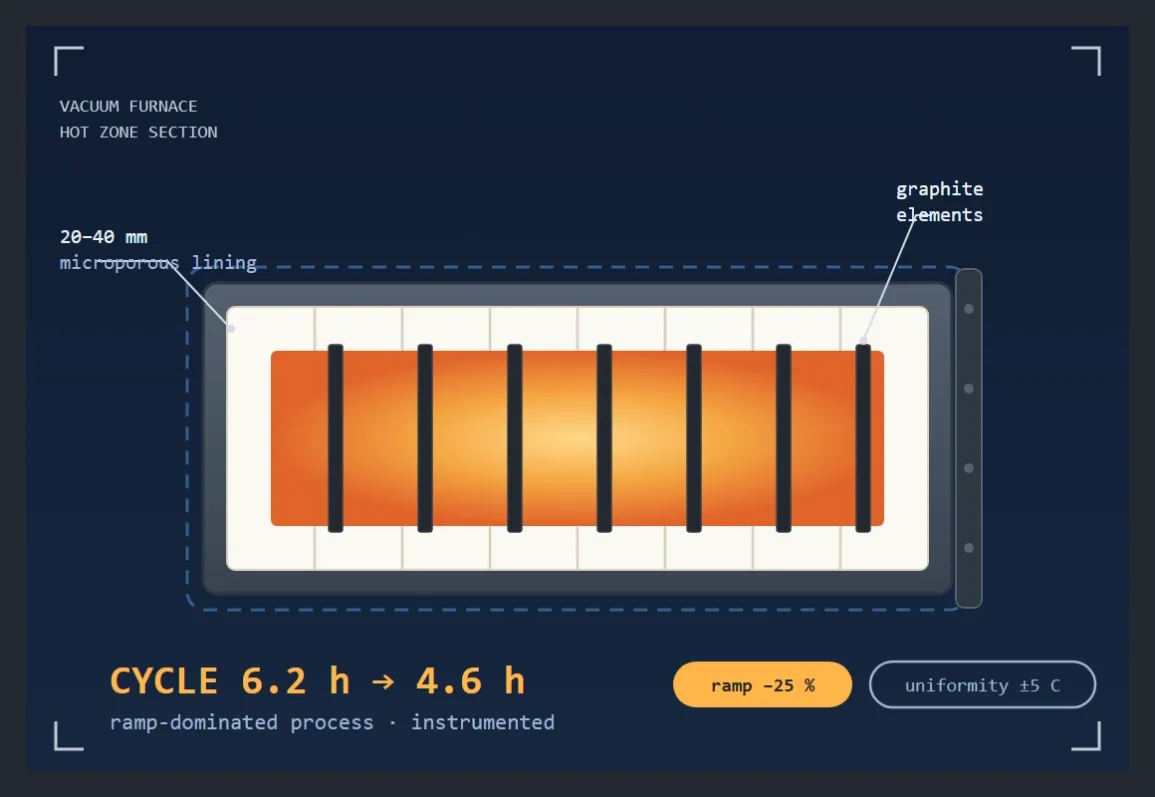
That is the low thermal mass argument, and it is why a growing number of vacuum furnace builders now put a 20 to 40 mm microporous board lining inside their hot zones where a 100 mm-plus stack of insulating board used to sit. This article walks through the physics, the numbers a builder can verify before committing a design, and the vacuum-specific details that decide whether the promised cycle reduction actually arrives.
Why cycle time is the product
Buyers of vacuum heat treatment — brazing, annealing, sintering, tool hardening — buy throughput per square metre of shop floor, and throughput is gated by cycle: pump-down, ramp, soak, quench, back to ambient. Ramp time in particular is pure overhead, paid in kilowatts and in minutes, on every batch.
Here is the part that surprises people outside furnace design: in a front-loading vacuum furnace, a large share of every ramp's energy never reaches the workload at all. It goes into heating the furnace itself — the hearth rails, the element assemblies, the shields and the lining. Heat the lining to 1300 C, quench the load, and that stored heat is thrown away; the next cycle buys it again. The heavier the lining, the bigger the tax.
Where the mass sits — and why microporous cuts it twice
A conventional hot-zone lining stacks insulating board in thick sections, because each layer's insulation value per millimetre is modest. The stack works thermally but it stores a lot of energy: the lining is typically the single largest share of the furnace's non-workload thermal mass.
Microporous board changes the equation on both axes at once. Its conductivity at hot-zone mean temperatures is a fraction of conventional lining board — the honest comparison lives on the conductivity curve at real mean temperatures, not in a headline figure — so a 20 to 40 mm sheet replaces the resistance of a much thicker stack. And because there is simply less material at low density, the stored heat in the lining collapses with it. Less resistance to heat escaping and less heat banked in the walls: the furnace reaches setpoint sooner and sheds temperature faster on the cool side, which shortens the parts of the cycle builders historically treated as fixed.
Builders who have made the switch report cycle reductions in the 20 to 30 percent class on ramp-dominated processes, with the exact figure set by the workload-to-lining mass ratio of each design. The number is verifiable in an instrumented ramp test before any design is committed — and because the test is the builder's own, on their own hot zone, it settles the argument without a datasheet in the room.
Uniformity: the second line on the spec sheet
Cycle time without temperature uniformity is a refund waiting to happen. Brazing and sintering spec sheets hold ±3 to ±5 C across the working zone, and the classic enemy is the edge cold zone — the ends and corners of the hot zone, where heat escapes through seams and thermally short-circuited joints faster than the middle loses it.
Seams are a geometry problem, and geometry is what CNC-machined kits solve: lining segments cut to the hot zone's exact curvature and penetrations, numbered per position, as SLM nano insulation boards are made for shaped assemblies. Fewer hand-cut joints, tighter fits, no crushed edges — the uniformity survey at commissioning shows the difference at the zone ends first.
The vacuum-specific details
Microporous board suits vacuum service for unglamorous reasons: it is fully inorganic, dimensionally stable, and contains no fuel to outgas at temperature. Two details still deserve design attention.
Bake-out and pump-down. Residual moisture in any lining becomes vapour load on the pumping system during the first cycles. A controlled bake-out on commissioning — the same logic as the preheat and dry-out curve applied to refractory linings — clears the adsorbed water and stabilises pump-down times. What the board must not contribute is binder decomposition, which is why the loss on ignition line on the supplier's data sheet matters in a vacuum application and not only in a furnace: low LOI means nothing volatile is left to contaminate the load or extend pump-down.
Thermal bridges. Element feedthroughs, hearth rail supports and thermocouple wells all cross the lining, and in vacuum service there is no convection to blur their signature — a bridged fitting paints a cold ring on the workload. The jointing rules are the same ones steel linings live by, set out in the joint and gap control article, and the feedthrough details belong on the drawing rather than in the installer's judgment.
Verifying the spec before committing
An OEM qualifying the lining for a furnace series should ask three things of the board supplier, in this order: the conductivity curve at hot-zone mean temperatures, batch test certificates tying deliveries to measured production, and the packaging spec that gets boards to the assembly line undamaged. The full question set lives in the supplier audit checklist, and the arrival checks that keep series production honest are in the incoming inspection protocol.
The same low-mass logic now scales far beyond heat treatment: grid-scale thermal batteries use the identical principle to hit their transport envelope, as the LDES vessel wall guide sets out.
For the industrial view of these assemblies in continuous duty, the anchored ladle back-up assembly page shows the build-up in place.
If you are designing a hot zone and want a lining proposal against your cycle and uniformity targets — including the CNC kit drawings — send us the geometry and the process window.
Questions on grades, hot-zone kits or an instrumented ramp comparison: sales@slmthermal.com