Microporous Insulation Board in Ceramic Shuttle Kilns: Cold-Face Backup, Heat-Mass Limits, and Where It Must Not Go
A product guide to SLM-1000/1200 microporous insulation board as cold-face backup in ceramic shuttle kilns: conductivity at 200-800 C, classification and facing limits, sizing from the refractory cold
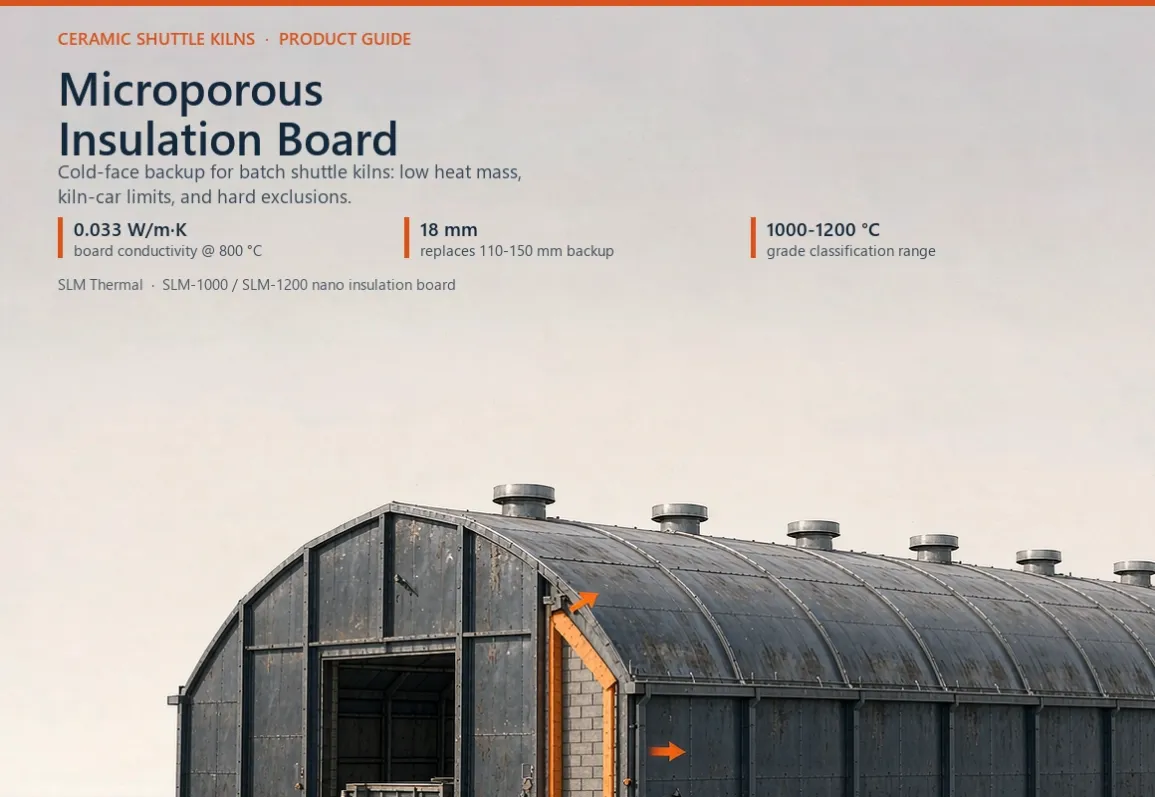
A ceramic shuttle kiln is the batch workhorse of the refractories, sanitaryware and technical-ceramics plant: load it on a car, fire it to 1,250–1,400 °C, cool it, unload it, repeat. That stop–start rhythm is exactly where a thin, low-heat-mass microporous board earns its place — but only as the cold-face back-up behind the working lining, never as the hot face. This guide explains where the board belongs in a shuttle kiln, how to size it from the refractory cold-face temperature, and the eight places it should not go.
What the board does behind a shuttle kiln lining
SLM microporous boards, in the 1000 and 1200 grades, are silica panels: a fumed-silica matrix with infrared opacifiers and fibre reinforcement, engineered so that most of the pore space is below the mean free path of air. The result is a flat thermal conductivity of roughly 0.022 W/m·K at 200 °C rising to about 0.038–0.044 W/m·K near 800 °C — lower than still air across that band. In a shuttle kiln the board is not the hot face and it is not structural. It is the final, thin, high-performance layer that sits against the steel shell or outer casing of the fixed walls and roof, behind the lightweight refractory and the insulating firebrick or ceramic-fibre backup.
Because the board carries almost no load and adds almost no heat capacity, it lets the wall reach temperature faster and shed less stored heat each cycle. The board's job is to stop heat at the cold face, not to take the flame, the load, or the abrasion. Keep that boundary fixed and every other decision follows.
Stacking more ceramic-fibre blanket is the obvious alternative, but fibre is bulky and, above a certain thickness, its own radiation contribution grows; a thin board does the same job in a tenth of the space. That recovered thickness is not vanity — on a shuttle kiln it widens the car deck, lengthens the chamber, or simply lets you hit a lower shell temperature without rebuilding the steel. The board is the space-efficient closing layer of a wall that already does its real work in the refractory ahead of it.
Why an intermittent kiln rewards low heat mass
A tunnel or roller kiln runs near steady state; a shuttle kiln is taken from room temperature to 1,300 °C and back, often every day. In that duty the lining and the kiln car soak up and release enormous heat. Published energy figures tell the story: gas-fired shuttle kilns are quoted in the 800–1,500 kWh/t range, while continuous tunnel kilns sit near 350–700 kWh/t and roller kilns 300–600 kWh/t. Vendors of low-mass linings claim 20–40 % lower lining heat storage for intermittent service, and the EU LIFE "ECONOMICK" project reported cutting sanitaryware firing energy roughly in half on an optimised intermittent line.
None of those numbers come from a third-party measurement on a microporous-backed shuttle kiln — they are vendor or project figures for low-mass linings in general. We state that plainly because the buyer should budget on conduction physics, not on a brochure. The mechanism, though, is sound: the thinner the cold-face backup, the less mass the kiln must heat and cool each batch. A 20 mm board substitutes for well over 100 mm of conventional backup, and that recovered wall thickness also widens the car deck or chamber.
Where the board belongs — and where it does not
On the fixed walls and the flat or sprung roof, the board belongs as the outermost backup, between the insulating backup course and the steel shell. The working lining (high-alumina or cordierite-mullite brick, or a dense ceramic-fibre module) takes the flame and the product; the lightweight backup drops the temperature; the board caps the wall with a thin, predictable resistance and pins the shell temperature. On a flat or suspended roof the board is held the same way — laid on a flat, rigid course and retained by the module above or by studs, never hung as a free span that can sag and crack under its own weight plus the thermal movement of the cycle.
The car deck and the door are different. They are not off-limits by magic, but they are the wrong place to leave a microporous board exposed. The deck is loaded, unloaded, wheeled in and out, and thermally cycled every batch; the door is opened, closed, vibrated and resealed. Vendor literature (for example METHERM and Anchor microporous guides) does list the board for kiln-car deck interlayers and door-frame backup — but always as a protected back-up, never as the exposed or load-bearing face. Our rule, therefore, is precise: the board may sit inside a car or door only when it is fully encapsulated behind a rigid, impact-resistant course and carries no load and no exposed edge. As the exposed working or load face, it must not be used. That distinction matters more in a shuttle kiln than in a steady tunnel kiln, because the car and door move.
Sizing the board from the refractory cold-face temperature
The only temperature that matters for grade and thickness is the temperature at the cold face of the refractory backup — the hot face of the board — not the 1,250 °C chamber temperature. In a typical sanitaryware shuttle wall (≈230 mm lightweight brick plus ≈30 mm fibre backup) the board hot face at peak soak often lands near 350–400 °C. Treat that interface as the design point, and confirm it with a wall thermal model rather than a rule of thumb.
Worked example, steady one-dimensional, illustrative only: board hot face 360 °C, target shell 70 °C, so ΔT ≈ 290 °C. An 18 mm board at a representative conductivity ≈ 0.035 W/m·K gives a resistance of 0.018 / 0.035 ≈ 0.51 m²·K/W, so heat flux q ≈ 570 W/m². To pass the same flux you would need roughly 150 mm of ceramic-fibre blanket (≈0.11 W/m·K) or about 110 mm of calcium silicate (≈0.075 W/m·K). The board recovers 90–130 mm of wall thickness for the same shell temperature. This is a simplified conduction comparison; it excludes the radiation and contact resistance of the preceding courses and should be confirmed against the actual build-up. In practice the preceding lightweight brick and fibre have already done most of the temperature drop, so the board is the final thin layer that trims the last few hundred watts per square metre — not the component that does the heavy lifting. No public, third-party measurement of a microporous-backed shuttle kiln was found, so every saving estimate here is a physics-based bound, not a field result you can put in a bid without your own trial.
Two constraints sit on the shell side. The metal casing must stay below its long-term service limit (commonly cited around 400 °C for structural steel) and, where the flue gas contains acid or water vapour, above the dew point so condensate does not form on the steel. The board helps drive the shell down, but it cannot by itself guarantee the lower bound; the preceding refractory and the casing seals do that.
Grade selection: 1000 vs 1200
Pick the grade from the board hot-face temperature, not the firing peak. If the refractory cold face stays at or below about 1,000 °C, the 1000 grade is the right choice; if the backup interface can reach 1,000–1,200 °C, specify the 1200 grade. For most sanitaryware and tableware shuttle walls the interface is comfortably under 1,000 °C at peak, so the 1000 grade is common; for refractory or technical-ceramic firing where the backup runs hotter, the 1200 grade is the safer specification. The continuous-use limit of the grade, not the chamber temperature, is the line you must not cross.
Facing, encapsulation and moisture control
The board is porous and, with the exception of the hydrophobic grade, is permanently damaged by liquid water and by oil. One vendor's data sheet states this explicitly: water and oil "irreversibly destroy the microporous structure." Hydrophobic treatment survives only up to about 250 °C (Morgan data sheets and ASTM C1676 agree), so it protects the board during storage, handling and any cool-face condensation — it is not a running-temperature waterproofing. In a shuttle kiln the running interface is far above 250 °C, so the real moisture defence is the steel casing, the seals, and keeping the backup dry during shutdowns. Where the board could see condensation at idle, use foil- or PE-film-faced stock and keep it wrapped until the wall is closed. The rated continuous-use temperature of the facing must also clear the board hot-face temperature, or the facing itself becomes the weak point. The choice between aluminium foil, PE film and glass cloth is a handling-and-sealing decision, not a thermal one: foil seals best against vapour but dents; PE film is robust in storage; glass cloth survives higher facing temperatures but breathes. Match the facing to how the board will be stored, moved and finally sealed behind the casing.
Anchoring and joint practice
A microporous board has a compressive strength on the order of 0.2–1.1 MPa — a fraction of a firebrick's 30–70 MPa — and its edges chip if unsupported. It must be laid against a flat, rigid backup and held by the overlying course or by studs sized for the board, not relied on to span a gap. At the joints, keep gaps tight and staggered between courses so there is no straight thermal shortcut through the backup. Because a shuttle kiln expands and contracts every cycle, the anchoring must tolerate that movement without crushing the board edges — a flat, fully supported bed matters more here than in a steady tunnel kiln, and loose studs that ratchet against the brittle edge will eventually open a leak path.
Receiving and verifying the boards
Before any board goes into the wall, verify it against the order: grade, thickness, facing, and dimensions, plus a conductivity or density check at incoming inspection. Reject boards with crushed corners, delamination, or facing tears, because those defects become thermal shortcuts once the wall is closed and cannot be repaired in place. Record the batch and the measured values; that paper trail is what lets you correlate a shell hot-spot two years later with a specific delivery, and it is the only way to learn whether your particular kiln is kind or cruel to the material. Store the boards flat and off the floor, never stacked under heavy material, and protect the edges with corner guards during the move to the wall — most field damage is inflicted in the last ten metres, not in transit.
Where the board is not the answer
Not the hot face. The board never sees the flame, the product, or the direct kiln atmosphere. It sits behind the working lining.
Not a load-bearing or impact face. With compressive strength under ~1 MPa and brittle edges, it must not carry load or take knocks. On a kiln car or door it is allowed only fully encapsulated behind a rigid course.
Not an exposed car-deck or door skin. The deck and door are handled, cycled and sealed every batch; an exposed board there will be bruised or loosened. Keep it buried behind refractory.
Not a fix for alkali, boron, lead or fluoride vapours. Glaze and body volatiles (Na, K, B, Pb, F, Cl) are heavy in ceramic firing, and silica-based board is chemically attacked by HF and strong alkali. No vendor or study quantifies long-term resistance of fumed-silica microporous board to ceramic-kiln vapours — treat it as unproven and keep a barrier course.
Not a shield against thermal-cycling fatigue by itself. The board's low heat capacity helps, but published cyclic data for the 1,300 °C daily swing of a shuttle kiln was not found; the anchoring and the protective course must be proven to survive the movement.
Not a substitute for the working lining's thickness. A thin board cannot replace the refractory that actually holds the temperature; it only trims the backup.
Not immune to liquid water or oil. Off-grade handling, a leaking seal, or oil during maintenance will wreck the pore structure permanently.
Not a proven energy-saving claim for your specific kiln. Every shuttle-kiln saving figure we found is a vendor or generic low-mass claim; no independent, year-long measurement on a microporous-backed shuttle kiln was located. Budget on the conduction physics, not on a brochure number.
Frequently asked questions
Can the board be used on the kiln car? Only as a fully encapsulated back-up inside the car build-up, never as an exposed or load-bearing face. The deck is loaded and cycled every batch, so the board must sit behind a rigid, impact-resistant course.
Will it survive the daily heat-up and cool-down? Low heat capacity is on its side, but published cyclic-durability data for shuttle-kiln duty is not available. Design the support and encapsulation to absorb the movement, and verify on the first campaign.
1000 or 1200 grade for a 1,300 °C sanitaryware kiln? Size from the board hot face, not the chamber peak. If the refractory cold face stays under ~1,000 °C, the 1000 grade; if the backup interface reaches 1,000–1,200 °C, use the 1200 grade.
Does the hydrophobic grade make it waterproof at running temperature? No. Hydrophobic treatment holds only to about 250 °C; the running interface is far hotter. The casing and seals do the real moisture defence.
How much wall thickness do I recover? In the illustrative example above, ~18 mm of board replaces roughly 110–150 mm of conventional backup for the same shell temperature — room that can widen the car or chamber.
Bottom line
In a ceramic shuttle kiln the microporous board is a cold-face back-up for the fixed walls and roof: thin, low-heat-mass, and graded from the refractory cold-face temperature. It is not the hot face, not load-bearing, and not a proven cure for vapour attack or for the daily thermal cycle — those limits are honest and, in the case of kiln-specific energy saving, untested. Size it from the interface, protect it behind the working lining, keep it dry, and confirm any energy claim on your own first campaign. A post-mortem on returned boards is the fastest way to learn what your specific kiln asks of them.
For the wider picture across furnace types, start with our application map and how the board is manufactured; read the datasheet guide and the SLM-1000 and SLM-1200 comparison, then the tunnel kiln guide and the thickness-sizing method. For field reality, see the failure analysis, the roller kiln guide and the cathode kiln guide; the installation guide, joint-gap control and incoming QC checklist cover putting it in well, and the high-strength nano insulation boards product page and the RFQ template close the loop on supply.