Specifying Vacuum Insulation Panels for Cold-Chain Duty: VIP for Medical, Vaccine, and Fishing-Box Use
How to specify vacuum insulation panels (VIP) for cold-chain, medical/vaccine, and fishing/cooler-box duty: real center-of-panel lambda (~0.004-0.008 W/mK) vs PU foam and EPS, WHO/CDC temperature band
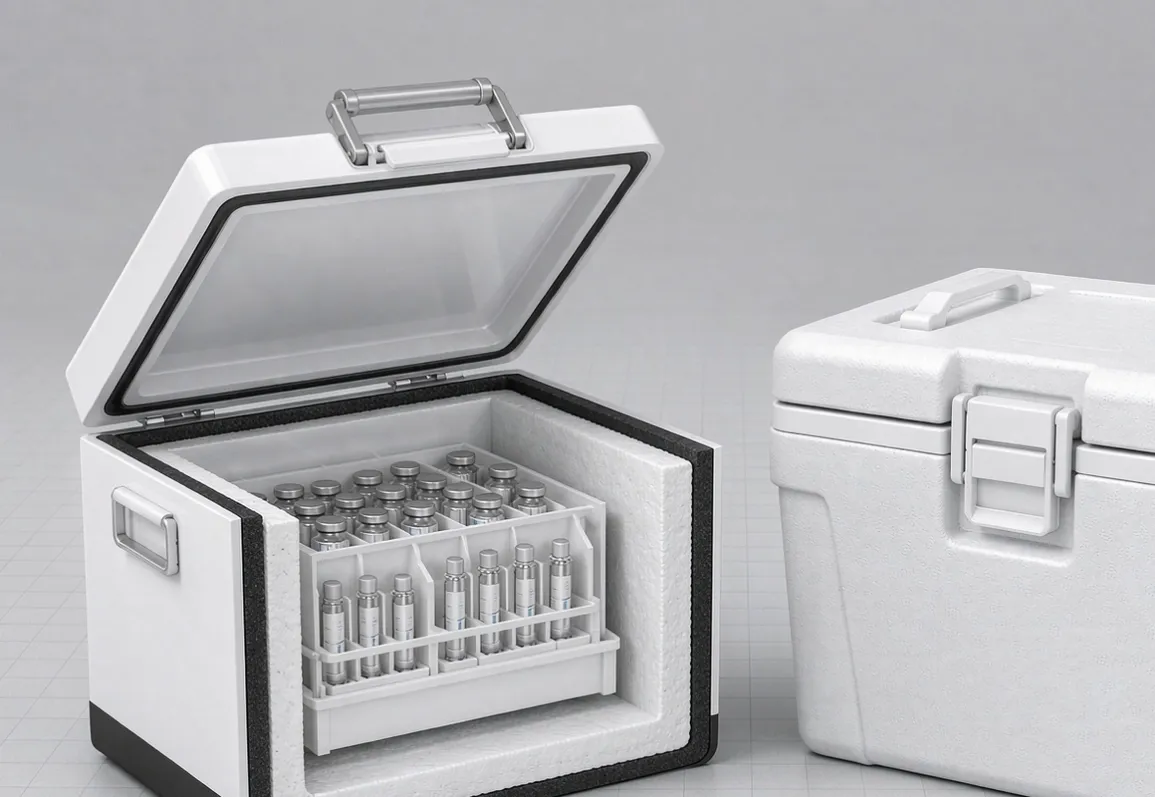
How to specify vacuum insulation panels for vaccine, medical, and fishing-box cold chain, and why a high-temperature microporous board is the wrong material for cold-side duty. Includes a technology comparison table and a VIP specification method.
Executive summary
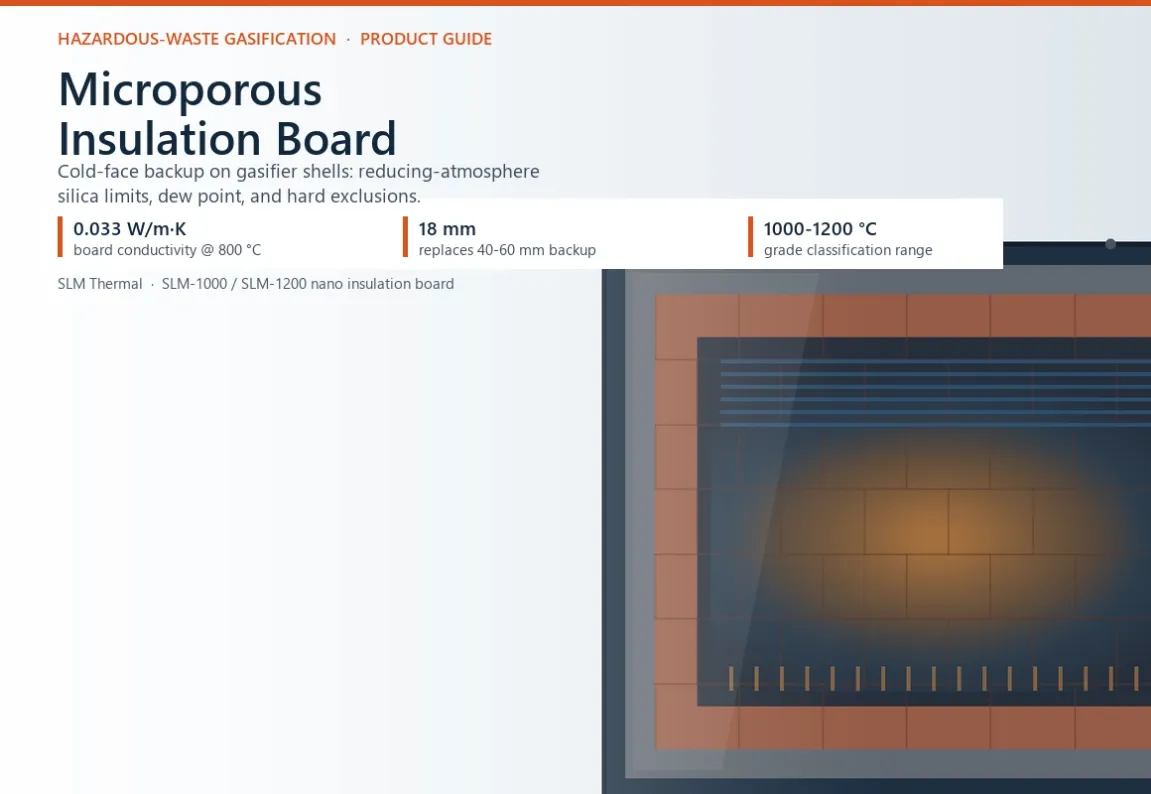
For cold-chain, medical, and fishing-box insulation, the correct technology is the vacuum insulation panel (VIP), not a high-temperature microporous board. A VIP uses an evacuated, gas-tight envelope around a low-conductivity core to reach a center-of-panel thermal conductivity of roughly 0.004–0.008 W/(m·K) — about five to ten times lower than the polyurethane (PU) foam or expanded polystyrene (EPS) otherwise used in these boxes. The company's 1000 °C class and 1200 °C class microporous nano insulation board is a high-temperature refractory back-up material. It sits behind the hot face (800–1400 °C) in furnaces and kilns. It is not a cold-chain material and should not be specified for vaccine carriers, medical freezers, or fishing coolers. The microporous vs VIP guide sets out the boundary between the two technologies in detail.
This article is a buyer's guide for engineers and procurement staff who need to specify VIPs for cold-chain duty. It covers what a VIP is, how the relevant insulation technologies compare at their working temperatures, the temperature bands that medical and fishing applications must hold, a practical specification method, installation and handling rules, and the common mistakes that cause field failures. Where the high-temperature microporous board is mentioned, it is presented as the material for the hot side only, so the line between the two product families stays clear.
The central point: cold-chain insulation is a low-temperature, vacuum-dependent problem; the company's microporous board is a high-temperature, atmospheric-pressure problem. They do not substitute for one another.
What a vacuum insulation panel is
A VIP is a composite. It has three functional parts:
A core material that provides mechanical structure and suppresses heat transfer. The two common cores are fumed silica (pyrogenic silica) and glass-fiber or PU/fiber batts.
A gas-tight, multi-layer high-barrier envelope (metallized polymer film, or aluminum-foil laminate) that holds a near-vacuum around the core.
Internal getters and desiccants that absorb residual gas and moisture to slow the loss of vacuum over time.
The vacuum removes gas conduction and convection, which are the dominant heat-transfer paths in conventional insulation. What remains is solid conduction through the core and a small radiative component. That is why a VIP reaches thermal conductivity values that conventional foam cannot approach.
Real published figures confirm the order of magnitude. va-Q-tec's va-Q-vip F (fumed-silica core) lists an initial center-of-panel thermal conductivity of 0.0043 W/(m·K) or lower at 10 °C, with a design value that includes aging and edge effects of 0.007–0.008 W/(m·K) (va-Q-tec product data sheet). A European Technical Assessment for a comparable fumed-silica VIP (ETA-23/0203, DIBt, 2024) declares λ_D of 0.0080–0.0087 W/(m·K) after adding the EN 17140 aging supplement and a 1.10 edge thermal-bridge factor on top of a λ90/90 of 0.0041–0.0045 W/(m·K). Manufacturer data from Wedge Insulation and Super Tech place the VIP range at 0.002–0.008 W/(m·K), against 0.020–0.030 for PU foam and 0.030–0.040 for EPS.
The working temperature range of a standard fumed-silica VIP is roughly −70 °C to +80 °C (va-Q-tec, Winnezone, and others state −70 °C to +80 °C, with temporary excursion to +120 °C). That band covers every cold-chain, medical, and fishing-box duty discussed below. The high-temperature microporous board, by contrast, is rated for continuous service where the hot face runs 800–1400 °C; it is engineered for the opposite end of the temperature scale.
Comparison of insulation technologies at their relevant conditions
The table below compares the materials at the temperatures where they are actually used. Note the temperature basis in each row, because thermal conductivity is temperature-dependent and a single number without a basis is not comparable.
| Technology | Core / type | Working temperature basis | Typical thermal conductivity at that basis | Relative thickness vs VIP at equal R | Source | |---|---|---|---|---|---| | VIP (fumed-silica core) | Evacuated fumed silica + barrier envelope | 10 °C (cold chain) | 0.004–0.008 W/(m·K) center; 0.007–0.008 design incl. edge + aging | 1× (reference) | va-Q-tec va-Q-vip F data sheet; ETA-23/0203 (DIBt, 2024) | | PU foam | Rigid polyurethane | ~10 °C | 0.020–0.030 W/(m·K) | ~5–10× | Super Tech VIP comparison; Wedge Insulation product data | | EPS | Expanded polystyrene | ~10 °C | 0.030–0.040 W/(m·K) | ~7–10× | Super Tech VIP comparison | | XPS | Extruded polystyrene | ~10 °C | 0.028–0.035 W/(m·K) | ~7–9× | Wedge Insulation product data | | Microporous nano board (1000 °C / 1200 °C class) | Atmospheric-pressure fumed-silica microporous board | Low / room temperature (~10 °C) | ~0.020–0.040 W/(m·K) reported at low temperature; advantage grows only at high mean temperature (600–1000 °C) | ~5–10× vs VIP; comparable to PU foam at cold temperature | Company product data; Microtherm-class published ranges |
Two readings follow directly from the table. First, a VIP delivers the same thermal resistance as PU foam at roughly one-fifth to one-tenth of the thickness. Wedge Insulation's own equal-resistance calculation shows a 20 mm VIP (λ ≈ 0.0045) matches about 102 mm of PU foam (λ ≈ 0.023) and about 156 mm of EPS. Second, the microporous nano board at cold temperature sits in the same band as PU foam and is far behind the VIP; its documented advantage appears only at high mean temperatures, which is the duty it is designed for. For a cold box, the board offers no space advantage over foam and is the wrong technology entirely.
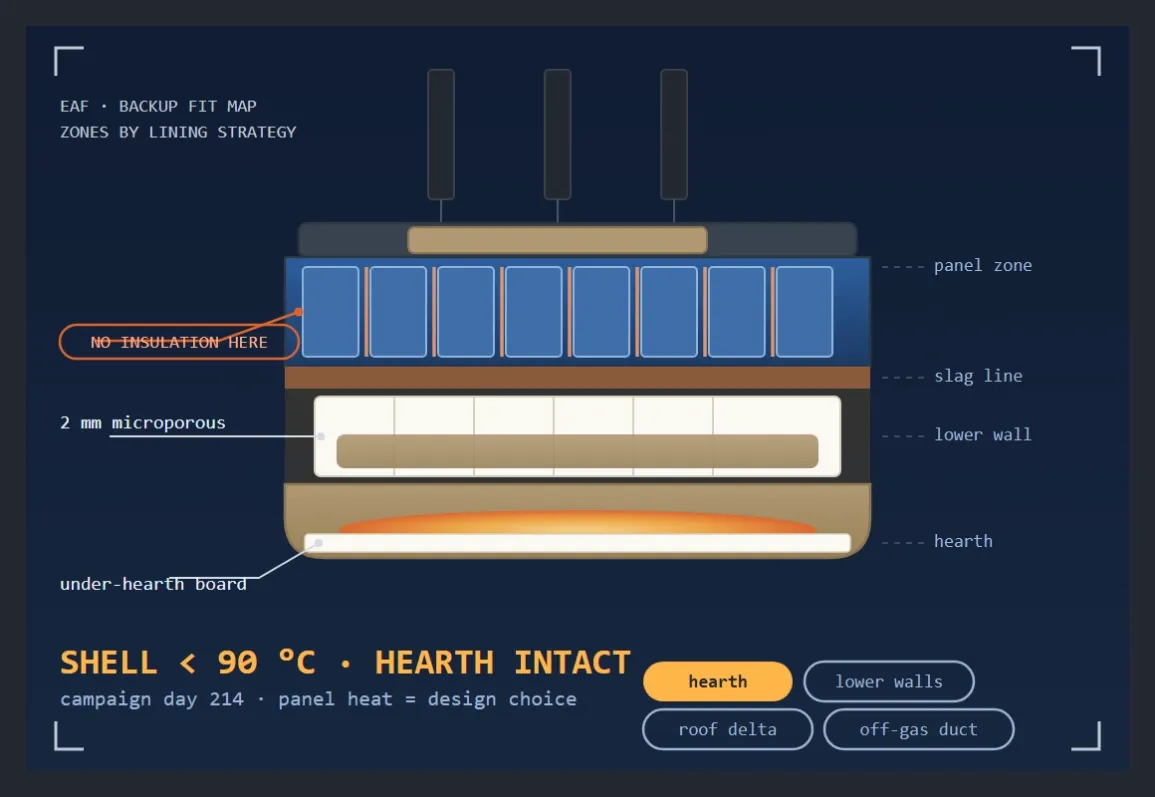
The application map shows where the high-temperature board is actually applied — furnace and kiln back-up insulation — which is the opposite duty from cold-chain boxes.
Cold-chain, medical, and fishing-box duty bands
Cold-chain and medical temperature bands are set by product stability, not by insulation preference. The relevant published bands are:
Vaccine cold chain (general refrigerated storage): +2 °C to +8 °C. This is the WHO and CDC standard for the large majority of vaccines (WHO vaccine cold-chain guidance; CDC storage and handling, ACIP).
Frozen vaccines and frozen food: roughly −15 °C to −25 °C for frozen vaccines (CDC freezers: −50 °C to −15 °C) and −18 °C as the conventional frozen-food storage temperature.
Ultra-cold mRNA vaccines: −60 °C to −80 °C (CDC/WHO COVID-19 logistics: ultra-cold freezers −90 °C to −60 °C; shipping −60 °C to −80 °C).
Fishing / angler cooler boxes: near 0 °C to +4 °C for fresh-catch icing and short-hold transport.
A VIP performs in each band because its published working range (−70 °C to +80 °C) spans all of them. The practical benefit is hold time and payload. In a cold box of fixed external size, thinner VIP walls leave more internal volume for product or refrigerant, and the low effective conductivity slows heat ingress, extending the time before an excursion occurs. Super Tech's cold-chain analysis notes that a VIP-based shipper typically holds temperature longer than a foam shipper of the same external dimensions, and that the smaller dimensional weight reduces air-freight cost — a material consideration for pharmaceutical lanes. va-Q-tec and field data (e.g., Thermtest, Simply Solved) report multi-day passive holds (commonly cited at 72–120 hours for qualified shippers) without active refrigeration.
The high-temperature microporous board plays no role in these bands. It is specified where the hot face sits at 800–1400 °C — behind refractory in furnaces, kilns, and reformers. The high-strength nano insulation boards cover the 1000 °C class, and the SLM-1000 vs SLM-1200 comparison guide explains the 1200 °C class option for hotter back-up duty. Neither is a cold-chain solution.
VIP specification method
Specifying a VIP for cold-chain duty follows a fixed sequence. The steps below are written for a buyer, not a vacuum physicist.
Step 1 — Choose the core. Fumed-silica core is the standard for cold-chain and medical boxes because it retains low conductivity to a higher internal pressure (roughly up to 10 mbar) than fiber cores, which extends service life and tolerates minor envelope permeability. Glass-fiber cores can be cheaper and slightly thinner but degrade faster as vacuum is lost. For vaccine and ultra-cold duty, fumed silica is the conservative choice.
Step 2 — Specify the envelope. Require a documented high-barrier laminate with stated oxygen and water-vapor transmission rates. A wrinkled, dimpled surface after evacuation is the sign of an intact vacuum; a smooth, taut face suggests lost vacuum and should be rejected at incoming inspection.
Step 3 — Calculate required thickness for a target U-value or R-value. Use d = R × λ. Pick the design value (including edge and aging allowance), not the ideal center-of-panel value. Example: to reach R = 2.5 (m²·K)/W with a design λ of 0.008 W/(m·K), the required thickness is 20 mm. The same R from PU foam at 0.023 would need about 58 mm. This is where the five-to-ten-times space saving originates.
Step 4 — Add an edge / thermal-bridging allowance. The barrier envelope conducts heat around the panel perimeter, raising the effective conductivity above the center value. The EN 17140 method applies an edge factor (the DIBt assessment uses 1.10) and a linear thermal bridge ψ at the perimeter. Thermtest summarizes a roughly 32% drop in thermal resistance along the perimeter from this edge bridge. Mitigation: use the largest practical panel size (edge losses scale with perimeter-to-area ratio), stagger joints between layers, and pre-frame panels with edge strips rather than butting bare edges.
Step 5 — Set the service-life expectation. With a metallized high-barrier envelope, the internal pressure of a 20 mm VIP rises by roughly 1 mbar per year, giving a working life of about 10–25 years depending on the required end-of-life conductivity (IRBnet durability review, citing Caps et al.). The DIBt assessment assumes a 25-year reference life for fumed-silica VIPs. Some manufacturers claim longer (va-Q-tec lists "up to 60 years" for its building-grade panel; published reviews note aluminum-foil envelopes can reach far longer lifetimes but at a higher edge-bridge penalty). For cold boxes, a 10–25 year expectation is the defensible planning figure; a punctured envelope ends the panel's vacuum immediately and is not covered by aging.
For the high-temperature board on its own duty, the sizing logic is different and is covered by the thickness sizing method and the datasheet guide, which explain how to read conductivity and hot-face limits from a microporous board data sheet.
Installation and handling rules
A VIP is fragile in a way that foam is not. The rules below are non-negotiable for cold-chain assembly.
No field cutting, drilling, or perforating. Any breach of the envelope destroys the vacuum and the panel reverts toward the conductivity of its bare core (commonly cited as 0.020–0.050 W/(m·K) once punctured — see TP Refractory and Anchor-Microporous guidance). Panels must be ordered to final dimensions after a frozen survey; tolerances are taken up with conventional filler strips, not by cutting the VIP.
Protect the envelope. VIPs need a protective outer shell or cladding in service — rigid casings for boxes, or board laminates in building use — to guard against puncture from tools, fixings, and abrasion. A bare panel should never be left exposed on a site.
Avoid punctures from fixings. Screws, nails, and staples must pass only through surrounding conventional insulation or designated infill zones, never through the VIP itself.
Inspect on arrival. Reject any panel with a smooth, flat face (lost vacuum) rather than the expected wrinkled or dimpled surface.
Plan for replacement. A punctured VIP cannot be repaired in the field; it is removed and replaced. In a cold box this typically causes a gradual cold-side temperature rise over hours, which is enough time to locate and swap the failed panel.
This is the opposite of the high-temperature microporous board, which can be cut and shaped on site with ordinary tools because it is not vacuum-dependent. The storage and cutting guide documents how the board is handled, cut, and stored for furnace back-up work. The contrast is the practical way to remember the boundary: if you can cut it on site, it is not a VIP; if it must stay sealed, it is not a cold-chain substitute for the microporous board.
Common mistakes
Specifying the microporous board for cold chain. The single most common error is to reach for the high-temperature board because both are "nano insulation." They are not interchangeable. The 1000 °C class and 1200 °C class boards are refractory back-up materials for hot faces of 800–1400 °C. For a vaccine carrier or fishing box they add cost and weight while delivering cold-side conductivity comparable to PU foam and far worse than a VIP. Use the failure analysis guide to see what happens when a material is applied outside its temperature regime.
Ignoring edge losses. Specifying thickness from the ideal center-of-panel λ and forgetting the edge thermal bridge under-specifies the wall. Apply the EN 17140 edge factor and prefer large, staggered panels. The joint-gap control note is about hot-side joints, but the principle — that joints and edges govern real performance — transfers directly.
Puncturing the envelope. Cutting, drilling, or impacting a VIP in assembly or service collapses its performance to core-material levels. Treat every panel as sealed and handle it accordingly.
Confusing temperature ranges. A VIP works from about −70 °C to +80 °C. The microporous board works from roughly ambient up to 1000–1200 °C hot-face. Mixing the two ranges — assuming the board can serve a cold box, or assuming a VIP can sit behind a 1200 °C flame — produces a failed installation either way.
For sourcing the high-temperature board correctly, the supplier audit checklist and the performance verification note describe how to qualify a microporous board supplier and confirm hot-side performance.
FAQ
1. Is a VIP the same as the company's microporous nano board? No. A VIP is an evacuated, gas-tight panel built for low-temperature duty (about −70 °C to +80 °C). The company's 1000 °C class and 1200 °C class microporous board is an atmospheric-pressure high-temperature material for furnace and kiln back-up (hot face 800–1400 °C). They solve different problems and are not substitutes.
2. What thermal conductivity should I specify for a cold-chain VIP? Use the design value that includes edge effects and aging — about 0.007–0.008 W/(m·K) for a fumed-silica VIP per va-Q-tec and the DIBt ETA-23/0203 assessment — not the ideal center-of-panel value near 0.004 W/(m·K). Sizing from the lower number under-insulates.
3. Can I cut a VIP to fit on site? No. Cutting, drilling, or puncturing breaks the vacuum and the panel drops to its core-material conductivity (roughly 0.020–0.050 W/(m·K)). Order panels to final size and fill gaps with conventional insulation. The high-temperature microporous board, by contrast, can be cut on site.
4. How long does a VIP last? With a metallized high-barrier envelope, planning figures are about 10–25 years before conductivity rises past the acceptable limit, based on roughly 1 mbar/year pressure increase (IRBnet durability review). The DIBt assessment uses a 25-year reference life. A puncture ends life immediately and is not an aging effect.
5. Which core is better for vaccine and ultra-cold duty? Fumed silica. It holds low conductivity to a higher internal pressure than fiber cores, which tolerates slow envelope permeation and extends service life — the safer choice for +2 °C to +8 °C vaccine storage and −60 °C to −80 °C ultra-cold shipping.
6. Why not just use PU foam or EPS in a cold box? You can, and foam remains the right choice for short-haul, low-value, or disposable shipments. VIP earns its cost when space, payload, hold time, or dimensional freight weight matters — typically long international pharmaceutical lanes and high-value medical shipments.
7. Can a VIP be used behind a hot refractory face? No. The standard VIP envelope is rated only to about +80 °C (temporary +120 °C). Above that, the envelope fails and the vacuum is lost. For hot-face back-up at 800–1400 °C, specify the high-temperature microporous board instead.
Where to go next
For high-temperature refractory back-up behind furnaces and kilns, the relevant material is the 1000 °C class and 1200 °C class microporous nano board, documented through the anchored back-up assembly application page and the product pages above. Use the RFQ template to request a hot-side quotation with your furnace dimensions and hot-face temperature.
For the boundary between the two technologies — high-temperature microporous board versus low-temperature VIP — read the dedicated microporous vs VIP guide referenced earlier in this article. That guide is the reference to use when a specification calls for cold-side insulation and someone proposes the high-temperature board, or vice versa.
---
PUBLISH META
Suggested slug: `nano-insulation-board-cold-chain-vip-guide`
Suggested cover image prompt: A clean technical product render of a vacuum insulation panel (VIP) placed inside a medical vaccine cold-chain box and a fishing cooler, shown side by side with a thick polyurethane foam wall of equal thermal resistance to illustrate the thin-panel-versus-thick-foam comparison; neutral industrial background, soft studio lighting, no text, no watermark, no logos.
-link verification: 13 Markdown internal/external links present, each anchor used exactly once: application map, microporous vs VIP guide, datasheet guide, thickness sizing method, performance verification, storage and cutting guide, supplier audit checklist, RFQ template, high-strength nano insulation boards, joint-gap control, SLM-1000 vs SLM-1200 comparison guide, failure analysis guide, anchored back-up assembly. Occurrences of the forbidden domain: 0. Domain used only as `www.slmthermal.com`.