Microporous Insulation Board in Power Equipment Enclosures: Specifications, Sizing, and Where It Does Not Belong
Specifications, conductivity data and sizing rules for SLM-1000/1200 microporous insulation board used as a thin enclosure liner - plus an honest boundary: when a 60-150 C cabinet does NOT justify a 1
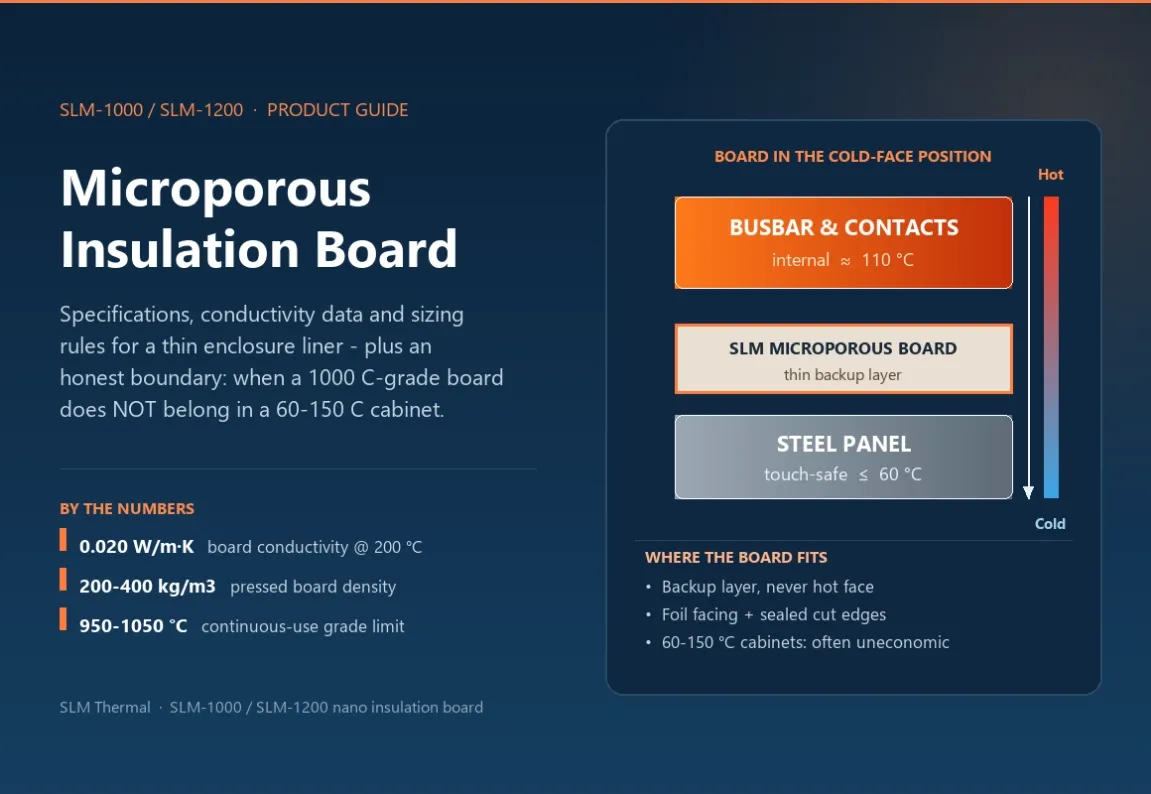
A microporous nano insulation board is a rigid panel made from fumed silica, opacifiers and reinforcing fibre, pressed to a density of 200–400 kg/m³. Its pores are smaller than the mean free path of air molecules, so gas conduction and convection are largely suppressed, and the opacifier blocks infrared radiation. The result is a thermal conductivity around 0.020 W/m·K at 200 °C — lower than still air. SLM supplies it in two standard grades, with continuous-use ratings of 950–1050 °C and special grades to 1100–1200 °C.
That rating is the first thing to understand about this product: it was engineered for the 800–1200 °C hot face of steel ladles, reheating furnaces, glass tanks, coke ovens and refinery fired heaters, where it sits as a thin backup layer behind the working refractory. Our application map shows where that backup position appears across those industries. Power-equipment enclosures run at 60–150 °C, which is a very different duty. This guide therefore does two things: it sets out the board's actual specification, sizing and installation rules, and it states plainly where a 1000 °C-grade board is not the right buy for a cabinet.
What the board is made of, and why its conductivity is so low
Three mechanisms are attacked at once. The nanoscopic silica particles minimise solid contact area, which cuts conduction through the skeleton. Pore diameters around 20 nm trap gas molecules so internal convection effectively disappears — the pores are smaller than the mean free path of air at atmospheric pressure. Finally, opacifiers such as titanium dioxide or silicon carbide reflect and absorb infrared radiation, which otherwise becomes the dominant heat-transfer path above roughly 400 °C.
Because the material is entirely inorganic, it is non-combustible (A1) and carries no fibre-shedding health classification — a practical advantage in a sealed electrical compartment where loose fibre would be unwelcome. It is also rigid and dimensionally stable, available in standard 1000 × 600 mm and 600 × 500 mm panels at 5–50 mm thickness, cut to ±1 mm by CNC where a shape has to fit a door or a cable gland. How the board is manufactured determines the pore structure and therefore the conductivity, so the production route is worth understanding before you compare suppliers on price alone.
The specification sheet that matters
Typical published values for standard commercial grades (datasheet figures; lot-to-lot variation is commonly 5–10 %):
Classification temperature: 950–1050 °C for standard grades; 1100–1200 °C for special grades.
Density: 200–400 kg/m³.
Compressive strength at 10 % deformation: 0.2–0.5 MPa — low, by design.
Thickness range: 5–50 mm; dimensional tolerance ±3 mm on length and width.
Facing options: aluminium foil, aluminium-foil cloth, POF film, non-woven fabric, glass-fibre cloth.
Shrinkage after a 12 h full soak at classification temperature: ≤2 %; ≤0.5 % on a single-face soak.
Relevant product standard: ASTM C1678.
Two numbers deserve emphasis. The low compressive strength means the board is a liner, never a structural member; it must be retained by the panel or a light frame, and must not carry load. And the pore structure is permanently destroyed by water ingress, so the board has to be sealed from moisture at every stage — transport, storage, installation and service.
The facing is therefore a functional part of the specification rather than a finish. Aluminium foil gives a clean, reflective, non-shedding skin and is the usual choice for a dry indoor cabinet; aluminium-foil cloth adds tear resistance where panels are handled repeatedly; POF film is a light, economical moisture barrier for short supply chains; non-woven fabric and glass-fibre cloth are chosen where the liner must tolerate abrasion or a higher surface temperature at the facing itself. Ask the supplier to state the facing on the drawing and on the certificate, because an unlined cut edge is the most common route for moisture to reach the core. A board that arrives with a damaged foil skin should be rejected at goods-in, not installed and hoped for.
Grade selection is straightforward once the temperature at the board's own position is known, not the temperature at the hot face. The SLM-1000 and SLM-1200 comparison sets out where the higher-temperature grade earns its premium and where the standard board is the economical call. The datasheet guide explains how to read a conductivity table, a shrinkage figure and a classification temperature without mistaking one for the other — a common source of over-specification.
Conductivity at real temperatures
The most rigorous way to judge this product is its conductivity against mean temperature, compared with conventional backup materials at the same temperature:
At 200 °C: microporous board ~0.020 W/m·K; ceramic-fibre blanket (128 kg/m³) ~0.070; roughly 3.5× better.
At 400 °C: ~0.024 versus ~0.130; roughly 5× better.
At 600 °C: ~0.028 versus ~0.190; roughly 7× better.
At 800 °C: ~0.031 versus ~0.270; roughly 9× better.
The gap widens with temperature because the blanket is dominated by solid-fibre conduction that climbs steeply above 400 °C, while the board's gas phase stays suppressed. That is why 30 mm of microporous board can replace roughly 150 mm of ceramic-fibre blanket at equivalent heat-stopping duty, and why a thinner backup layer frees internal volume in a furnace or a boiler wall.
Now the honest part for a 60–150 °C cabinet. At those temperatures the board is at the bottom of its curve, near 0.020 W/m·K, but conventional insulation is also far more competitive than it is at 600 °C. The nine-fold advantage at 800 °C is not available here. Microporous board typically costs three to eight times more per square metre than ceramic-fibre blanket, so in a cabinet with room for a thicker conventional liner, the premium is hard to justify. The board earns its place only when wall thickness is genuinely constrained, when an A1 non-combustible liner is mandatory, or when a very thin profile is needed to preserve internal clearance. That is a specification decision, not a marketing claim.
Sizing the board
Thickness selection works backwards from a surface-temperature target. Fix the allowable outer-panel temperature, estimate the temperature at the board's inner face from load and ventilation, and solve the one-dimensional conduction problem for thickness. ASTM C1055 is the usual reference for a 60 °C touch-safe surface in US practice and EN ISO 13732-1 in the EU; many operators tighten the target to 45–50 °C for caution. The thickness-sizing method walks through that calculation, including the joint-loss correction that first-pass estimates usually miss.
A worked example: an internal surface at 110 °C, a 40 °C ambient, and a 60 °C target on the outer face. A 15 mm board at roughly 0.022 W/m·K bridges the full 50 K across its thickness, giving a heat flux of about 73 W/m². Bare steel would need a substantially thicker conventional layer to hold the same drop. The point is not the exact figure — it is that a thin board converts a 50 K envelope into a few millimetres of wall.
Three practical rules follow. Keep the board on the cold-face side, behind any refractory or high-temperature layer; it is not a hot-face material. Specify the facing for the environment and seal every cut edge, because a single wet panel loses its structure permanently. And remember that seams dominate: a 1 mm open joint in a 20 mm board can leak as much heat as several millimetres of solid material.
Where a single 50 mm panel is not available or a thicker build is needed, stack two thinner boards with the joints staggered rather than aligned; a continuous through-joint is a thermal bridge that no conductivity figure can compensate for. Allow for differential movement between the steel panel and the liner when choosing a retainer — clamping a brittle board rigidly against a panel that expands on warm-up is a reliable way to crack it. A small compressible gasket at the edges, or a light frame that holds the board without preload, preserves both the panel and the thermal result. Re-check the outer surface after the first full-load heat soak, since a liner that looked continuous cold can open a seam once the steel has expanded.
Where the liner goes, and how to install it
In an enclosure the board is fitted to the inside of the steel panel, on the cool side of the wall, so it never sees the hot face and never carries mechanical load. Adhesive, light framing or the panel itself retains it. Around doors, removable covers and cable entries, the liner should be terminated so inspection stays possible — a board that has to be destroyed to reach a termination will be removed at the first service interval and never refitted.
Storage and cutting guidance covers the handling rules that matter most: keep panels in sealed moisture-barrier packaging until fit-up, cut with a fine-tooth blade or CNC, protect cut edges immediately, and avoid crushing the panel during clamping. Joint-gap control explains how to butt and strap panels, stagger seams and close the thermal short-circuits that otherwise undo a good conductivity figure.
Verifying what you bought and what you built
Two checks close the loop. At goods-in, an incoming QC checklist verifies density, thickness tolerance, facing integrity and — where a supplier can provide it — a spot conductivity result before panels are released to the cabinet build. After installation, performance verification is done with infrared thermography at no less than 75 % of rated current; partial-load scans under-read contact temperature and should never be used for sign-off. Periodic surface-temperature logging in service then catches ventilation drift before it becomes an insulation-life problem.
If a panel underperforms, the failure analysis notes show what actually goes wrong in the field: moisture ingress collapsing the pore structure, mechanical crushing from an over-tightened retainer, open joints at a door return, or a board placed too close to the hot face and run above its classification temperature. Most field "material failures" are installation failures.
Where the board is not the answer
This is the section a specification should start with.
Mild-temperature cabinets. At 60–150 °C a 1000 °C-rated board is over-engineered. Where there is room for a thicker conventional liner, or where a low-cost insulating pad or aerogel felt will hold the panel below the touch limit, use that. Specify microporous board only when three conditions coincide: wall thickness is severely constrained, an A1 non-combustible liner is required, and the thin profile buys something measurable in clearance or volume.
Cold-chain and near-ambient duty. Vaccine carriers, medical cold boxes, fishing boxes and chilled distribution use vacuum insulation panels, not microporous board. Those are different products with different temperature bands.
Direct hot-face contact. Molten metal, dross or slag will penetrate joints. The board belongs behind a working lining, never against the melt.
Structural or highly irregular geometry. Compressive strength of 0.2–0.5 MPa rules out load-bearing use. Deeply curved or complex shapes are better served by a conformable blanket unless a CNC-cut part is specified.
Unsealed wet environments. Without a reliable moisture barrier, do not use it.
Electrical protection is not its job. Slowing heat transfer through a compartment wall is a thermal function. Transformer fire barriers and switchgear arc-fault containment are engineered primarily through compartment design, fast protection tripping and pressure relief; our oil-immersed transformer fire barrier guide and the separate arc-fault protection discussion for medium-voltage switchgear cover that discipline. A liner may reduce transmitted heat during a fault, but it is not a substitute for it.
One adjacent application does sit closer to the product's real temperature range: battery energy storage systems, where a module-to-module barrier can see far higher excursions than a switchroom cabinet. Even there, the board is specified as a thermal break within a protection system, not as the protection system itself.
Buying, packing and shipping
Specify grade, thickness, facing and cut list together, and require sealed moisture-barrier packaging with the facing integrity called out on the purchase order. A useful RFQ states five things: classification temperature and grade, panel thickness and tolerance, facing type, the cut list with edge-sealing requirement, and the test certificate required at goods-in. Asking for those up front removes most of the back-and-forth that otherwise turns into a price comparison between unlike products.
Boards ship flat on pallets; container loading notes cover palletising, weather protection and how to keep panels dry through an overseas project. Because the material is brittle and moisture-sensitive, it is worth confirming the supplier's packaging before comparing unit prices — a cheaper panel that arrives with a punctured vapour barrier is not cheaper. Record the lot number against the cabinet serial at installation so that a later query about conductivity or shrinkage can be traced to a production batch.
Frequently asked questions
Can a microporous board keep a 130 °C enclosure below 60 °C? Yes, with the right thickness and a continuous lining. At 60–150 °C the board sits near its 0.020–0.024 W/m·K floor, so 10–20 mm typically bridges that gap. Solve for thickness from the surface target rather than relying on a rule of thumb.
Is this a fire-protection material? No. It is a thermal-insulation and temperature-control material, non-combustible by composition but not a rated fire barrier.
Does the liner interfere with switchgear cooling? Installed on the enclosure wall, it changes the outer-panel temperature rather than the internal airflow. Ventilation paths are a separate design constraint and must remain clear.
Which grade do I need? For a 60–150 °C liner, a standard 950–1050 °C grade is far more than sufficient. Reserve higher-temperature grades for positions that can see a sustained excursion above 1000 °C.
How should boards be stored on site? Sealed, flat, dry and off the floor; cut only when ready to fit, and seal cut edges the same day.
Can two thin boards be stacked instead of one thick one? Yes, and staggered joints usually perform better than a single panel with a continuous seam. Keep the total thickness in the conduction calculation and make sure the retainer does not crush the stack.
Bottom line
Start with the product, not the equipment. A microporous insulation board is a thin, non-combustible, moisture-sensitive, low-strength liner with a conductivity near 0.020 W/m·K and a 950–1050 °C rating; its value comes from specification discipline — grade, thickness, facing, joint control, incoming QC and an honest boundary on where it should not be used. Its home is the 800–1200 °C backup position behind refractory. A 60–150 °C power-equipment cabinet is an edge case: worth considering when space and non-combustibility dominate, usually not worth the premium otherwise. Judge the board on those terms and the specification will hold up.
Nano insulation boards are supplied by SLM (Nantong Suleiman). Figures cited as "datasheet" are typical published product values; standard references are ASTM C1055, EN ISO 13732-1 and ASTM C1678. Confirm grades, facings and thicknesses against the current product datasheet before specification.