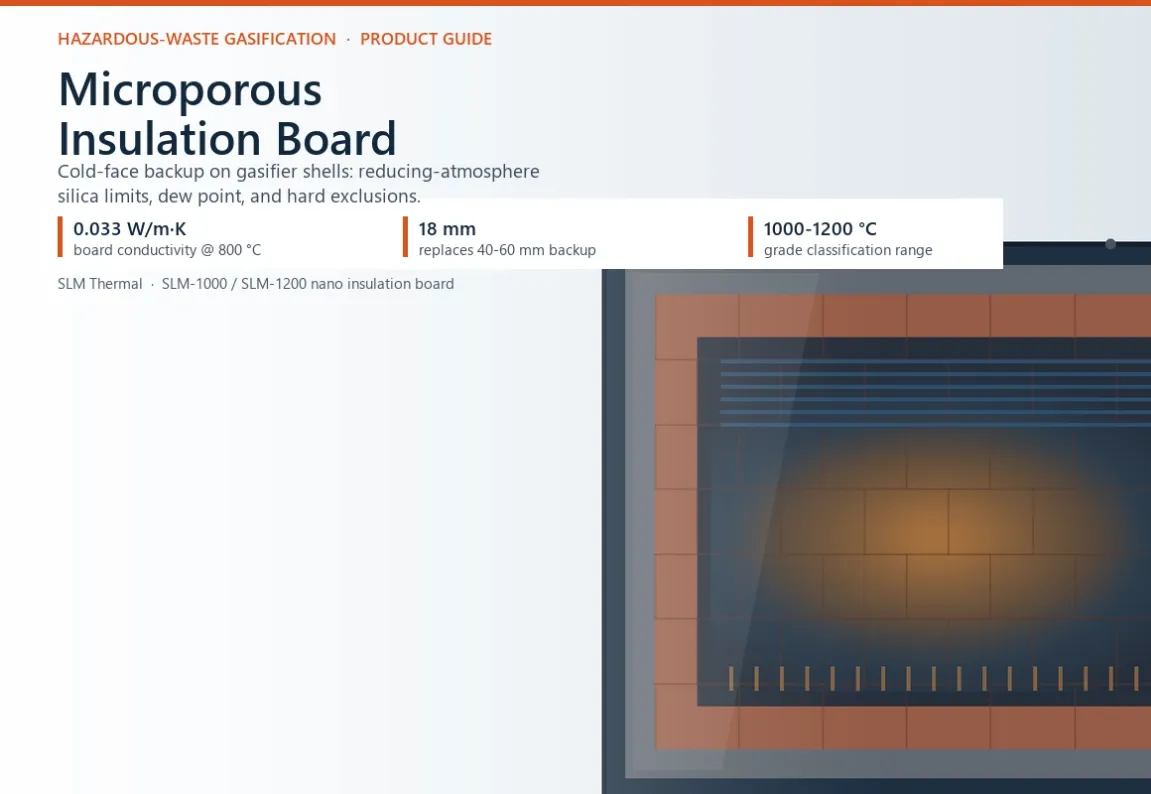
Microporous Insulation Board in Rotary Kiln Incinerators: Fixed-Shell Backup, Dew-Point Windows, and Where It Must Not Go
A product guide to SLM-1000/1200 microporous insulation board as cold-face backup in fixed steel casings of rotary kiln incinerators: conductivity at 200-800 C, classification versus continuous servic
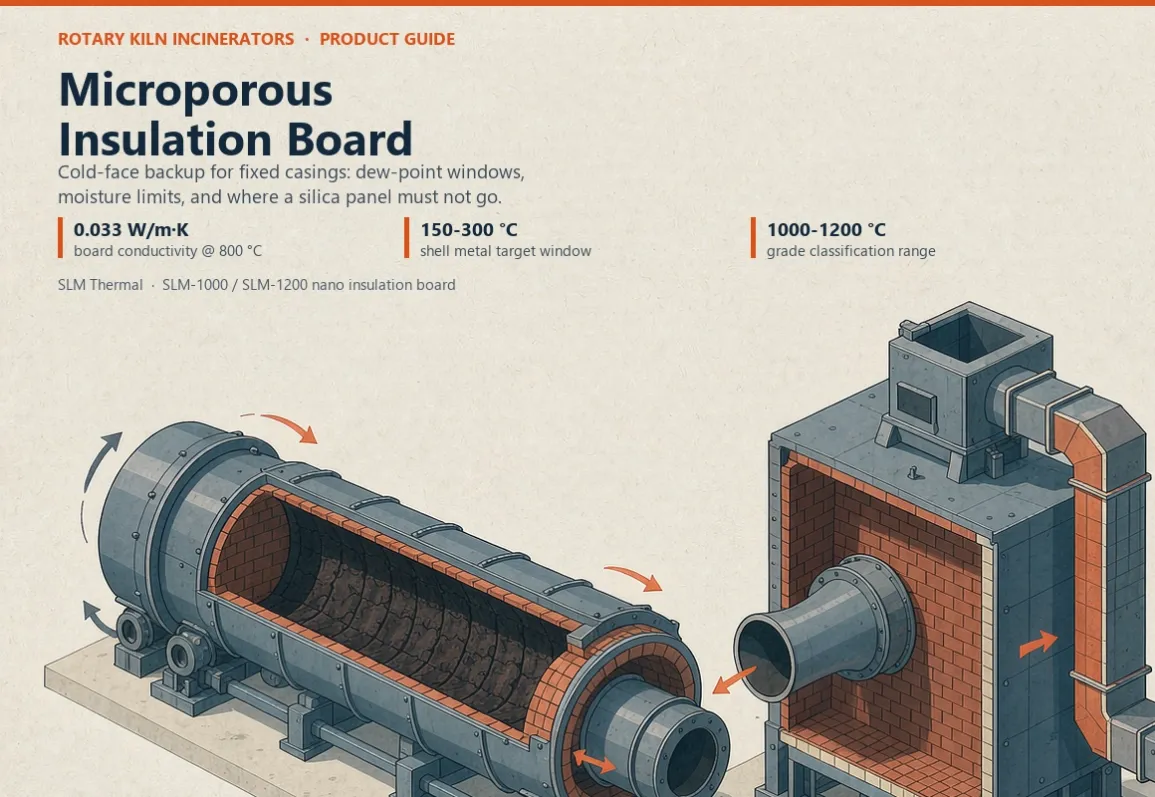
A hazardous-waste rotary kiln runs at roughly 900–1000 °C; the secondary combustion chamber is held near or above 1100 °C with a two-second gas residence time. Government environmental reports describe a waste-heat boiler taking flue gas from about 1150 °C down to roughly 550 °C, then a quench tower dropping it below 200 °C in about one second. Those are process conditions, not our product. Our application map puts SLM-1000/1200 microporous insulation board on the cold side of a dense refractory lining in fixed steel casings — the secondary chamber, flue ducts, kiln hoods and boiler casings — and nowhere else.
This is a product guide: what the board is, what its conductivity means at backup temperatures, how to read classification, shrinkage and hydrophobic grades, why wet flue gas changes the moisture specification, how to choose thickness from two opposing limits, and where the material is the wrong answer. Two honest limits up front. No independent third-party measurement of a fumed-silica board retrofit in an incinerator was found; the figures in circulation are datasheets, vendor claims, design estimates and reports on related kilns. And a rotating kiln shell is a dynamic, load-bearing component — a panel rated at 0.12–0.36 MPa does not belong on it.
What the board is, and what it is not
The board is a pressed composite of fumed silica, reinforcing fibre and an opacifier. Pores smaller than the mean free path of air suppress gas conduction and convection, while the opacifier scatters the infrared radiation that dominates above 400 °C. How the board is manufactured explains the difference from a fibre blanket: no network to settle under cycling, no binder to burn out during bake-out, no open cell for gas circulation.
Commercial grades carry 1000, 1100 and 1200 °C classification temperatures. One-hand datasheets give densities of 240–400 kg/m³, compressive strengths of 0.12–0.36 MPa under ASTM C165 and thicknesses of 3–50 mm. Facings include E-glass cloth, PE film, aluminium foil and hydrophobic cores; panels can be cut and drilled to a relining drawing. A1 non-combustibility is a material property, not a fire-protection rating, and this is a thermal backup layer, not a safety device.
The product boundary follows directly. A cold-face board is not a working lining, a chemical barrier against fly ash or slag, a structural layer, a vapour barrier or a gas-tight seal. One datasheet states that liquids — water, oil, petroleum spirit — densify the pore structure and change its conductivity, while non-condensed moisture does not. That sentence governs most of this article: incinerator flue gas carries 12.5–23.5 % water by volume in one published measurement and 15–30 % in supplier literature.
Product conductivity at backup temperatures
Published SLM curves give roughly 0.020 W/m·K at 20 °C, 0.022 at 200 °C, 0.025 at 400 °C and 0.033 at 800 °C. Independent datasheets sit in the same band: a 1000-grade panel lists 0.023 / 0.026 / 0.031 / 0.039 at 200 / 400 / 600 / 800 °C, a 1200-grade panel 0.029 / 0.033 / 0.039 / 0.044. The datasheet guide explains how to read these as mean-temperature values tied to a test method, density and grade.
| Mean temperature | Microporous board | Ceramic-fibre blanket | Calcium silicate | Lightweight castable | |---|---|---|---|---| | 200 °C | 0.022–0.023 W/m·K | ~0.06–0.07 W/m·K | ~0.06–0.10 W/m·K (room temp) | ~0.15–0.25 W/m·K | | 400 °C | 0.025–0.027 W/m·K | ~0.09–0.12 W/m·K | ~0.095–0.10 W/m·K | ~0.25–0.45 W/m·K | | 600 °C | ~0.029–0.034 W/m·K | ~0.12–0.17 W/m·K | ~0.12–0.13 W/m·K | ~0.28–0.45 W/m·K | | 800 °C | 0.033–0.044 W/m·K | ~0.16–0.23 W/m·K | ~0.12–0.15 W/m·K | ~0.30–0.45 W/m·K |
These values come from different supplier datasheets and one third-party verified calcium-silicate EPD (0.06–0.10 W/m·K at room temperature, 0.12–0.15 at 800 °C, strength above 1 MPa), not one comparative test programme. The board's curve stays nearly flat while fibrous alternatives steepen, which is why millimetres can replace tens of millimetres of backup. Above 600 °C radiation grows, so the opacifier and the hottest interface temperature matter more than the room-temperature figure.
Reading the datasheet before selecting the board
Classification temperature is a short shrinkage test, not a continuous working limit. One definition ties it to a 24-hour full-soak test with less than 2 % linear shrinkage; the same handbook maps grades 1000 / 1100 / 1200 °C to continuous service of 900 / 1000 / 1100 °C. Another datasheet is explicit: maximum continuous use applies only in an oxidising atmosphere without contaminants. A chlorinated, alkali-bearing flue gas is not one.
Shrinkage is equally conditional. One datasheet quotes less than 0.5 % after a 12-hour single-face soak at 1000 °C but less than 3 % after a 24-hour full soak; another gives 0.6 % versus 3.0 %. Ask for the figure with soak type, temperature and duration on the certificate. The SLM-1000 and SLM-1200 comparison sets out where a higher grade pays; here the decision is driven by the lining cold-face temperature, not the 1100 °C flame.
Facings need the same scrutiny. Hydrophobic grades are documented as water-repellent only to about 250 °C and foil encapsulation as a moisture barrier only to about 500 °C; above those the core behaves as an untreated panel. An industry association notes that liquid water causes permanent damage outside hydrophobic grades and that protective jacketing is required. Request the conductivity curve, density, strength, tolerance, facing, hydrophobic grade and written continuous-service confirmation.
The moisture and dew-point constraint on the board
Fumed silica has an open pore network, and one-hand datasheets state that any wetting liquid destroys or densifies it while non-condensed vapour does not. Laboratory work quantifies the effect: each 1 % of adsorbed water raises conductivity by 1.5–2 mW/(m·K); capillary condensation accelerates above 60 % RH, and at 95 % RH pores below 20 nm fill with water. Wetted hydrophilic silica peaks in conductivity near 100 °C, and drying does not reverse the damage. Wetted panels are rejected, not reused.
Flue gas makes that risk operational. Published acid dew points include about 72 °C for HCl, 110–150 °C for sulphuric acid and 129–147 °C for SO₂/SO₃; one hazardous-waste case calculated 149.4–166.5 °C. A corrosion reference states that if shell temperature falls below the gas dew point, condensation occurs, with corrosion peaking 15–50 °C below it. Two government reports describe a secondary-chamber support shell held near 180–200 °C with an insulated outer skin around 50 °C, expressly to avoid both low- and high-temperature HCl corrosion. Published mapping puts the weak-corrosion band near 150–300 °C.
Read that as a product constraint, not a compliance clause. The steel is meant to sit in a temperature window: over-insulating pushes the metal toward the dew point, under-insulating leaves the skin hot. A thin, high-resistance panel is useful precisely because its thickness can be tuned in millimetres — but more insulation is not automatically better. Hydrophobic cores and sealed facings address non-condensed humidity and short upsets, not sustained wetting, acidic condensate, salt solutions or temperatures above the facing's own limit.
Selecting the board from the lining cold face
Grade and thickness come from the worst case at the board's own interface. A published secondary-chamber section describes 230 mm of high-alumina brick plus roughly 320 mm of insulating courses, an air jacket and rock-wool felt; kiln linings are quoted at 250–300 mm total, with single-layer designs leaving the barrel above 350 °C and two-layer designs near 220 °C. The board sees that cold face, not the flame.
The thickness-sizing method guide gives the full calculation. Illustrative example, all inputs stated as design assumptions: assume a 380 °C lining cold face, a 190 °C target at the shell metal and 400 W/m² allowed by the designer. Required resistance is (380 − 190) / 400 = 0.475 m²·K/W — about 18 mm of board at 0.027 W/m·K, against 48 mm of calcium silicate at 0.10 or 59 mm of fibre blanket at 0.125. No public incinerator shell heat-flux limit was found, so the flux is a designer input.
Now apply the second constraint. A second 18 mm course would cut heat flux further and pull the metal toward the dew point during a cold start, when gas is wet and the lining cold. Run the calculation at start-up as well as steady state, with gas moisture, dew point and shell metal temperature written into the RFQ. Where the window is narrow, a thinner panel plus a conventional outer course is more robust than one thick nano layer.
Where the board sits in an incinerator lining
Published sections describe, from the hot side inward, a dense working lining of high-alumina brick or castable, insulating courses of lightweight castable, calcium-silicate or fibre board, and the steel casing. Secondary chambers list refractory castable, lightweight castable and calcium-silicate board; hoppers are described at 200–250 mm total and quench-tower upper zones near 100 mm. Waste-heat boilers are generally membrane-wall designs with superheater metal at 350–450 °C.
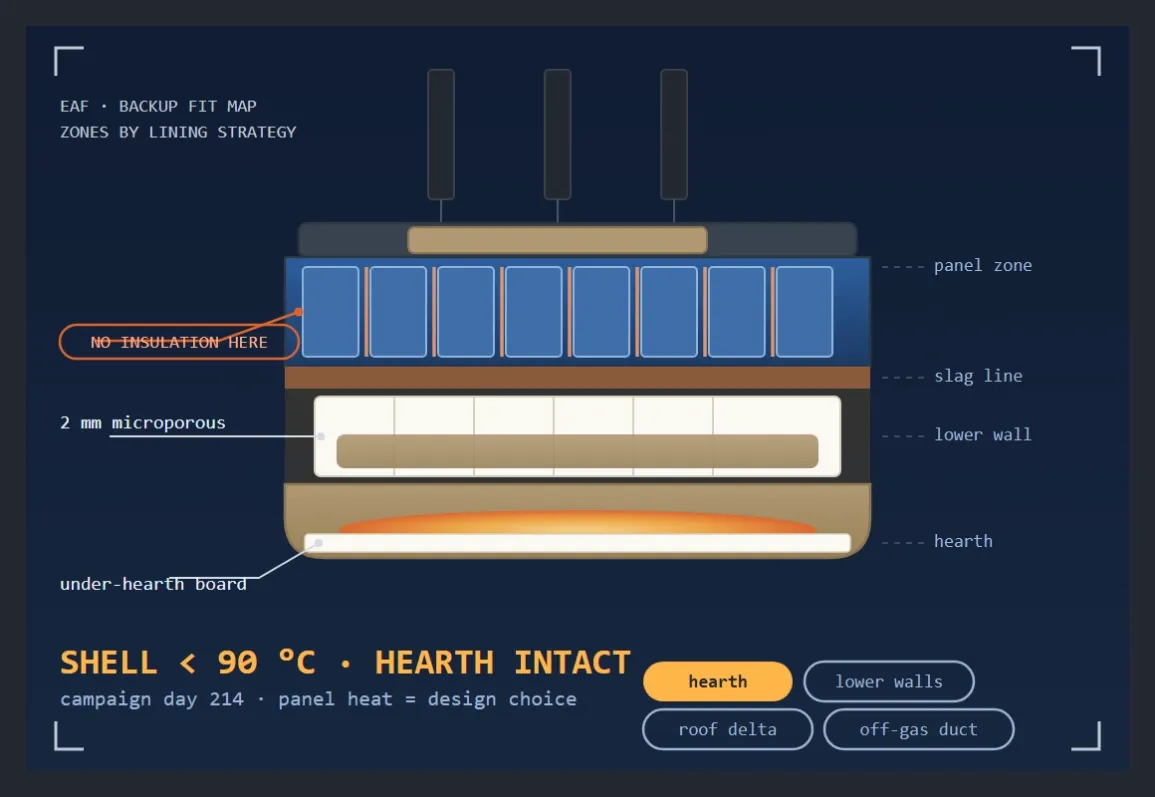
Read as a product rule: the board is a candidate only for the cold-side backup course in a fixed casing — chamber walls, flue ducts, kiln hoods, hopper shells and boiler casing panels — replacing part of the conventional insulating thickness. Rotating-kiln backup in dry conditions is covered in the cement kiln guide; the steam side in the industrial boiler guide. Neither addresses a wet, chlorinated flue gas, the extra specification item here.
Why the board is excluded from the rotating kiln shell
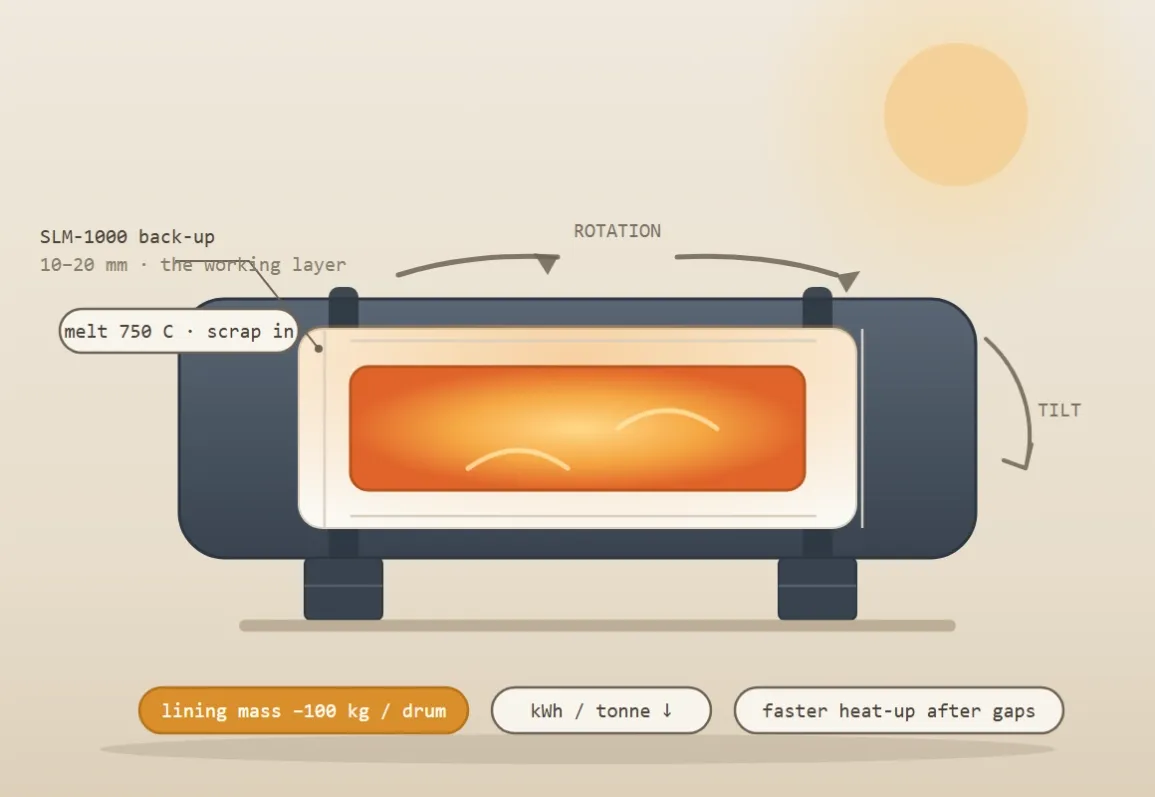
A kiln barrel is a welded cylinder on riding rings and rollers, driven through a girth gear and spring plates that damp shock. Speed is typically below 1 rpm, but the lining is a moving, loaded system: brick displacement, lost keying, vibration and thermal-mechanical stress are documented failure modes. Suppliers describe insulation bricks above 20 MPa compressive strength there and composite bricks with a 50–70 mm insulating zone, because the layer must carry load.
A panel at 0.12–0.36 MPa cannot carry that. It is rigid, cracks if flexed, and loses thickness and conductivity permanently if compressed past its elastic limit. Datasheets claim shock and vibration resistance, but no public measurement under rotating-kiln brick loading was found. One supplier estimates that nano board in grooves of composite bricks lowers barrel temperature 30–50 °C; that is a vendor design estimate, and the material still sits inside a load-bearing brick assembly.
The second reason is bake-out. A published schedule ramps to a 150 °C free-water plateau at 10 °C/h, a 300 °C stage at 30–50 °C/h and a 600 °C crystalline-water hold of at least 48 hours; castable guidance adds 8–16 hours at 800 °C, plus 24–48 for low-cement mixes. Heat-up also requires periodically rotating the kiln. A sealed panel in a wet, rotating assembly has no reliable drainage path; keep it in fixed casings where that route can be drawn and inspected.
What the published measurements show about the board
One-hand datasheets do list incineration: a board datasheet names incineration, cement kilns and power generation; a granulate names industrial chimney walls; a roll product names ducting. A second major manufacturer's industry list names none of incinerators, waste-to-energy, boilers or flues. Application lists show supplier intent, not performance.
Quantified gains are all vendor-sourced. A supplier page claims board in an incinerator and secondary chamber lowers casing temperature 35–50 °C; others quote 10–30 % energy savings or halved lining thickness. A vendor case on a rotating kiln reports 283 → 237 °C with a cost estimate, without identifying the material as a fumed-silica board in an incinerator; another is a steady-state calculation projecting 454 → 210 °C. None states a measurement protocol or third-party verification. Where a hot spot appears late in a campaign, the failure analysis notes explain what moisture, crushing and opened joints do to this material.
One peer-reviewed post-mortem reads against that narrative. Bricks from three kilns showed no significant thermo-chemical reaction with molten bottom ash; melt penetrated open pores by capillary action up to 5 mm, Na₂O to 7.5–12.5 mm, and one material was unaffected chemically after 21 months. Failure was attributed mainly to thermal-expansion mismatch and spalling, not alkali corrosion. That concerns dense brick, not microporous board — it cannot clear the board chemically, but it shows the "alkali destroys the lining" story is unsettled. No public compatibility study between fumed-silica board and HCl, chlorides, alkali vapour or fly ash was found. Keep a dense layer in front of the panels.
Installing the board: dry-out, joints, fixing and sealing
Re-check the bake-out curve before ordering. Cold start-up is quoted near 16 hours, hot restart at 2–5 hours, with 2–4 start-stop cycles per month at some plants. Free and chemically bound water leave at different plateaus, and a foil-faced panel on the wet side of a castable traps that water. The installation guide for ladles covers handling; the lining drawing governs where panels start and stop. Keep them on the dry shell side with a continuous drainage and vent path during heat-up.
A narrow open seam through an 18 mm panel bypasses the pore structure and acts as a thermal bridge; a few millimetres of gap can double local heat loss, and metal anchors become heat bridges and corrosion sites. Fit panels tight, stagger joints between courses, avoid continuous vertical seams, pack residual gaps with compatible fibre and allow 1–2 mm for expansion at steel interfaces. The joint-gap control notes give tolerances; duct transitions, hopper corners and cut-outs are where pre-cut pieces earn their cost.
Datasheets allow glue, anchors, pins and clips, but a fastener driven from the casing into the dense lining becomes a heat path, and an over-tightened clamp crushes a panel rated below 0.4 MPa. Where the casing detail cannot be adapted, retain panels with a light cold-side frame. Never use the board to close an expansion gap designed to move.
Panels arrive in sealed moisture-barrier packaging, are stored flat and dry, and are cut only when ready to fit; storage and cutting guidance covers the sequence. Every cut edge is sealed the day it is cut, and the facing is selected for expected condensate exposure with its temperature limit stated. Air in-leakage at kiln and chamber seals also raises excess oxygen, shifts the dew point and creates cold spots a panel cannot correct.
Inspection, acceptance and what a survey can prove
The incoming QC checklist covers tolerance, thickness uniformity, density, facing integrity, edge sealing, package moisture indication and certificates against the order. Add four items: shrinkage with its soak condition, written continuous-service confirmation at the design interface, the hydrophobic grade and its ceiling, and the calculated cold-face and shell-metal temperatures.
Acceptance is a like-for-like infrared shell survey at fixed points, logged with feed rate, waste calorific value, chamber temperature, flue-gas moisture, acid dew point, start-up versus steady state and campaign age. A public standards compilation notes that rotary incinerator outer surfaces commonly run 70–80 °C and sometimes above 100 °C against a design intent of no more than 50 °C above ambient, and calls for shell scanning and tight kiln-to-chamber joints. A slow rotating shell needs line-scanning synchronised to rotation. A reading after a cold start is not comparable to steady state, and a falling shell temperature is not automatically an improvement if it crosses the dew point.
Trend the survey through the campaign and re-measure at each relining. Brick linings need partial or full renewal every 1–3 years in one peer-reviewed study and 1–2 years in another; supplier figures range from 12–24 months to 8–12 years — resolve that conflict with plant records, not a brochure. Fouling is separate: one plant report describes severe ash deposition after ten days and duct differential pressure rising about 100 Pa per day before a forced shutdown.
Where the board is not the answer
The rotating kiln barrel. Dynamic brick loading, vibration and displacement demand a load-bearing insulating brick, not a panel rated at 0.12–0.36 MPa.
The working or chemical barrier lining. Dense brick or castable stops slag, ash and chloride penetration. A porous panel must not be the last line of defence.
The wet side of a castable. Free water from monolithic layers destroys the pore structure permanently. Keep the board on the dry, shell side with a drainage path during bake-out.
Sustained condensation and acidic liquid. Hydrophobic grades are documented only to about 250 °C and foil encapsulation to about 500 °C; neither survives continuous wetting or salt solutions.
Below the acid dew point. Over-insulating can pull the steel into the condensation range. Thickness is bounded by the dew point as well as by heat loss.
Direct flame, jet impingement and heavy abrasion. Secondary-chamber burner zones and slag-tapping areas need dense refractory.
Load-bearing, clamped or traffic positions. At under about 0.4 MPa compressive strength the board cannot carry the lining or absorb maintenance impact.
Unverified energy and shell-temperature promises. No independent third-party measurement of a microporous-board retrofit in an incinerator, no public shell heat-flux limit, no public chemical-compatibility study and no independent lining-life result was found.
Buying the board: RFQ inputs and packaging
Specify grade, thickness, facing, hydrophobic treatment, panel dimensions and cut list together, and call out sealed moisture-barrier packaging, edge-sealing material and the shrinkage test condition. Ask for the current datasheet with its conductivity curve and written confirmation of the continuous service temperature at the design interface. High-strength nano insulation boards are listed on the SLM product page; use that as the quotation reference so conductivity is compared at the same mean temperature and density.
A workable RFQ states which casings are fixed and which rotate, the full lining section, normal and peak chamber temperatures, calculated cold-face and shell-metal temperatures, target outer-skin temperature, flue-gas moisture, Cl/S/alkali content and acid dew point, start-up frequency, bake-out curve, available backup space, anchors, exclusion zones and a measured shell baseline. An RFQ template keeps those fields consistent across suppliers. Without the drawing, dew point and baseline, a thickness recommendation is a guess.
Frequently asked questions
Can the board be fitted to the rotating kiln shell? No. The barrel is a loaded, vibrating assembly whose brickwork must carry mechanical stress. Panels are for fixed casings only.
Why not simply add more thickness to lower the shell temperature? Because the steel is meant to sit in a temperature window. Design descriptions hold the support shell near 180–200 °C to avoid low- and high-temperature HCl corrosion; excessive backup can push the metal below the dew point.
Is there published field evidence? Application lists in datasheets and vendor-quoted shell reductions of 35–50 °C exist, but no independent third-party measurement of a fumed-silica board retrofit in an incinerator was found.
Does a hydrophobic facing solve the moisture problem? It addresses non-condensed humidity and short upsets. It is documented only to about 250 °C, and does not cover sustained wetting, acidic condensate or salt solutions.
How is a failing installation detected? By an infrared shell survey at fixed points trended against feed, gas moisture, start-up state and campaign age, with the dew point recorded alongside. A new hot spot usually means a joint, a fixing, a failed edge seal or a crack in the layer in front of the panel.
Bottom line
Microporous insulation board earns its place in a rotary kiln incinerator by delivering large thermal resistance in a few millimetres at the one position where it is wanted: the cold side of a dense lining in a fixed steel casing. It can cut casing heat loss, free lining thickness and hold an outer skin near target. It does not belong on the rotating barrel, does not face slag or fly ash, carry load, tolerate liquid water or release the designer from the acid dew point. Specify it from the worst-case cold-face temperature, bound thickness from both ends, keep it on the dry side of castables, control joints and fixings, and verify with a like-for-like shell survey that records gas moisture and dew point. Where rotation, chemistry, wetting or impact dominates, the board is only one part of the answer.
Data levels: temperatures, residence time, lining sections, shell descriptions, corrosion mapping, bake-out, start-up, campaign life and fouling from government environmental reports, international guidance, peer-reviewed papers, refractory literature and plant reports; conductivity, density, strength, classification, shrinkage, facings, hydrophobic limits and liquid sensitivity from commercial microporous datasheets, with SLM values from our own datasheet; comparison conductivity from supplier datasheets and a third-party verified calcium-silicate EPD. Vendor-quoted shell reductions, energy savings and the 30–50 °C composite-brick estimate are claims or design estimates without a stated protocol; the 283 → 237 °C case concerns a rotating kiln and is not identified as this product. The resistance calculation is a one-dimensional steady-state estimate with assumptions stated. No public independent third-party measurement of a microporous-board retrofit in an incinerator, no public incinerator shell heat-flux limit, no public compatibility study between fumed-silica board and HCl, chlorides, alkali vapour or fly ash, and no independent lining-life result was found. Confirm all product values against the current SLM datasheet before specification.