Microporous Insulation Board in Sodium-Ion Hard-Carbon Calcination Kilns: Cold-Face Back-Up Behind the Calcination Lining
A product guide to SLM-1000/1200 microporous insulation board as cold-face backup in sodium-ion hard-carbon calcination kilns: conductivity at 200-800 C, classification and facing limits, sizing from
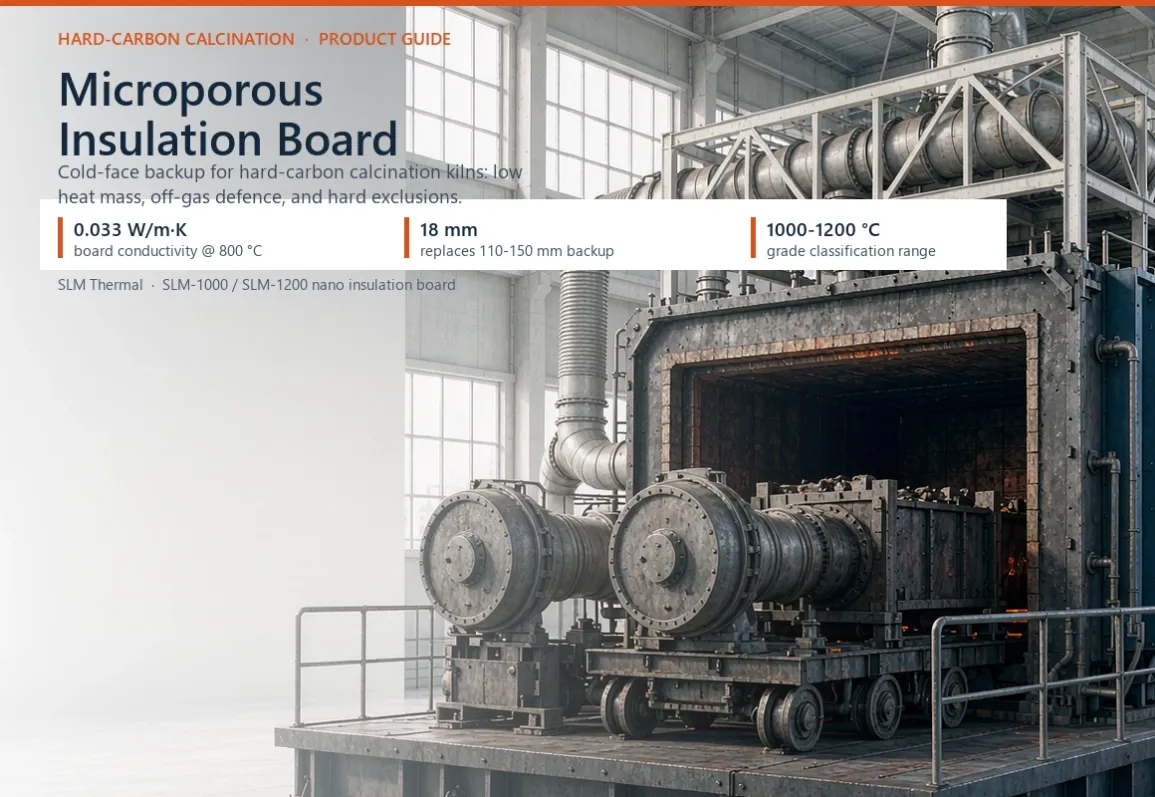
Sodium-ion batteries have put hard carbon back in the spotlight. The anode that lets Na⁺ store where graphite cannot is made by calcining an organic precursor — biomass, pitch or a polymer resin — at roughly 1,000–1,500 °C in an inert sweep. That calcination step runs in a continuous or semi-continuous high-temperature furnace, and it is squarely inside the 800–1,200 °C window where a thin microporous board earns its place. This guide explains where the board belongs in a hard-carbon calcination kiln, how to size it from the refractory cold-face temperature, and the eight places it should not go — including an honest look at what the off-gas does and does not threaten to the panel.
What the board does behind a calcination lining
SLM microporous boards, in the 1000 and 1200 grades, are silica panels: a fumed-silica matrix with infrared opacifiers and fibre reinforcement, engineered so that most of the pore space is below the mean free path of air. The result is a flat thermal conductivity of roughly 0.022 W/m·K at 200 °C rising to about 0.034–0.044 W/m·K near 800 °C — lower than still air across that band. In a hard-carbon calcination furnace the board is not the hot face and it is not structural. It is the final, thin, high-performance layer that sits against the steel shell or outer casing of the fixed walls and roof, behind the working refractory and the insulating backup course.
Because the board carries almost no load and adds almost no heat capacity, it lets the furnace reach temperature faster and shed less stored heat each cycle. The board's job is to stop heat at the cold face, not to take the flame, the load, or the product. Keep that boundary fixed and every other decision follows.
Stacking more ceramic-fibre blanket is the obvious alternative, but fibre is bulky and, above a certain thickness, its own radiation contribution grows; a thin board does the same job in a tenth of the space. That recovered thickness is not vanity — on a calcination furnace it widens the chamber, shortens the hot zone, or simply lets you hit a lower shell temperature without rebuilding the steel. The board is the space-efficient closing layer of a wall that already does its real work in the refractory ahead of it.
Why a hard-carbon line runs where the board fits
Hard carbon is used precisely because the sodium ion (about 95 pm) is too large to intercalate cleanly into graphite; graphite manages only a shallow NaC₇₀ stage with poor reversibility, whereas hard carbon's disordered, turbostratic structure with wider interlayer spacing stores sodium by adsorption, intercalation and nanopore filling. Making it means heating the precursor — coconut shell, lignin, phenolic resin, coal or petroleum pitch — through its pyrolysis and then a high-temperature soak. Published ranges put the calcination at 1,000–1,300 °C, with many lines converging on a 1,200–1,400 °C window, and some pushing toward 1,500 °C. The defining point is that hard carbon is deliberately not graphitized: graphite-anode graphitization runs at 2,800–3,000 °C, a categorically different and far hotter step that hard-carbon lines avoid. That 1,000–1,500 °C calcination band is exactly why the 1000 and 1200 grades of the board are a natural fit rather than an over-specification.
The furnaces used are continuous or semi-continuous: inclined rotary kilns with a counter-current inert sweep, and roller-hearth or pusher (push-plate) kilns for powder and pellet feed. Equipment makers quote pusher units rated to about 1,450 °C with a 1,400 °C working point, and roller-hearth carbonization furnaces working around 1,250 °C and rated to 1,300 °C. The atmosphere is high-purity nitrogen (often 99.999 %) or argon with oxygen held below roughly 10–50 ppm, and the dwell at peak is commonly 2–4 hours. Those are the conditions the lining — and therefore the board — must sit behind.
Where the board belongs — and where it does not
On the fixed walls and the flat or suspended roof of a pusher or roller-hearth calcination furnace, the board belongs as the outermost backup, between the insulating backup course and the steel shell. The working lining (high-alumina or cordierite-mullite brick, or a dense ceramic-fibre module) takes the flame and the powder; the lightweight backup drops the temperature; the board caps the wall with a thin, predictable resistance and pins the shell temperature. On a flat or suspended roof the board is held the same way — laid on a flat, rigid course and retained by the module above or by studs, never hung as a free span that can sag and crack under its own weight plus the thermal movement of the cycle.
A rotary calcination kiln is a different animal. Its drum rotates, and the board is neither load-bearing nor abrasion-resistant, so it cannot be the hot-face lining inside the turning cylinder. Where a rotary kiln is used, the board is relevant only on the stationary steel shell, mechanically retained behind the refractory brick and never exposed to the tumbling burden. In practice the fixed-wall pusher or roller-hearth furnace is the cleaner home for the board; treat the rotating drum as a case that needs explicit mechanical retention, not a default.
Sizing the board from the refractory cold-face temperature
The only temperature that matters for grade and thickness is the temperature at the cold face of the refractory backup — the hot face of the board — not the 1,200–1,400 °C chamber temperature. In a typical pusher-kiln calcination wall (working brick plus an insulating backup course) the board hot face at peak soak often lands near 350–400 °C. Treat that interface as the design point, and confirm it with a wall thermal model rather than a rule of thumb.
Worked example, steady one-dimensional, illustrative only: board hot face 360 °C, target shell 70 °C, so ΔT ≈ 290 °C. An 18 mm board at a representative conductivity ≈ 0.035 W/m·K gives a resistance of 0.018 / 0.035 ≈ 0.51 m²·K/W, so heat flux q ≈ 570 W/m². To pass the same flux you would need roughly 150 mm of ceramic-fibre blanket (≈0.11 W/m·K) or about 110 mm of calcium silicate (≈0.075 W/m·K). The board recovers 90–130 mm of wall thickness for the same shell temperature. This is a simplified conduction comparison; it excludes the radiation and contact resistance of the preceding courses and should be confirmed against the actual build-up. In practice the preceding brick and fibre have already done most of the temperature drop, so the board is the final thin layer that trims the last few hundred watts per square metre — not the component that does the heavy lifting. No public, third-party measurement of a microporous-backed hard-carbon calcination kiln was found, so every saving estimate here is a physics-based bound, not a field result you can put in a bid without your own trial.
Two constraints sit on the shell side. The metal casing must stay below its long-term service limit (commonly cited around 400 °C for structural steel) and, where the off-gas contains water vapour or acid, above the dew point so condensate does not form on the steel. The board helps drive the shell down, but it cannot by itself guarantee the lower bound; the preceding refractory and the casing seals do that.
Grade selection: 1000 vs 1200
Pick the grade from the board hot-face temperature, not the calcination peak. If the refractory cold face stays at or below about 1,000 °C, the 1000 grade is the right choice; if the backup interface can reach 1,000–1,200 °C — for example near the peak zone of a pusher kiln where the backup runs hot — specify the 1200 grade. For most hard-carbon calcination walls the interface is comfortably under 1,000 °C at peak, so the 1000 grade is common; for the hotter backup zones the 1200 grade is the safer specification. The continuous-use limit of the grade, not the chamber temperature, is the line you must not cross.
Facing, encapsulation and off-gas defence
The board is porous and, with the exception of the hydrophobic grade, is permanently damaged by liquid water and by oil. One vendor's data sheet states this explicitly: water and oil "irreversibly destroy the microporous structure." Hydrophobic treatment survives only up to about 250 °C (Morgan data sheets and ASTM C1676 agree), so it protects the board during storage, handling and any cool-face condensation — it is not a running-temperature waterproofing. In a calcination furnace the running interface is far above 250 °C, so the real moisture and condensate defence is the steel casing, the seals, and keeping the backup dry during shutdowns.
The off-gas is the part that deserves a clear-eyed look. Precursor pyrolysis at 1,000–1,500 °C releases permanent gas (H₂, CH₄, CO, CO₂) and a condensable tar fraction that carries phenolics and polycyclic aromatics; tar formation continues above 800 °C. Tar is an organic liquid that wets the board the same way oil does, and the manufacturer warnings about oil apply by direct analogy: a tar film on the cold face would irreversibly fill the nanopores and raise the conductivity. The defence is therefore mechanical, not chemical — a continuous vapour barrier facing, tight casing seals, and venting the pyrolysis gas so it cannot migrate back to the cold face and condense on the panel. Where the board could see condensation or tar at idle, use foil- or PE-film-faced stock and keep it wrapped until the wall is closed.
Anchoring and joint practice
A microporous board has a compressive strength on the order of 0.2–1.1 MPa — a fraction of a firebrick's 30–70 MPa — and its edges chip if unsupported. It must be laid against a flat, rigid backup and held by the overlying course or by studs sized for the board, not relied on to span a gap. At the joints, keep gaps tight and staggered between courses so there is no straight thermal shortcut through the backup. Because a calcination furnace heats and cools every campaign, the anchoring must tolerate that movement without crushing the board edges — a flat, fully supported bed matters more than in a truly steady installation, and loose studs that ratchet against the brittle edge will eventually open a leak path.
Receiving and verifying the boards
Before any board goes into the wall, verify it against the order: grade, thickness, facing, and dimensions, plus a conductivity or density check at incoming inspection. Reject boards with crushed corners, delamination, or facing tears, because those defects become thermal shortcuts once the wall is closed and cannot be repaired in place. Record the batch and the measured values; that paper trail is what lets you correlate a shell hot-spot two years later with a specific delivery, and it is the only way to learn whether your particular furnace is kind or cruel to the material. Store the boards flat and off the floor, never stacked under heavy material, and protect the edges with corner guards during the move to the wall — most field damage is inflicted in the last ten metres, not in transit.
Where the board is not the answer
Not the hot face. The board never sees the flame, the powder burden, or the direct furnace atmosphere. It sits behind the working lining.
Not a load-bearing or impact face. With compressive strength under ~1 MPa and brittle edges, it must not carry load or take knocks. Inside a rotary drum it is disqualified as the working lining; on the shell it needs explicit retention.
Not an exposed rotating-surface lining. The turning cylinder of a rotary calcination kiln abrades and tumbles its burden against the lining; the board cannot be that lining. Keep it on stationary structures only.
Not a barrier to alkali from ash-bearing precursors. Standard hard-carbon calcination acts on the organic precursor with no sodium added — sodiation is a downstream step, so free sodium-metal vapour is essentially absent at calcination. But biomass precursors can carry natural sodium and potassium that volatilize above 1,000 °C as Na₂O/Na₂CO₃ and condense on a cold face, and silica-based board is attacked by alkali: molten alkali hydroxide reacts with silica to form a soluble silicate, and alkali vapour forms sodium silicate on silica below roughly 1,320 °C in air-fuel atmospheres (about 1,410 °C under oxy-fuel). No vendor or study quantifies long-term resistance of fumed-silica microporous board to battery-kiln alkali — treat it as unproven and keep a barrier course when the feed is ash-rich.
Not a shield against tar wetting. Pyrolysis tar is an organic liquid that wets and destroys the nanopores by the same mechanism as oil. Vent the off-gas and keep a vapour barrier; no third-party test of the board against carbonization off-gas was located.
Not a substitute for the working lining's thickness. A thin board cannot replace the refractory that actually holds the temperature; it only trims the backup.
Not immune to liquid water or oil. A leaking seal, wash-down, or oil during maintenance will wreck the pore structure permanently.
Not a proven energy-saving claim for your specific furnace. Every calcination saving figure we could locate is a vendor or generic low-mass claim; no independent, year-long measurement on a microporous-backed hard-carbon calcination kiln was found. Budget on the conduction physics, not on a brochure number.
Frequently asked questions
Can the board line a rotary calcination kiln? Not as the hot-face lining of the rotating drum — the board is neither load-bearing nor abrasion-resistant. On a rotary kiln it is relevant only on the stationary steel shell, mechanically retained behind the refractory brick and never exposed to the tumbling burden. Fixed-wall pusher and roller-hearth furnaces are the cleaner home for it.
1000 or 1200 grade for a 1,300 °C calcination peak? Size from the board hot face, not the chamber peak. If the refractory cold face stays under ~1,000 °C, the 1000 grade; if the backup interface reaches 1,000–1,200 °C near the peak zone, use the 1200 grade.
Does sodium vapour attack the board? In standard hard-carbon calcination, no — the step acts on the organic precursor with sodium added only later, so free sodium-metal vapour is essentially absent. The caveat is ash-rich biomass feed, which can carry natural alkali that volatilizes and condenses on a cold face; keep a barrier course in that case.
Will tar from the off-gas ruin the board? Yes, if it reaches the cold face as a liquid: tar wets and permanently fills the nanopores just like oil. Vent the pyrolysis gas, seal the casing, and use a vapour-barrier facing so condensate or tar cannot migrate back onto the panel.
How much wall thickness do I recover? In the illustrative example above, ~18 mm of board replaces roughly 110–150 mm of conventional backup for the same shell temperature — room that can widen the chamber or shorten the hot zone.
Bottom line
In a sodium-ion hard-carbon calcination kiln the microporous board is a cold-face back-up for the fixed walls and roof: thin, low-heat-mass, and graded from the refractory cold-face temperature. It is not the hot face, not load-bearing, and not a proven cure for tar wetting or for ash-derived alkali — those limits are honest, and in the case of kiln-specific energy saving, untested. The off-gas at calcination is mostly benign pyrolysis gas with the sodium step still downstream, so the board's real enemies here are mechanical exposure and condensate or tar reaching the cold face, not sodium vapour. Size it from the interface, protect it behind the working lining, vent the off-gas, and confirm any energy claim on your own first campaign. A post-mortem on returned boards is the fastest way to learn what your specific furnace asks of them.
For the wider picture across furnace types, start with our application map and how the board is manufactured; read the datasheet guide and the SLM-1000 and SLM-1200 comparison, then the tunnel kiln guide and the thickness-sizing method. For field reality, see the failure analysis, the roller kiln guide and the cathode kiln guide; the installation guide, joint-gap control and incoming QC checklist cover putting it in well, and the high-strength nano insulation boards product page and the RFQ template close the loop on supply.