Microporous Insulation Board in Continuous Casting Tundishes: Cold-Face Backup, Superheat Control, and Where It Must Not Go
A product guide to SLM-1000/1200 microporous insulation board as cold-face backup between the permanent lining and the steel shell of a continuous casting tundish: conductivity at 200-800 C, classific
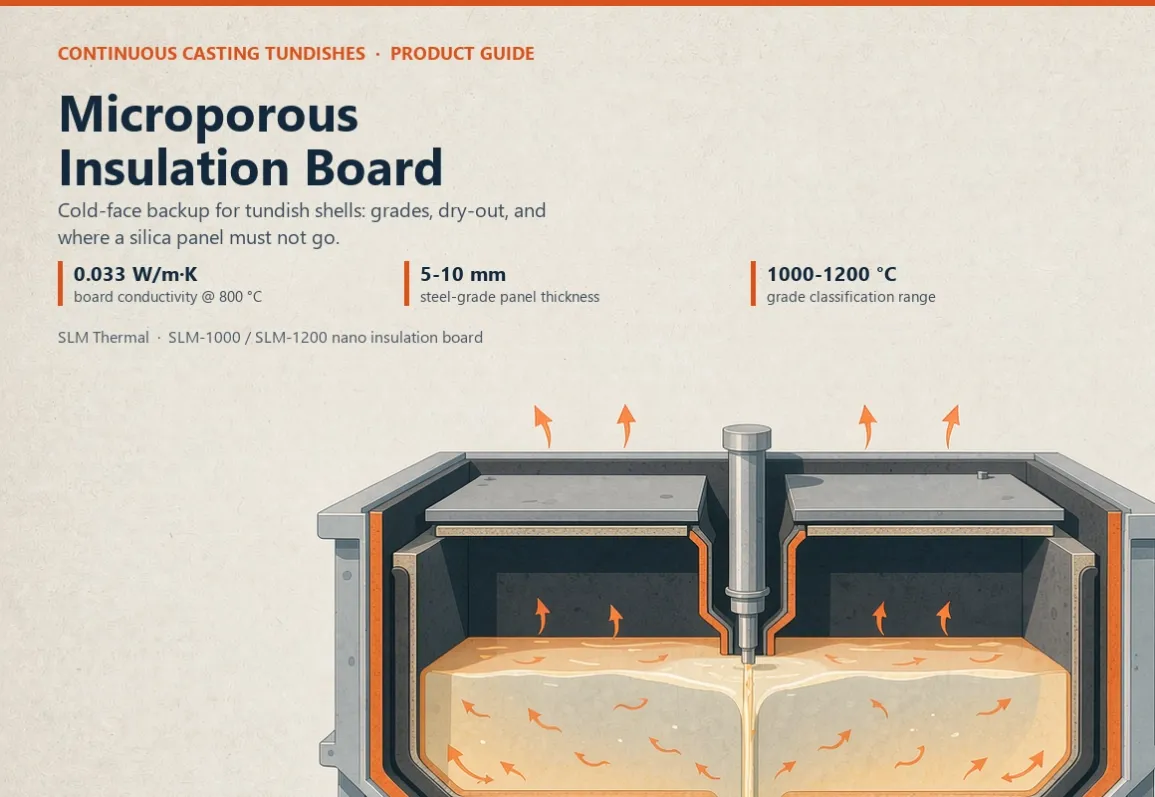
Steel enters a continuous casting tundish at roughly 1550–1600 °C and leaves it cooler. One published set of 13 heats measured 1596–1632 °C from the ladle and 1552–1587 °C in the tundish after 15 minutes; an instrumented 8 t caster recorded 0.164 K/min and 11.1 K over a 70-minute sequence, against a quoted 0.2–0.5 K/min range. Ladle-to-ladle swings of 15–25 °C narrow to 5–10 °C with tundish heating. Those numbers describe the process, not our product. Our application map puts SLM-1000/1200 microporous insulation board on the cold side of a dense permanent lining, between that lining and the steel shell, and nowhere else.
This is a product guide: what the board is, what its conductivity means at backup temperatures, how to read classification and shrinkage figures, how to choose grade, facing and thickness from the permanent-lining cold face, where it fits in a tundish build-up, how to dry, cut, fix and inspect it, and where the material is the wrong answer. Two honest limits up front. First, no independent third-party field measurement of microporous board in a tundish was found; the numbers that exist are a Chinese plant trial, a steelmaker's report on related vessels, a numerical model and supplier claims. Second, a published heat-balance study attributes about 82 % of tundish heat loss to the top surface and only 18 % to the lining. A shell-side panel works on the smaller share. It cannot deliver a steel-temperature promise on its own.
What the board is, and what it is not
The board is a pressed composite of fumed silica, reinforcing fibre and an opacifier. Pores smaller than the mean free path of air suppress gas conduction and convection, while the opacifier scatters the infrared radiation that dominates above 400 °C. How the board is manufactured explains the difference from a fibre blanket: no fibrous network to settle under repeated thermal cycling, no organic binder to burn out during preheat, no open cell for slag vapour to circulate through.
Commercial grades carry 1000, 1100 and 1200 °C classification temperatures. One-hand datasheets give densities near 230–450 kg/m³, compressive strengths from 0.12 to just over 1 MPa, and thicknesses from 3 to 50 mm; steel-industry products are commonly supplied at 5, 7 or 10 mm. Facings include E-glass cloth, PE film, aluminium foil, mica laminate and hydrophobic cores. Panels can be cut, sawn, drilled and punched to a relining drawing. A1 non-combustibility is a material property, not a fire-protection rating, and this product is a thermal backup layer rather than a safety device.
One naming trap matters here. Published descriptions of a "cold tundish" say it uses insulation boards as the lining and needs no preheating. Those are disposable resin-bonded magnesia or calcium-silicate working-lining panels, discarded after each sequence — not microporous backup panels. A microporous board is a permanent, protected, cold-face layer that stays in the vessel through many working-lining campaigns.
The product boundary follows. A cold-face board is not a working lining, not a safety or penetration barrier, not a structural layer, not a disposable cold-tundish panel and not a substitute for a cover. Datasheets for microporous granulate state that liquids — water, oil, petroleum spirit — densify the pore structure and change its conductivity, while non-condensed moisture does not. Facing, edge sealing and packaging are part of the specification.
Product conductivity at backup temperatures
Published SLM curves give roughly 0.020 W/m·K at 20 °C, 0.022 at 200 °C, 0.025 at 400 °C and 0.033 at 800 °C. Independent commercial datasheets sit in the same band. A widely cited ultra board lists 0.022 / 0.027 / 0.034 / 0.044 W/m·K at 200 / 400 / 600 / 800 °C; a 1000-grade panel lists 0.023 / 0.026 / 0.031 / 0.039; a 1200-grade panel 0.029 / 0.033 / 0.039 / 0.044. The datasheet guide explains how to read these as mean-temperature values tied to a test method, a density and a defined grade before putting them into a calculation.
| Mean temperature | Microporous board | Ceramic-fibre blanket | Calcium silicate | Insulating firebrick | |---|---|---|---|---| | 200 °C | 0.022–0.023 W/m·K | ~0.06–0.07 W/m·K | ~0.06–0.10 W/m·K (room temp) | ~0.15 W/m·K | | 400 °C | 0.025–0.027 W/m·K | ~0.10–0.12 W/m·K | ~0.095–0.10 W/m·K | ~0.19 W/m·K | | 600 °C | ~0.029–0.034 W/m·K | ~0.17–0.22 W/m·K | ~0.12–0.13 W/m·K | ~0.20–0.22 W/m·K | | 800 °C | 0.033–0.044 W/m·K | ~0.19–0.23 W/m·K | ~0.12–0.15 W/m·K | ~0.22 W/m·K |
These comparison values come from supplier datasheets, not one comparative test programme. Lightweight castable is quoted near 0.15–0.42 W/m·K at 400 °C and 0.28–0.36 at 600 °C. The board's curve stays nearly flat while fibrous alternatives steepen, which is why a millimetre-scale layer can replace tens of millimetres of backup. Above 600 °C radiation through the pores grows, so the grade's opacifier and the hottest interface temperature matter more than the room-temperature figure.
Reading the datasheet before selecting the board
Classification temperature is a short shrinkage test, not a continuous working limit. One manufacturer's own definition ties it to a 24-hour full-soak test with less than 2 % linear shrinkage; the same manufacturer's handbook maps grades 1000 / 1100 / 1200 °C to continuous service of 900 / 1000 / 1100 °C. A steel-grade datasheet also distinguishes a 1000 product rated for continuous use from 1100 and 1200 products described only as withstanding peak temperatures. That distinction belongs in a purchase order here, because a tundish permanent lining is expected to survive 100–300 sequences.
Shrinkage is equally conditional. One datasheet quotes less than 0.5 % after a 12-hour single-face soak at 1000 °C but less than 3 % after a 24-hour full soak at the same temperature; another gives 0.6 % versus 3.8 %. A six-fold difference hides in the test condition. Ask for the figure with soak type, temperature and duration written on the certificate.
Also check the grade itself. Some 1200-grade products are alumina-based, not pure fumed silica, and "SILCA" lines are largely calcium silicate — as is traditional tundish insulation board at 0.05–0.06 W/m·K and 130–230 kg/m³. Request the conductivity curve, density, strength, thickness tolerance, facing type and written continuous-service confirmation.
Selecting the board from the permanent-lining cold face
A 1550 °C bath does not expose a backup panel to 1550 °C — the panel sees the permanent-lining cold face. A published finite-element study gives a baseline shell temperature of 207 °C and 3189 W of lining heat loss, an optimised case at 143 °C / 2036 W and a poor case at 290 °C / 4684 W. An infrared comparison reports 298.2 °C / 6749.8 W/m² for a brick-lined tundish against 201.6 °C / 3237.5 W/m² insulated. Model and plant figures use different bases; do not mix them.
Grade is chosen from the worst case at the board's own interface, not from steel temperature. The SLM-1000 and SLM-1200 comparison sets out where a higher grade pays. In a tundish the excursion case dominates: a thinned working lining, a delayed deskulling, an extended sequence and a long preheat all raise the permanent-lining cold face together. Ask for shrinkage at that interface temperature with the soak condition stated, and add margin for the late-campaign condition rather than the new-lining condition.
Thickness follows from allowable shell heat flux. The thickness-sizing method guide gives the full one-dimensional calculation. Illustrative example: assume a 400 °C permanent-lining cold face, a 180 °C shell target and 350 W/m² allowed by the designer. Required resistance is (400 − 180) / 350 = 0.63 m²·K/W. At a mean board conductivity near 0.026 W/m·K that is about 16 mm of board, against 63 mm of calcium silicate at 0.10 or 76 mm of fibre blanket at 0.12. These are design assumptions, not measured tundish values; no public shell heat-flux limit was found.
Where the board sits in a tundish build-up
Published lining sections describe, from the hot side inward, a 20–50 mm MgO-based dry working lining (50–70 mm in some descriptions), a 100–200 mm high-alumina or mullite permanent castable, a 10–30 mm insulating course of aluminosilicate fibreboard, and the steel shell. One supplier specifies 40–50 mm at the bottom, 45–60 mm at the sidewalls and at least 55 mm at the slag line, with the permanent lining required to stay below 100 °C. Well blocks, dams, weirs and turbulence inhibitors are separate dense precast shapes.
Read as a product rule: the board is a candidate only for that 10–30 mm backup position between the permanent course and the shell, along sidewalls and bottom. It replaces part of the conventional insulating thickness. It does not replace the permanent layer, which stops metal and slag penetrating working-lining cracks, and it does not go into the working lining, nozzle and well-block zone, impact pad, slag line or cover.
What the published measurements show about the board
One Chinese plant trial rebuilt a tundish with nano microporous board, lightweight brick and semi-lightweight mullite castable. Across six heats the insulated vessel's shell temperature was 17 °C lower on the first heat and 83 °C lower on the sixth, and the standard deviation of steel temperature drop fell by 10.39 %. That is a plant result in technical articles, not an independent trial, and no measurement protocol or lining-life result is stated.
The strongest measured numbers come from related vessels. A steelmaker's technical report describes a torpedo car with a 3 mm microporous layer showing about 50 °C lower shell temperature and 25 % less radiant heat loss, a hot-metal ladle with 5 mm showing 96 °C and 45 %, and a monolithic ladle with the board kept on the dry side of the permanent layer showing 70 °C and 36 %. Those are plant results published by the steelmaker, not an independent trial.
Everything else is a supplier claim. Vendor pages quote steel-temperature drops reduced by up to 25 %, shell temperatures down by as much as 100 °C, 20–50 % energy savings on tundishes, and a 130 t ladle dropping 80–100 °C. None carries a stated measurement protocol, vessel identity or third-party verification. Where a hot spot appears late in a campaign, the failure analysis notes explain what moisture, crushing and opened joints do to this material. Treat marketing percentages as hypotheses, not specification inputs.
What the board cannot fix in a tundish heat balance
The most useful boundary in the published literature is a heat-balance split. In one numerical case, roughly 82 % of total heat loss left through the top surface and only 18 % through the refractory lining. Covering fluxes dominate that share: a 45 mm covering layer reduced top heat loss by 68 % in one study and 67.5 mm by 74 %; changing insulation conductivity from 0.72 to 0.18 W/m·K reduced total loss by 27 %. A shell-side panel acts on the lining fraction, not the open surface.
Superheat control has the same character. Published work puts the target window near liquidus plus 15–35 °C with control around ±10 °C, and reports centre-segregation incidence rising from 0 % to 55 % as superheat moves from 15 to 30 °C. Start-of-cast dips, ladle-change transients and nozzle skulling are driven by flow, residence time, preheat practice and covering powder. A more resistive backup layer can flatten the wall contribution; it cannot hold a narrow superheat window by itself.
Why the board is excluded from nozzles, well blocks and impact zones
The working lining wears unevenly and is replaced after every sequence, typically 6–20 heats, while the permanent lining is expected to last 100–300 sequences. Maintenance guidance describes skull formation at casting start, slag-line hot spots that risk steel penetration, and damage from oxygen lancing during deskulling; tilting to dump residue can spall the permanent layer badly enough to need recasting.
A board behind a cracked working lining at those positions would see metal, slag or temperatures far above its rating. Silica is not chemically stable against molten alkali and metal oxides, and no dedicated compatibility study between fumed-silica board and liquid steel or tundish slag was found. The engineering answer is to keep a dense permanent layer in front of the board and to exclude the nozzle, well-block, impact and slag-line zones from the panel layout entirely, even if the shell there is hottest.
Mechanical damage is a second limit. At compressive strengths from 0.12 to just over 1 MPa a panel cannot carry the lining, absorb deskulling impact or be clamped to close a fit. Datasheets describe resistance to shock and vibration, but no public measurement of microporous-board behaviour under tundish tilting or deskulling was found. Design fixings conservatively and inspect at every relining.
Installing the board: dry-out, joints, fixing and moisture
Before any panel is ordered, re-check the preheat and dry-out curve for the vessel. A published general schedule ramps from ambient to 600 °C at 50 °C/h and from 600 to 1100 °C at 100 °C/h, with a 4–8 hour cold start, a 20–60 minute hold at 1050–1150 °C and a ceiling of 1150 °C. A dry vibratable working lining has its own regime: 1–1.5 hours at 200–250 °C to activate the resin bond, then at least 70 minutes at 1100 °C before casting, not exceeding 180 minutes. Free and chemically bound water leave at different plateaus, and a sealed foil-faced panel on the wrong side of a wet castable can trap that water. The installation guide for ladles covers the sequence; the tundish drawing governs where panels start and stop.
Joints decide much of the result. A narrow open seam through a 16 mm panel bypasses the pore structure and behaves as a thermal bridge. Fit panels tight, stagger joints between courses, avoid continuous vertical seams, pack residual gaps with compatible fibre and allow 1–2 mm for expansion at steel interfaces. The joint-gap control notes give the tolerances and packing detail; shell returns, corner radii and nozzle-block cut-outs are where pre-cut pieces earn their cost.
Fixing needs its own check. Datasheets allow glue, anchors, pins and clips, but a fastener driven from the shell into the permanent layer becomes a heat path and a corrosion site, and an over-tightened clamp crushes a panel whose compressive strength is below 1 MPa. Where the shell detail cannot be adapted, retain panels with a light cold-side frame. Never use the board to close an expansion gap that was designed to move.
Moisture control is unforgiving. Panels arrive in sealed moisture-barrier packaging, are stored flat and dry, and are cut only when ready to fit. Storage and cutting guidance covers the handling sequence; wetted panels are rejected, not dried and reused. Every cut edge is sealed the day it is cut. Water-repellent facings exist for castables and mortars, and dry magnesia mixes are themselves highly absorbent.
Inspection, acceptance and what a survey can prove
The incoming QC checklist covers dimensional tolerance, thickness uniformity, density, facing integrity, edge sealing, package moisture indication and certificates against the order. For a tundish add three items: the shrinkage figure with its soak condition, written confirmation of the continuous service temperature at the design interface, and the calculated interface temperature in the agreed lining build-up.
The meaningful acceptance test is a like-for-like shell-temperature and heat-flux survey at defined points on the sidewalls and bottom, logged with steel temperature at ladle open and at the mould, heat number within the sequence, residence time, covering-flux thickness, lid practice and campaign age. Performance verification guidance describes the instrumented approach. The six-heat plant trial is a good model of what to record: shell readings on every heat, because the first-heat difference was 17 °C and the sixth 83 °C, plus the standard deviation of steel temperature drop rather than a single average. A reading taken on a different vessel or with the cover off is not comparable.
A local hot area usually means a gap, a displaced panel, a failed edge seal or a crack in the layer in front of it, and rarely insufficient thickness. Trend the survey as the baseline through the permanent-lining campaign and re-measure at each relining.
Where the board is not the answer
The open top. With roughly 82 % of heat loss leaving through the surface in one published case, a cover and a controlled covering flux do more for steel temperature than a shell-side panel. A board does not fix radiation.
The working lining and the cold-tundish panel. Disposable magnesia or calcium-silicate boards are working linings replaced each sequence. A permanent microporous backup panel is a different product in a different position.
Nozzles, well blocks, impact pads and the slag line. Skulling, steel penetration, oxygen lancing and deskulling impact can reach the cold face there. A silica-rich panel must not be the last line of defence.
The permanent or safety lining. That layer stops penetration and carries the consequences of a working-lining failure. A porous panel cannot substitute for it, and no compatibility study supports that position.
The wet side of a castable. Free water from monolithic permanent layers destroys the pore structure permanently. Keep the board on the dry, shell side and provide a drainage path during bake-out.
Load-bearing and clamped positions. At under about 1 MPa compressive strength the board cannot carry the lining, absorb tilting loads or survive maintenance traffic, and must not be compressed to close a fit.
Excursions above the continuous rating. Selecting from average steel temperature or a new lining invites shrinkage, opened joints and hot spots late in the campaign.
Unverified temperature and energy promises. No independent third-party measurement of a microporous-board retrofit in a tundish, no public deskulling-impact study and no independent lining-life result was found. Treat all quoted degree and percentage gains as claims to verify.
Buying the board: RFQ inputs and packaging
Specify grade, thickness, facing, panel dimensions and cut list together, and call out sealed moisture-barrier packaging, edge-sealing material and the shrinkage test condition. Ask for the current datasheet with its conductivity curve and written confirmation of the continuous service temperature at the design interface. High-strength nano insulation boards are listed on the SLM product page; use that as the quotation reference so conductivity is compared at the same mean temperature and density.
A workable RFQ states tundish capacity and strand count, the full lining section with every layer thickness, steel grade and liquidus, target superheat window, heats per sequence, turnaround time, the preheat schedule and dry-out regime, covering-flux practice, nozzle/well-block/impact exclusion zones, measured shell-temperature baseline and allowable heat flux. An RFQ template helps keep those fields consistent across suppliers. Without the lining drawing and a shell baseline, a thickness recommendation is a guess.
Frequently asked questions
Can the board be fitted behind the nozzle or impact zone? No. Those positions lose working lining first and can expose the cold face to steel, slag and temperatures beyond the board's rating. Exclude them from the panel layout.
How is thickness chosen? From the permanent-lining cold face, the target shell temperature and the allowable heat flux. The worked example gives about 16 mm for a 0.63 m²·K/W requirement, with all inputs stated as design assumptions.
Is there published field evidence? A Chinese plant trial reports shell temperatures 17–83 °C lower across six heats and a 10.39 % reduction in the standard deviation of steel temperature drop. No independent third-party trial, controlled steel-temperature result or lining-life measurement was found.
Does the board replace preheating? No. It is a permanent cold-face layer; the working lining still needs its own cure and preheat schedule. Cold-tundish practice uses disposable working-lining boards, a different product.
How is a failing installation detected? By a shell-temperature and heat-flux survey at fixed points, trended against heat number and campaign age. A new hot spot usually means a joint, a fixing or a crack in the layer in front of the panel.
Bottom line
Microporous insulation board earns its place in a continuous casting tundish by delivering large thermal resistance in a few millimetres at the one position where extra resistance is wanted: the cold side of a dense permanent lining along the sidewalls and bottom. It can cut shell heat loss and free lining thickness, and one six-heat plant trial supports that with measured shell readings. It does not face steel, replace a safety lining, act as a disposable cold-tundish working panel, tolerate water, carry load, close the open top or belong behind a nozzle that wears through. Specify it from the worst-case interface temperature, keep it on the dry side of castables, control joints and fixings, and verify with a like-for-like shell survey. Where surface radiation, chemistry, wear or impact dominates, the board is only one part of the answer.
Data levels: steel and tundish temperatures, temperature-drop rates, superheat windows, segregation data, heat-balance splits, covering-flux results, lining build-ups, preheat schedules, sequence counts and damage mechanisms from peer-reviewed papers, plant trials, supplier technical literature and patents; conductivity, density, strength, classification definitions, shrinkage conditions, facings and liquid sensitivity from commercial microporous datasheets, with SLM values from our own current datasheet; the six-heat shell readings and 10.39 % figure from a Chinese plant trial, not an independent trial; the 3 mm, 5 mm and monolithic-ladle results from a steelmaker's technical report on related vessels. Supplier-quoted gains are manufacturer claims without a stated measurement protocol; comparison conductivity values come from supplier datasheets. The resistance calculation is a one-dimensional steady-state estimate with assumptions stated. No public independent third-party measurement of a microporous-board retrofit in a tundish, no public deskulling-impact study, no public shell heat-flux limit for a tundish, and no independent lining-life result was found. Confirm all product values against the current SLM datasheet before specification.