Microporous Insulation Board in Carbon Anode Baking Furnaces: Covers, Cold-Face Backup, and Where It Must Not Go
A product guide to SLM-1000/1200 microporous insulation board as cold-face backup in carbon anode baking ring furnaces: conductivity at 200-800 C, classification versus continuous service temperature,
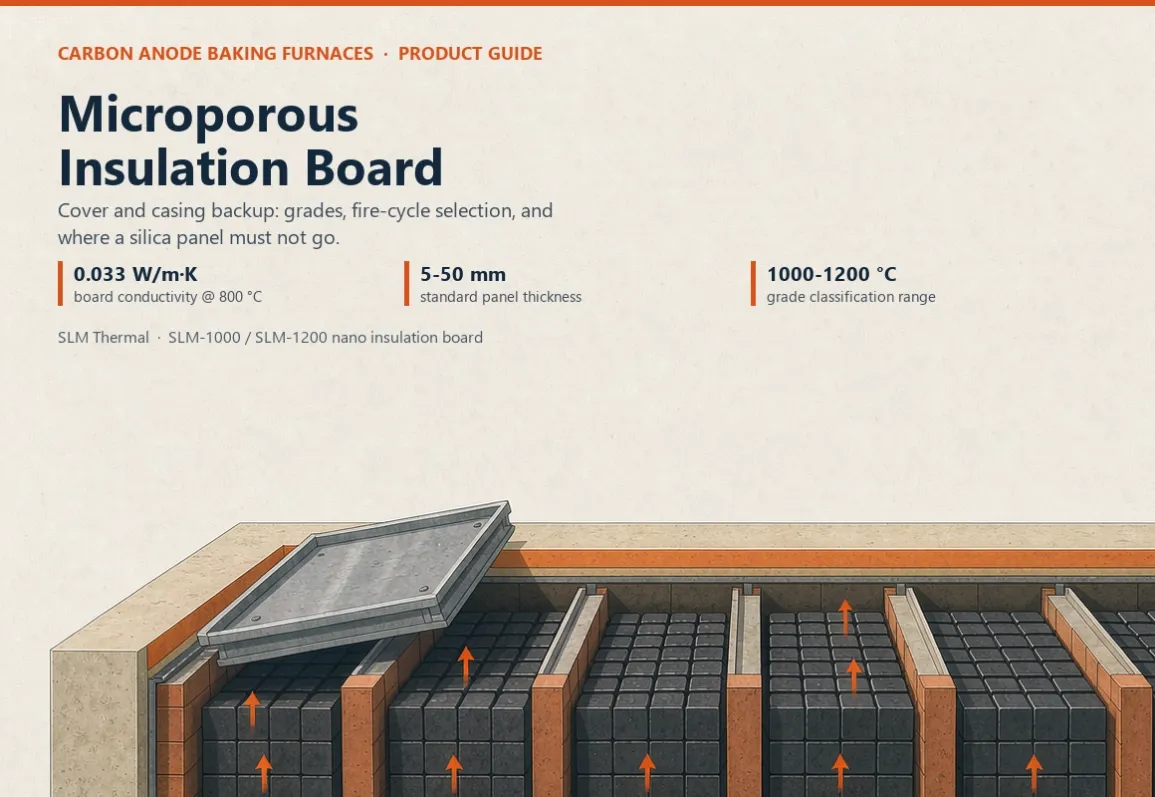
An anode baking ring furnace takes green carbon blocks to roughly 1000–1150 °C, then cools them again, section by section, every few weeks. A published heat balance puts only 15–25 % of the energy into the anodes, with 25–30 % stored in the structure on each cycle and 5–10 % lost through the top. Our application map places SLM-1000/1200 microporous insulation board behind dense refractory in ladles, kilns and process heaters; an anode furnace cover and its concrete casing are the cyclic version of that job.
This is a product guide: what the board is, what its conductivity means at 200–800 °C, how to pick grade, facing and thickness, where it can sit in a cover or pit wall, how to cut, fix and seal it, and where it is the wrong material. One limitation up front: no public instrumented measurement of a microporous-board retrofit on this furnace was found, and no published application note places the material behind a flue wall. Furnace data below sets the selection inputs; it is not a measured saving.
What the product is, and what it is not
The board is a pressed composite of fumed silica, reinforcing fibre and an opacifier. Pores smaller than the mean free path of air suppress gas conduction and convection together, while the opacifier scatters the infrared radiation that dominates above 400 °C. How the board is manufactured explains the difference from a fibre blanket: no fibrous network to compress, no organic binder to burn out, no open cell for flue gas to circulate through.
Commercial grades span 1000, 1100 and 1200 °C classification temperatures, densities of about 230–450 kg/m³, compressive strength from roughly 0.12 to 1.02 MPa depending on grade and test method, and thicknesses from 3 to 50 mm. Facings include E-glass cloth, PE film, aluminium foil on two or six faces, mica laminate and hydrophobic core variants. Panels can be sawn, drilled and CNC-cut with ordinary tools. A1 non-combustibility is stated on at least one current datasheet.
Two numbers need care. Classification temperature is not continuous service temperature: supplier literature for a 1000 °C grade specifies about 950 °C for long-term exposure, and classification is based on a defined shrinkage test, not a working-life rating. Shrinkage is meaningless without its condition — one manufacturer quotes below 0.5 % for a single-face 12-hour soak at 1000 °C but 3.8 % for a 24-hour full immersion at the same temperature. Ask for the condition with the number.
The product boundary follows from that. This is a cold-face backup insulator whose value is high thermal resistance in small thickness. It is not a hot-face refractory, not a structural wall, not a gas seal and not a fire-protection device. Liquid water, oil and petroleum spirits densify the pore structure permanently, according to a Morgan datasheet, so facing, edge sealing and packaging are part of the specification rather than an afterthought.
Product conductivity at cover-backup temperatures
Published curves for the SLM grades give about 0.020 W/m·K at 20 °C, 0.022 at 200 °C, 0.025 at 400 °C and 0.033 at 800 °C. Independent commercial datasheets sit in the same band: a 1000 °C-grade microporous panel is listed at 0.023 / 0.026 / 0.031 / 0.039 W/m·K at 200 / 400 / 600 / 800 °C, and a 1200 °C grade at 0.029 / 0.033 / 0.039 / 0.044. The datasheet guide explains how to read these as mean-temperature values tied to a test method and a density before using them in a calculation.
| Mean temperature | Microporous board | Ceramic-fibre blanket | Calcium silicate | |---|---|---|---| | 200 °C | 0.022–0.023 W/m·K | 0.06–0.07 W/m·K | ~0.08–0.10 W/m·K | | 400 °C | 0.025–0.026 W/m·K | 0.10–0.12 W/m·K | ~0.10–0.12 W/m·K | | 600 °C | ~0.028–0.031 W/m·K | 0.15–0.20 W/m·K | ~0.12–0.14 W/m·K | | 800 °C | 0.033–0.039 W/m·K | 0.19–0.30 W/m·K | ~0.12–0.15 W/m·K |
Lightweight castable is quoted around 0.25–0.53 W/m·K at 800 °C. The board's curve is nearly flat while the fibrous alternatives steepen, which is what makes a thin backup layer possible. These are datasheet values, not anode-furnace measurements; confirm them against the current SLM datasheet. The spread between the two columns is the spread between two products, not a test error.
Why the board's low stored heat matters in a cyclic furnace
A ring furnace is not steady state. Process-industry descriptions give a fire cycle of roughly 24–30 hours per section, nine to twelve sections under a fire, 150–170 hours of baking and a 13–15 day turnaround including cooling. Heating rates are held near 10–15 °C/h and capped at 15 °C/h to avoid anode cracking during volatile release. Flue walls are quoted at 50–170 fire cycles, about 20 a year.
Every one of those cycles heats the furnace structure and throws that heat away again. The 25–30 % storage term in the published heat balance is the reason a low-mass backup layer is more interesting here than in a continuously fired heater. The arithmetic is straightforward: a 29 mm board at 280 kg/m³ is about 8 kg/m² of added mass, while an equivalent-resistance layer of calcium silicate at 250 kg/m³ is about 22 kg/m². Less mass per square metre means less heat absorbed on the way up.
That is a physical argument, not a performance claim. No public measurement was found that quantifies fuel savings, cycle-time reduction or cover weight for a microporous-board retrofit here. Savings figures published by vendors of other insulation systems are supplier claims about different materials.
Selecting grade, facing and thickness from the interface temperature
The recurring specification error is to size the board from the baking temperature. A 1150 °C flue gas temperature does not expose a cold-face panel to 1150 °C. What the panel sees is the cold-face temperature of the brick or castable in front of it, typically several hundred degrees lower. The SLM-1000 and SLM-1200 comparison sets out where the higher grade pays; in this furnace the choice should be made against the worst case, not the average: the peak of the fire cycle, a section running with a thin or cracked hot-face layer, and a cover left in place longer than designed.
Grade first, then facing. Aluminium foil gives a clean, non-shedding skin and a vapour barrier. Hydrophobic core grades and foil facings are the defensible choice wherever shutdown condensation is plausible; PE film is a dry-handling option. Datasheets state that facings also protect the core from water in mortars and castables during installation. Every cut edge is sealed the day it is cut, because an unsealed edge is a wick.
Thickness follows from the allowed heat flux, and the thickness-sizing method guide gives the full calculation with correction factors. An illustrative example: assume a 350 °C interface behind dense brick, a 60 °C outer skin target and 400 W/m² allowed by the designer. Required resistance is (350 − 60) / 400 ≈ 0.73 m²·K/W. At a mean board conductivity near 0.025 W/m·K that is about 29 mm of board, against roughly 87 mm of calcium silicate at 0.14 or 81 mm of fibre blanket at 0.09. None of those three inputs is a measured value from an anode baking furnace — no public cover heat-flux limit for this furnace type was found — so the arithmetic shows the relative thickness, not a promised shell temperature. A real design needs the zone heat-flux profile, the anchor pattern and the measured brick cold-face temperature.
In a cover retrofit the useful output is often thickness and lifting weight rather than fuel. A thinner cover is easier to move at every fire shift; that has to be checked against the crane and the cover's structural design, which the board does not replace.
Where the board goes: cover, headwall and concrete casing
A published process description gives 34 sections in two bays, each with eight pits and nine flue walls, in a U-shaped concrete casing protected by several thicknesses of insulating brickwork. Flue walls and headwalls use alumino-silicate brick with 45–55 % alumina and a service ceiling near 1450 °C; patents describe flue walls around 115 mm and headwalls around 460 mm thick. Only closed-top furnaces have steel section covers, lined with fibrous material. A 1978 cover patent records a cold face near 171 °C and a heat flux around 2.7 kW/m², and about 111 °C and 1.2 kW/m² after an insulating cover was fitted — a 43 % reduction per pit for that flexible-blanket design, not for microporous board.
Read as a product rule: the board belongs in the backup position of covers, headwalls and the concrete casing, behind a separate hot-face layer, replacing part of an insulating-brick or blanket build-up. It does not go into the flue wall. Published work describes flue walls as load-bearing brick subject to creep, bowing, packing-coke abrasion and thermal shock, and the research found no application of this board there. Treating that wall as a candidate surface is an inference with no support.
The same cold-face discipline applies in aluminium holding furnaces, where the board sits behind the refractory that sees molten metal, and in the tunnel kiln, where the lining is continuous rather than cyclic. An anode furnace is neither: the top opens, the fire moves, and the cover is handled every day or two.
What a fire cycle does to the board specification
Cycle count changes what to ask for. A structure that heats and cools 20 times a year for five to eight years sees more movement than a continuously fired heater, so shrinkage, reinforcement and fixing detail matter more than a marginally lower conductivity figure. One microporous grade's datasheet claims thermal-shock resistance and suitability for rapid heat-up and cool-down; that is a manufacturer's statement and needs checking against the actual ramp rate and cycle count.
Select the grade on the peak interface temperature and ask for shrinkage data at that temperature with the soak condition stated. Enhanced-strength grades exist where vibration or handling is expected, and a cover that is lifted, set down and sealed every fire move is exactly such a location. Facing and edge seals must survive the same cycling: a foil skin that debonds after repeated expansion leaves an unsealed edge in a furnace that sweeps flue gas past the pit top under draft.
Published studies report pit gradients above 100 °C and inter-flue differences of tens of degrees, while a patent claims that finishing within ±5 °C improves anode properties. A lower-heat-loss cover can reduce edge cooling, but no public data was found attributing a uniformity improvement to this board. Treat uniformity as an intent to verify, not a number to quote.
Why the board stays behind dense refractory
Temperature is the first reason. Flue gas is raised from about 900 °C to 1150–1200 °C in the heating zone; that exceeds every continuous rating this product carries. The dense brick exists to bring the interface down to something the backup tolerates.
Chemistry is the second, and it needs careful wording. Pitch volatiles are released mainly between 200 and 600 °C, with the plastic phase and the heaviest release around 250–450 °C. Furnace operators keep exhaust temperatures above the VOC dew point because those volatiles otherwise condense as tar in bends, ring mains and treatment equipment. Datasheets document that oils and petroleum spirits densify this board's pore structure. No published study was found that measures pitch or tar uptake in microporous board, so the correct design statement is an inference, not a measured failure mode: keep the board sealed on the cold side of gas-tight brickwork, where neither hot flue gas nor condensate can reach it.
Published operating data shows draft moving from about −100/−200 Pa at the first section to +100/+200 Pa at the last, with a zero point near section seven; operators report false air entering at top brick joints, packing coke and inspection holes. A porous panel is not a gas seal. A thinner, tighter backup makes the remaining joints at cover edges and headwall interfaces more important, not less.
At 0.12–1.02 MPa compressive strength the board cannot carry a cover frame, a lifting lug, footfall or coke abrasion. Alkali, fluoride and sulphur species returned on butts attack alumino-silicate refractories; a cold-face layer sealed behind brick is the position least exposed to them.
Cutting and installing the board: joints, fixing and moisture
Panels are cut on site with standard woodworking tools, which helps around cover frames, ramps and headwall returns. Two failure modes come with that convenience. The first is the open joint: a narrow gap through a 29 mm panel bypasses the pore structure entirely and behaves like a thermal bridge. Fit panels tight, stagger joints between layers and pack residual seams with compatible fibrous material. The joint-gap control notes give the tolerances and packing detail; cover corners, lifting-lug penetrations and the headwall intersection are where this usually fails.
The second is moisture. Panels arrive in sealed moisture-barrier packaging, are stored flat and dry off the floor, and are cut only when ready to fit. Storage and cutting guidance covers the handling sequence. Wetted panels are rejected, not dried and reused. Because a cover is removed and parked outdoors between fire moves, the facing and edge-seal specification has to cover the parked condition as well as the installed one.
Fixing needs its own check. A thinner build-up changes stud length, washers and compression hardware, and a steel stud protruding into the hot-face zone becomes both a thermal bridge and a corrosion site. Where the existing anchor pattern cannot be adapted, retain panels with a light frame or a casing-side detail rather than penetrating dense brick. Allow for expansion at cover edges and around degassing gaps, and never use the board to close a gap that was designed to move.
Incoming inspection and board acceptance
The incoming QC checklist covers dimensional tolerance, thickness uniformity, density, facing integrity, edge sealing, package moisture indication and certificate-of-analysis documents against the order. For this furnace add three items: the shrinkage figure with its soak condition, written confirmation of the continuous service temperature for the chosen grade, and the calculated worst-case interface temperature used in the design.
After installation, the meaningful check is a surface-temperature and heat-flux survey on the cover and casing at the same point in the fire cycle, logged with ambient, wind, firing rate and section position. Performance verification guidance describes the instrumented approach; a reading from a different point in the cycle is not comparable. Record a baseline after the first full cycle and repeat after a relining window. A local hot area usually means a gap, a displaced panel, a failed edge seal or a crack in the brick in front of it — the failure analysis notes show what moisture and crushing do to this material — and rarely insufficient thickness. Re-check furnace pressure and flue-gas oxygen, since cover work can change leakage paths.
Tie acceptance to the agreed heat flux or surface temperature at defined survey points, with explicit exclusions for lifting lugs, cover edges and joints where the design basis allows higher readings.
Where the board is not the answer
The hot face and the flue wall. A 1150–1200 °C flue gas stream, direct flame, creep, packing-coke abrasion and 50–170 thermal cycles belong to 45–55 % alumina refractory brick. No published application places microporous board there.
Any exposed pit surface. Packing coke is loaded and unloaded against the pit walls, and green anodes are set and lifted. A 0.12–1.02 MPa compressive strength does not qualify for that traffic.
Cover structure and lifting hardware. The board adds insulation, not stiffness. A thinner cover still needs a designed steel frame, anchors and lugs.
Gas sealing. Expansion joints, degassing gaps, cover edges and headwall interfaces are sealed by brickwork, fibrous packing and gaskets. Negative-pressure furnaces punish a porous panel used as a seal.
Positions that can get wet. Rain on a parked cover, wash water, a leaking service line or shutdown condensation destroys the pore structure permanently. If dryness cannot be guaranteed, choose another material.
Sustained temperature above the continuous rating. Classification temperature is not a working limit. Selecting from an average instead of the fire-cycle peak invites shrinkage and opened joints.
Direct exposure to condensate or tar. Volatiles that condense in cold zones are an operating problem for the fume system; the board should be sealed away from that path rather than acting as a sponge for it.
Process problems. Under-baking, flue wall bowing, air ingress, volatile combustion and anode quality are furnace-design and operating issues. A thinner backup changes heat loss; it does not fix them.
Buying the board: RFQ inputs and packaging
Specify grade, thickness, facing, panel dimensions and cut list together, and call out sealed moisture-barrier packaging, edge-sealing material and the shrinkage test condition. Ask for the current datasheet with its conductivity curve and written confirmation of the continuous service temperature at the worst-case interface. High-strength nano insulation boards are listed on the SLM product page; use that as the quotation reference so conductivity is compared at the same mean temperature and density.
A workable RFQ states open- or closed-top furnace type, section and fire count, flue wall and headwall drawings, peak gas and anode temperatures, fire-cycle length and ramp rate, fuel, the existing cover or casing build-up and its measured cold-face temperature, available thickness, present hot spots and leakage points, and the surface-temperature or heat-flux target with survey conditions. Without those inputs a thickness recommendation is a guess.
Panels ship flat on pallets and are brittle and moisture-sensitive, so packaging is part of the price comparison. Container loading notes cover palletising, weather protection and keeping panels dry through an overseas project and site lay-down.
Frequently asked questions
Can the board replace insulating brick in a flue wall? No. Flue walls are structural refractory brick exposed to hot gas, coke and cycling. The board is a cold-face backup behind a dense layer, and no published application supports the flue-wall position.
How is thickness chosen? From the worst-case brick cold-face temperature, the allowed cover or casing surface temperature and the resulting heat flux. The worked example gives about 29 mm for a 0.73 m²·K/W requirement, with inputs stated as design assumptions rather than measurements.
Will a thinner cover reduce fuel consumption? Lower stored heat reduces the energy absorbed by the structure on each cycle in principle. No public measurement quantifies that effect for a microporous-board anode furnace, so it should not be promised as a number.
What facing is recommended for a removable cover? Foil-faced or hydrophobic grades with all cut edges sealed, because a cover is parked between fire moves and can see condensation. PE film is a dry-handling option.
How is a failing installation detected? By a surface-temperature and heat-flux survey at the same point in the fire cycle, repeated after the first full cycle. Hot spots usually indicate joints, fixings or cracks in the brick in front of the panel.
Bottom line
Microporous insulation board earns its place in an anode baking furnace by doing one thing well: providing large thermal resistance in small thickness and low mass at the temperature where a cold-face backup operates. That can reduce cover heat loss and the heat stored in the structure on every fire cycle, and it can recover space in a cover or casing build-up. It does not face the flue gas, carry a cover, seal a joint, tolerate water or repair a bowed flue wall. Specify it from the worst-case interface temperature, keep it sealed behind dense refractory, control joints and moisture, and verify with a like-for-like surface survey. Where temperature, chemistry, pressure or mechanics can reach the board, choose a different material.
Data levels: baking temperatures, fire-cycle timing, ramp rates, furnace geometry, refractory composition, energy balance and draft figures from process-industry reports, peer-reviewed furnace studies and conference papers; cover cold-face temperature and heat flux from a 1978 furnace-cover patent describing a flexible-blanket design, not this product; conductivity, density, strength, classification temperature, shrinkage conditions, facings and liquid sensitivity from commercial microporous insulation datasheets, with the SLM values from our own current datasheet. The resistance and mass calculations are one-dimensional steady-state estimates with their assumptions stated. No public instrumented measurement of a microporous-board retrofit on a carbon anode baking furnace was found, and no published application places the board behind a flue wall. Confirm all product values against the current SLM datasheet before specification.